The Knot on the Right: What the Rigveda Wore
A Hymn That Recognises People by Their Hair
Somewhere in the seventh book of the Rigveda, Indra opens a hymn by describing a group of men he has just noticed. He does not name them first. He describes how they look.
The white-clad ones, with hair-knots worn on the right, quickeners of thought, have won me over. Rising from the ritual grass I said to the men: my Vasiṣṭhas are not so far away that they cannot help you.
(RV 7.33.1, rendering after Griffith 1896, checked against the Sanskrit)
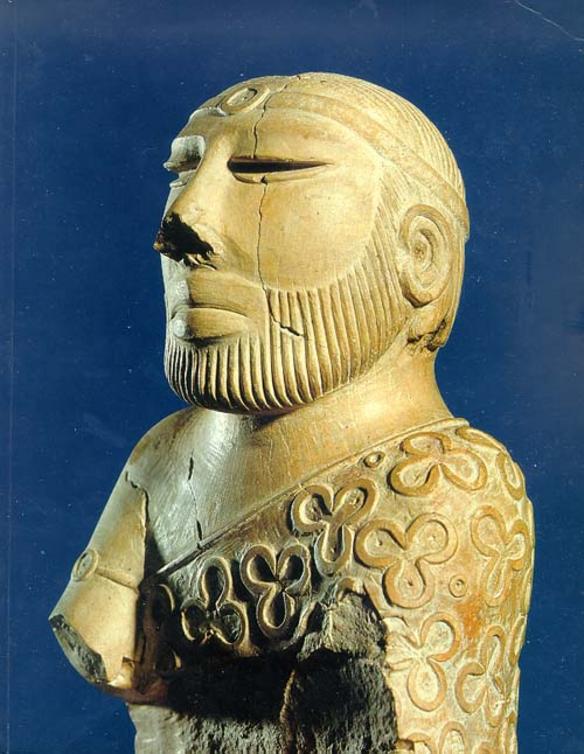
Two details do all the work: the white garments, and the kaparda, the coiled braid, tied on the right side of the head. The same pair of markers returns in RV 7.83, where the Tṛtsus who fight in the Battle of the Ten Kings are “white-clad, with braids”. A collection that is otherwise almost indifferent to physical description will stop and tell you which side a family knots its hair on, because that detail is the family.
This is a strange thing to find in a text that never describes a house, rarely describes a face, and gives no sustained account of what anybody is wearing. The Rigveda has a small clothing vocabulary. Perhaps two dozen words carry the whole subject, and several of them are disputed. What makes them worth chasing is where they lead. Follow ūrṇā, “wool”, and you land in the middle of the pastoral economy, in gift lists and river praise. Follow tantu, “thread”, and you arrive at the loom, and then, with no change of vocabulary, inside the poets’ theory of what a poem is. Follow niṣka, the gold ornament, and you find portable wealth, a god’s neck, and a charm against bad dreams.
What follows reads the Rigveda as a wardrobe inventory: what its people spun, wore, hung on themselves and knotted into their hair, what the archaeology can and cannot confirm, and why the loom, of all the crafts available to these poets, became the one they used to describe their own work.
A Small Vocabulary, Every Word Working Two Jobs
The basic verb is vas-, “to clothe oneself, to wrap”. It is one of the older words in the language and it travelled: Latin vestis, Greek esthḗs, English wear and vest descend from the same Indo-European root. The etymology already gives you the shape of the garment. Vas- is wrapping, not fitting. Nothing in the Rigveda suggests tailoring, and no word for a sewn, shaped coat appears in it.
| Term | Sense in the Rigveda | Representative verse |
|---|---|---|
| vásas, vástra | garment, cloth, the general word | RV 10.85.35 |
| átka | mantle or cloak; also used of flame and of the body as a covering | RV 6.29.3 |
| drāpí | mantle, often golden, worn by gods | RV 1.25.13 |
| nirṇíj | the bright festal garment; also the milk poured onto soma | RV 9.107.26 |
| péśas | ornament, embroidery, decorative form | RV 1.92.4 |
| ū́rṇā | wool | RV 5.52.9 |
| kapardá | coiled braid of hair | RV 1.114.1 |
| niṣká | gold ornament worn at the neck; also a countable unit of wealth | RV 2.33.10 |
| rukmá | gold disc worn on the chest | RV 5.55.1 |
| khādí | ring or armlet worn on hands and feet | RV 5.58.2 |
| añjí | unguent, ointment, applied adornment | RV 7.57.3 |
Péśas is the word to watch. It covers embroidery, dappling, decorative pattern and, by extension, beauty of form. Its root belongs to a well-attested Indo-European family of words for cutting and marking: Greek poikílos, “many-coloured, intricate”, Old Church Slavonic pisati, “to write”, Latin pingere, “to paint”. The same root yields cloth decoration in one language and writing in another. In the Rigveda it does something comparable. A hymn can be supéśas, “well-ornamented”, exactly as a garment can be. When RV 7.34.11 calls a king “the péśas of the rivers”, the compliment is that he is to them what decoration is to cloth.
The absences matter as much as the words. There is no cotton, no silk, no vocabulary for a loom-and-shuttle industry of the sort the Near Eastern archives document. What the text has, in quantity, is sheep.
Wool Is the Whole Economy
The Rigveda belongs to people who counted their wealth in animals, and wool follows the animals. It appears where a pastoral society would put it: on rivers, in gift lists, on the bodies of raiding troops.
Bright and pure, on the Paruṣṇī they clothed themselves in wool; and with the rims of their chariot wheels they split the rock apart.
(RV 5.52.9, rendering after Griffith 1896, checked against the Sanskrit)
The Maruts, the storm troop, put on wool at a named river. That is a curiously local detail for a hymn about weather gods, and it fits a pattern. Macdonell and Keith, compiling the Vedic Index in 1912, noted that the Paruṣṇī country was known for its wool as Gandhāra was known for its sheep. Both facts are visible in the text. In the Nadīstuti, the Sindhu is praised in the exact vocabulary you would use for a well-turned-out woman: rich in horses, rich in chariots, suvā́sas, “well-dressed”, golden, and ū́rṇāvatī, “wool-rich” (RV 10.75.8). A river becomes a person by being dressed, and the dress is wool and gold. For the geography behind that hymn, see the close reading of the Nadīstuti.
Gandhāra’s sheep appear in one of the most notorious verses in the collection. In the Bhāvayavya hymn, a woman named Romaśā tells her husband not to think she has little body hair: she is shaggy all over, she says, like a ewe of the Gandhāris (RV 1.126.7). Griffith refused to put the passage into English and left it in Latin, which is how his 1896 version handles anything it judged indecent; that habit has a history of its own. Strip away the prudery and a piece of economic geography survives inside a bedroom joke: the sheep of the northwest were famous enough for their fleece to carry a punchline.
Wool is also currency. A gift list in the Vālakhilya appendix has a patron handing over “a hundred asses, a hundred wool-bearing ewes, a hundred slaves, and garlands besides” (RV 8.56.3). That is the standard form of the dānastuti, the praise-of-the-gift verse in which poets record their fees, and the presence of fleece animals alongside slaves and gold places wool among the things worth counting in hundreds. The wider gift economy is treated in the piece on dānastuti and the poet-patron bond.
Aside. Wool is one of the oldest words in the family. Sanskrit ū́rṇā, Latin lāna, Greek lē̂nos, Gothic wulla and English wool all go back to a single Proto-Indo-European term. Sheep, however, were not woolly from the start. Fleece-bearing breeds are a secondary development of the fourth and third millennia BCE, and the spread of wool as a fibre is among the better documented transformations in Eurasian prehistory (Barber 1991; Breniquet and Michel 2014). The Rigvedic poets inherited both the animal and the word.
What the Text Does Not Wear
The word karpāsa, cotton, does not occur in the Rigveda. It occurs in no Saṃhitā and in no Brāhmaṇa; its earliest Sanskrit attestation is in the Śrautasūtra literature, centuries later (Macdonell and Keith 1912). This is a genuinely odd silence, because cotton in the subcontinent is very old. Mineralised fibres preserved inside a copper bead from Neolithic Mehrgarh, analysed by Moulherat and colleagues in 2002, pushed the earliest known use of cotton in the Old World back to the sixth millennium BCE. Silk is attested too: threads recovered from copper-alloy ornaments at Harappa and from steatite beads at Chanhu-daro, published by Good, Kenoyer and Meadow in 2009, date to roughly 2450 to 2000 BCE and constitute the earliest silk known outside China.
So the region had cotton for millennia and silk in the Bronze Age, and the Rigveda names neither.
Methods note. Arguments from silence are weak instruments, and this one needs three qualifications. First, the Rigveda is liturgical poetry, not an inventory; whole domains of daily life are missing from it for reasons of register rather than absence. Second, its geography is the northwest, upland and pastoral, where wool is the obvious fibre whatever is grown downriver. Third, vocabulary tracks prestige as much as availability: ritual language is conservative, and a fibre can be in daily use long before it is fit to name in a hymn. What the silence supports is a claim about the poets’ world, not about the subcontinent’s technology. On the general problem of words that arrive from elsewhere, see substrate loanwords in the Rigveda.
| Material | Archaeological evidence in the region | Rigvedic vocabulary |
|---|---|---|
| Cotton | Mehrgarh, 6th millennium BCE, mineralised fibres | none; karpāsa first in the Śrautasūtras |
| Silk | Harappa and Chanhu-daro, c. 2450 to 2000 BCE | none |
| Wool | Indirect; fleece rarely survives in South Asian soils | abundant: ū́rṇā, ū́rṇāvatī, avya |
| Gold | Widespread from the Indus period onward | hiraṇya, niṣká, rukmá, khādí |
The Most Famous Piece of Cloth in the Rigveda Is a Filter
Here is the count that reorganises the subject. The textile object mentioned most often in the Rigveda is not a garment. It is a strainer.
Soma, pressed from stalks between stones, has to be filtered before it can be drunk, and the filter is a fleece: vā́ra, the sheep’s hair, avyáya, “made of sheep”. Maṇḍala 9, the book given over entirely to the purification of soma, returns to it constantly. In Griffith’s rendering, some forty-six verses of that book mention the fleece or the wool through which the drink runs. Whole hymns are built on the image of a liquid passing through hair.
Once the fleece is established, the poets start to play with it.
Soma has crossed over the bright fleece of the sheep, and has wrapped himself in it as though in a garment freshly washed.
(RV 9.69.4, rendering after Griffith 1896, checked against the Sanskrit)
The drink puts on the filter. A piece of equipment becomes clothing, and the clothing becomes the sign that the god has arrived in usable form. Elsewhere the milk mixed into the pressed juice is called its nirṇíj, its festal robe (RV 9.107.26). The workshop behind these images is described in the article on the soma pressing stones, and the book itself in Maṇḍala 9 and the filtered god.
The point is not that the poets enjoyed textile similes. It is that in a liturgy preoccupied with purification, the object that performs the purifying is made of wool, which puts the vocabulary of cloth at the centre of the ritual rather than at its edges.
The Loom, the Pegs, and the Single Needle
On the loom itself the text is unexpectedly precise. RV 10.130 describes the sacrifice as a piece of weaving in progress, and in doing so describes a working loom.
The sacrifice drawn out with threads on every side, stretched by a hundred and one divine actions: these Fathers weave it, they who have come here. They sit beside the stretched warp and call out, weave forward, weave back.
(RV 10.130.1, rendering after Griffith 1896, checked against the Sanskrit)
The next verse names the parts. Mayū́kha, pegs, are fixed at the seat; the Sāman chants serve as tásara, shuttles, for the weft. Pegs driven into the ground, a warp stretched between them, weavers seated alongside and calling instructions back and forth: this is a horizontal ground loom worked by more than one person, of a kind used across a wide arc of the ancient world. The later Vājasaneyi Saṃhitā adds pegs and weights to the picture (Macdonell and Keith 1912). Wilhelm Rau’s study of Vedic weaving and plaiting, still the standard treatment, works through the vocabulary in production order, from raw material through spinning and weaving to the names of finished garments.
The terminology is consistent across the collection. Tántu is the warp, from tan-, “to stretch” (compare Latin tendere). Ótu is the weft. Vayati is the act of weaving. Agni’s poet in the sixth book uses the full set in order to confess ignorance.
I do not know the warp, I do not know the weft, nor the cloth they weave when they come together to contend. Whose son will speak here the words that must be spoken, going beyond the father at his side?
(RV 6.9.2, rendering after Griffith 1896, checked against the Sanskrit)
Notice who weaves in the Rigveda. Night and Dawn do, “like two women weavers”, drawing out the stretched thread in concert and producing the péśas, the ornament, of the sacrifice (RV 2.3.6). Pūṣan is called vāsovāyá, weaver of the garments of sheep, and the one who brushes cloth clean (RV 10.26.6). That is a startling job description for a deity better known for finding lost cattle and guiding travellers on the road, and it is easy to miss because it occupies half a verse; the fuller portrait is in the piece on Pūṣan, lord of paths.
Then there is the needle. Sūcī occurs once in the entire Rigveda, in a verse addressed to Rākā, goddess of the full moon.
With a needle that cannot be broken, let her sew the work together; let her give us a son, rich and worthy of praise.
(RV 2.32.4, rendering after Griffith 1896, checked against the Sanskrit)
One needle in the whole collection, it belongs to a goddess, and what she sews is not cloth but ápas, “work” in the widest sense, with the birth of a son as the outcome. A society that wraps rather than tailors has limited use for needles, and the text reflects that exactly.
graph TD
  A["Sheep, ūrṇā"] --> B["Spun thread, tantu"]
  A --> C["Fleece filter, vāra"]
  B --> D["Warp on pegs, mayūkha"]
  D --> E["Weft, otu"]
  E --> F["Cloth, vāsas"]
  C --> G["Purified soma"]
  D --> H["Sacrifice as loom"]
  B --> I["Poem as woven thought"]
  F --> J["Ornament, peśas"]
  H --> K["Ritual order"]
  I --> K
Methods note. Almost none of this survives physically. Textiles decay fast in the monsoon belt, and the Vedic period has left no cloth to examine. What archaeologists work with instead are spindle whorls, loom weights, needles, fibres mineralised against metal, and impressions in clay. Elizabeth Barber’s Prehistoric Textiles (1991) is the classic demonstration of how much can be reconstructed from that thin evidence when it is combined with linguistic reconstruction and later ethnography. It also marks the limit. When the Rigveda says “pegs”, we can say the description matches a ground loom; we cannot say how wide the cloth was, what dyed it, or who owned the loom.

Gold on the Chest, a Knot on the Head
If the Rigveda is thin on garments, it is generous on ornament, and its most decorated figures are the Maruts. They are described the way one describes a uniformed unit.
They wear rukmá, gold discs, on their chests, so consistently that rukmavakṣas, “gold-disc-chested”, becomes a standing epithet (RV 2.34.2, RV 5.55.1). They wear khādí, rings, on hands and feet (RV 5.58.2). One verse reads almost as an inventory: unguents, axes, garlands, gold discs, armlets, chariots, bows (RV 5.53.4). And in RV 7.57.3 the decisive word is samāná: they anoint themselves with a common unguent, all alike, for the sake of the display. That is not a description of individuals who happen to like jewellery. It is a description of a band that dresses identically on purpose, which is what the comparative work on the Marut troop and the Indo-European warrior band would predict; see the Maruts as a Männerbund.
Rudra wears the same class of object, and his poet turns it into a moral point.
You are worthy, and you carry the bow and arrows; worthy, you wear the many-formed necklace fit for worship. Worthy, you deal with all this immensity: there is nothing mightier than you, Rudra.
(RV 2.33.10, rendering after Griffith 1896, checked against the Sanskrit)
The word for that necklace, niṣká, does double duty. It is an ornament worn at the throat, and it is a quantity of gold: Kakṣīvān reports receiving a hundred niṣkas from a king in the same verse that counts his horses and cattle (RV 1.126.2). Ornament here is not decoration set apart from wealth. It is wealth, worn where it can be seen, which is a common arrangement in societies without coinage. It also explains why the same objects turn up in a charm against nightmares: whatever the bad dream may be, the singers say, even if it takes the form of a niṣka or a garland, they hand it over to Trita Āptya (RV 8.47.15). Valuable things attract danger; the article on bad dreams and Trita Āptya follows that logic further.
Hair is the other marker, and it is the sharper one.
| Marker | Sanskrit | Who wears it | Verse |
|---|---|---|---|
| Braid coiled on the right | dakṣiṇatas-kapardá | Vasiṣṭhas, Tṛtsus | RV 7.33.1 |
| Braid, side unspecified | kapardín | Rudra, Pūṣan | RV 1.114.1, RV 6.55.2 |
| Four braids | catuṣkapardá | a riddling young woman | RV 10.114.3 |
| Headdress terms | opaśá, kurī́ra | Sūryā the bride | RV 10.85.8 |
| Soiled tawny garments | mála | the long-haired muni | RV 10.136.2 |
Read down that column and a social map appears. A priestly lineage is identifiable by the side its braid is tied on. Two gods are identifiable by wearing a braid at all, which suggests the style carried an association, and in Rudra’s case the epithet kapardín follows him into later Śaiva iconography; see Rudra, the dangerous healer. The muni of RV 10.136 is marked out by dirty yellow-brown cloth, an early instance of the ascetic dressing as the negation of ordinary dress, discussed in the piece on the Keśin hymn.
And in the bridal hymn the pieces of a woman’s headgear are used to explain the structure of poetry itself: the hymns of praise were the cross-pieces, and the kurīra and the opaśa were the metres (RV 10.85.8). Sūryā’s wedding is assembled out of chants, and the chants are itemised as parts of a headdress. The full bridal hymn carries more of this than any other passage in the collection.
Dressing the Gods
Gods in the Rigveda are dressed, and the dressing is how they become visible. Varuṇa “wears a golden mantle and clothes himself in a shining robe” (RV 1.25.13). Savitṛ, the impeller, puts on a tawny drāpi as he rises (RV 4.53.2). The newborn Indra stands up “clothing himself in his own mantle” (RV 4.18.5), and elsewhere he wears a fragrant atka “to be looked at”, carrying himself, the poet says, like a dancer (RV 6.29.3). The Maruts wear rain: varṣanirṇij, “having the rainstorm for a festal robe” (RV 5.57.4).
The finest instance belongs to Dawn.
She spreads out her ornaments like a dancer; she bares her breast as a cow yields her udder. Making light for the whole world of living things, Uṣas has thrown open the darkness as cows open their pen.
(RV 1.92.4, rendering after Griffith 1896, checked against the Sanskrit)
Adhi péśāṃsi vapate: she strews her embroideries over herself. What is being described is the sky at first light, and the poet’s instrument for describing it is a woman putting on a decorated cloth in front of an audience. The comparison runs both ways, which is why it works. A dancer’s costume is understood as a small dawn; the dawn is understood as a large costume. There is more on that hymn’s technique in the article on Uṣas and the poetry of dawn.
Cloth also carries things nobody wants. The bridal hymn treats the garment worn during the wedding as saturated with danger: give away the śāmūlya, it instructs, distribute wealth to the priests, for the harmful power in it “has got feet” and enters the husband as a wife (RV 10.85.29). A few verses later the fringe, the head-cloth and the threefold robe are itemised as things a knowledgeable brahmin must purify. Garments hold on to what has happened in them, an ordinary enough intuition given precise ritual form. Meanwhile the giving of clothes is listed among the acts that extend a life: those who give robes prolong their days (RV 10.107.2). And when the dead are laid down, the earth is asked to be ūrṇamradas, “soft as wool”, over them (RV 10.18.10). That is the last textile image most Rigvedic people would have been given.
The Poem Is a Cloth
Everything above is prologue to the move that makes this vocabulary matter. The Rigvedic poets describe their own work as weaving, and they do it so often, and so technically, that the metaphor has to be treated as a theory rather than an ornament.
Do not let my thread be cut while I weave my thought; do not let the measure of my work snap before its time.
(RV 2.28.5, rendering after Griffith 1896, checked against the Sanskrit)
That is a poet asking Varuṇa for the one thing a weaver fears. Elsewhere the instruction is to “weave the work of the singers without knots” (RV 10.53.6): anulbaṇám, free of lumps and unevenness, is a quality-control term borrowed from the loom and applied to a hymn. The whole of RV 10.130 treats the sacrifice as a fabric the ancestors are still working on, with chants for shuttles. And in the great hymn on the origin of speech, failure is described the same way: those who reach Vāc improperly “stretch a warp in ignorance, like weaving-women” (RV 10.71.9). The word for warp in that line is tántra.
Five verses earlier in the same hymn, Vāc is described in the language of dress: to the one who understands her, speech “reveals her body as a wife, well-dressed and desiring, reveals herself to her husband” (RV 10.71.4). Meaning discloses itself the way a body discloses itself through clothing, which is to say partially, deliberately, and to one particular person.
| Textile word | Literal sense | What it came to mean |
|---|---|---|
| tántu, tántra | warp, stretched thread | tantra, a system or doctrine |
| sū́tra | thread, cord | sūtra, an aphoristic text |
| granth- | to tie, to knot | grantha, a book |
| péśas | embroidery, pattern | beauty of poetic form |
| Latin texere | to weave | textus, and English text |
Stefan Niederreiter’s study of textile metaphor in the Rigveda takes its title from the plea at 2.28.5, and observes that the practical information about weaving in the text arrives almost entirely inside poetic comparison. That is usually treated as a limitation on the evidence. It is better read as the finding. These poets knew weaving well enough to think with it, and their vocabulary for holding a composition together, keeping it unbroken, judging it smooth or knotted, is loom vocabulary from end to end.
The pattern is not confined to India. Comparative work on Indo-European poetics, from Rüdiger Schmitt’s 1967 study of inherited poetic language to Calvert Watkins’s How to Kill a Dragon, has long identified the weaving of words as an inherited formula, alongside the fashioning of words as carpentry. The Rigvedic poets use both. They call themselves carpenters of hymns, discussed in the poet as carpenter, and they call themselves weavers. The carpentry image stresses the fitting together of parts. The weaving image stresses something else: continuity, tension, and the ever-present risk of a break.
Aside. A caution about over-reading. Griffith renders RV 10.33.3 as “As rats eat weavers’ threads, cares are consuming me”, which looks like precious evidence for domestic weaving and its household pests. The Sanskrit is mū́ṣo ná śiśnā́ vy adanti mā́dhyaḥ, and modern translators generally read it as rats gnawing their own tails, the loom having been imported by later commentary. The lesson is not that Griffith was careless. It is that a translator who expects textile imagery will find it, and that the weight of the weaving evidence rests on passages where the technical vocabulary is present, not on similes that could go either way.
What the Wardrobe Knows
Pull the threads together and a coherent picture emerges from a text that never sets out to give one.
The Rigvedic world is a wool world: sheep on the upper rivers, fleece as gift and as tribute, a strainer of sheep’s hair at the centre of the most important ritual these people knew. Its garments are wrapped rather than cut, which is why a single needle serves the entire collection and why the vocabulary of the wardrobe is short. Its ornaments are gold worn where gold can be counted, at chest and throat and wrist. Its social signals are carried in the hair, precisely enough that a hymn can identify a lineage by a knot tied on the right.
Its intellectual signature is the loom. Of all the crafts these poets could have chosen for self-description, they took the one in which a single continuous thread is held under tension while something is built across it, where a break at any point ruins the whole, and where the finished object is judged by whether the surface came out even. That is a demanding picture of what a poem is. It is also, and this seems to me the substantial point, a picture that outlived every change in Indian intellectual life that followed. When a later philosopher composed a sūtra, a thread, and a later tradition organised itself around a tantra, a warp, and a scribe bound leaves into a grantha, a knot, they were using a vocabulary whose first attestations describe pegs in the ground and weavers calling to each other to weave forward and weave back. English arrives at the same place from a different root when it calls this paragraph a text, from texere, to weave.
Two suggestions for reading. Take RV 10.130 and RV 6.9 together in one sitting: the first builds a universe on a loom, the second admits that the poet cannot see the warp. Then read RV 7.33 and notice that in a collection of more than a thousand hymns with hardly any physical description in it, the detail a god chooses to notice about a family of poets is their hair.
References
Aufrecht, Theodor. Die Hymnen des Rigveda. 2nd ed. Adolf Marcus, 1877. archive.org.
Barber, Elizabeth J. W. Prehistoric Textiles: The Development of Cloth in the Neolithic and Bronze Ages with Special Reference to the Aegean. Princeton University Press, 1991. publisher.
Barber, Elizabeth Wayland. The Mummies of Ürümchi. W. W. Norton, 1999.
Breniquet, Catherine, and Cécile Michel, eds. Wool Economy in the Ancient Near East and the Aegean: From the Beginnings of Sheep Husbandry to Institutional Textile Industry. Ancient Textiles Series 17. Oxbow Books, 2014. publisher.
Chandra, Moti. Costumes, Textiles, Cosmetics and Coiffure in Ancient and Mediaeval India. Oriental Publishers on behalf of the Indian Archaeological Society, 1973.
Geldner, Karl Friedrich. Der Rig-Veda aus dem Sanskrit ins Deutsche übersetzt. Harvard Oriental Series 33-36. Harvard University Press, 1951.
Good, Irene L., J. Mark Kenoyer, and Richard H. Meadow. ‘New Evidence for Early Silk in the Indus Civilization.’ Archaeometry 51, no. 3 (2009): 457-466. Wiley.
Griffith, Ralph T. H. The Hymns of the Rigveda. E. J. Lazarus, 1896. Wikisource.
Jamison, Stephanie W. Sacrificed Wife / Sacrificer’s Wife: Women, Ritual, and Hospitality in Ancient India. Oxford University Press, 1996.
Jamison, Stephanie W., and Joel P. Brereton. The Rigveda: The Earliest Religious Poetry of India. 3 vols. Oxford University Press, 2014.
Kenoyer, Jonathan Mark. Ancient Cities of the Indus Valley Civilization. Oxford University Press and American Institute of Pakistan Studies, 1998.
Macdonell, Arthur A., and Arthur B. Keith. Vedic Index of Names and Subjects. 2 vols. John Murray, 1912. archive.org.
Mayrhofer, Manfred. Etymologisches Wörterbuch des Altindoarischen. 3 vols. Carl Winter, 1992-2001.
Moulherat, Christophe, Margareta Tengberg, Jérôme-François Haquet, and Benoît Mille. ‘First Evidence of Cotton at Neolithic Mehrgarh, Pakistan: Analysis of Mineralized Fibres from a Copper Bead.’ Journal of Archaeological Science 29, no. 12 (2002): 1393-1401. ScienceDirect.
Niederreiter, Stefan. ‘“Der Faden soll nicht reißen, während ich meine Dichtung webe…”: Zum metaphorischen Gebrauch von Textilterminologie im Rigveda.’ In Textile Terminologies from the Orient to the Mediterranean and Europe, 1000 BC to 1000 AD, edited by Salvatore Gaspa, Cécile Michel, and Marie-Louise Nosch, 404-412. Zea Books, 2017. full text.
Oldenberg, Hermann. Prolegomena zur Metrik und Textgeschichte des Rigveda. Wilhelm Hertz, 1888. archive.org.
Rau, Wilhelm. Weben und Flechten im vedischen Indien. Abhandlungen der Akademie der Wissenschaften und der Literatur, Mainz. Franz Steiner Verlag, 1970-71.
Schmitt, Rüdiger. Dichtung und Dichtersprache in indogermanischer Zeit. Otto Harrassowitz, 1967.
Watkins, Calvert. How to Kill a Dragon: Aspects of Indo-European Poetics. Oxford University Press, 1995.
Witzel, Michael. ‘Early Indian History: Linguistic and Textual Parameters.’ In The Indo-Aryans of Ancient South Asia, edited by George Erdosy, 85-125. Walter de Gruyter, 1995.
Comments (0)
No comments yet. Sign in to start the discussion.