The Nadistuti at Close Range: A Verse-by-Verse Reading of Rigveda 10.75
imáṃ me gaṅge yamune sárasvati śútudri stómaṃ sacatā páruṣṇiy ā́ ǀ asiknyā́ marudvṛdhe vitástayā́ árjīkīye śṛṇuhyā́ suṣómayā ǁ
“This song of mine, O Gaṅgā, Yamunā, Sarasvatī, Śutudrī, accept it together with the Paruṣṇī. With the Asiknī, the Marudvṛdhā, the Vitastā, with the Ārjīkīyā, listen, with the Suṣomā.”
Rigveda 10.75, verse 5. After Jamison & Brereton (Oxford 2014), with diacritics standardised. [1]
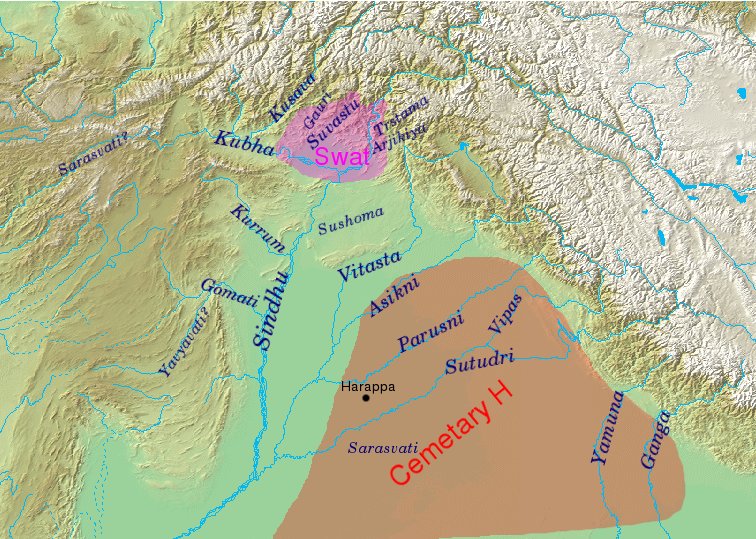
This is the verse for which the Nadistuti Sukta is famous. Ten rivers are named, in geographical order, from east to west. The verse occurs roughly in the middle of a nine-verse hymn that is itself unusual in the Rig Vedic corpus, because its primary subject is not a deity in the conventional sense but a river: the Sindhu, the Indus, addressed throughout in the second person. The hymn has been read since the mid-19th century as one of the oldest surviving geographical inventories from South Asia, and it remains an evidentiary anchor for historians of the late-second-millennium-BCE north-west.
This post is a verse-by-verse close reading. It is the first of a three-part series. The second post traces two centuries of scholarship on identifying the rivers named here; the third asks what the hymn implies about the ecology, settlement, and climate of the Vedic Punjab. The Sarasvati, which receives its own treatment in The Lost Sarasvati: Satellite Imagery, Geology and the Rig Veda’s Sacred River, is referenced here but not re-argued.
At a glance
The hymn at a glance
| Verse | Speaker / addressee | Subject | Metre |
|---|---|---|---|
| 1 | Poet to Sindhu (3rd person) | Invocation: praise the Sindhu of the waters | Triṣṭubh |
| 2 | Poet to Sindhu | Cattle-and-chariot imagery; the rivers as mothers | Triṣṭubh |
| 3 | Poet to Sindhu | The Sindhu’s pace; bull-comparison | Triṣṭubh |
| 4 | Poet to Sindhu | Ornaments, silver, the river’s roar | Jagatī |
| 5 | Poet to the rivers (vocative) | First river-list (10 names, eastern to western) | Jagatī |
| 6 | Poet to the rivers (vocative) | Second river-list (western tributaries) | Jagatī |
| 7 | Poet to Sindhu | Boat-bearing, gold, fertility | Jagatī |
| 8 | Poet to Sindhu | Sindhu’s wealth: cattle, horses, garments | Jagatī |
| 9 | Poet to Sindhu | Closing benediction | Jagatī |
The hymn was traditionally attributed to Sindhukṣit Praiyamedha (Anukramaṇī attribution; preserved in Kātyāyana’s Sarvānukramaṇī, c. 4th century BCE). The name is itself transparent: Sindhu-kṣit, “dweller on the Sindhu.” That a poet bearing this name is associated with a hymn to the Sindhu may be coincidence or may reflect a real attribution; in either case the tradition treats the hymn as the work of someone whose imaginative geography centres on the great north-western river. [2]
The metre shifts from Triṣṭubh (eleven-syllable padas) in the opening four verses to Jagatī (twelve-syllable padas) for the river-lists and the closing praise. Hermann Oldenberg argued in 1888 that this metre-shift marks a deliberate compositional choice: the Triṣṭubh opening establishes the cosmic stature of the Sindhu; the longer Jagatī accommodates the dense catalogue of toponyms that follows. [3] The argument has held up.
A note on the text
The standard critical text of the Rigveda is Theodor Aufrecht’s edition (Bonn, 1861-63; second edition 1877), which prints the Saṃhitā-pāṭha of the Śākala recension. Aufrecht’s text is the basis of every subsequent translation, including Karl Friedrich Geldner’s Der Rig-Veda (Harvard Oriental Series, 4 vols., 1951), Louis Renou’s Études védiques et pāṇinéennes (17 vols., 1955-69), and the most recent complete English version, Stephanie W. Jamison and Joel P. Brereton, The Rigveda (Oxford University Press, 3 vols., 2014). All translations below are after Jamison and Brereton unless otherwise noted, with diacritics adjusted for legibility.
The Padapāṭha (word-by-word recitation) and the Sāyaṇa commentary (14th c. CE, Vijayanagara) preserve every accent and sandhi-juncture of the original. For RV 10.75 specifically, Sāyaṇa’s gloss is brief and largely grammatical; he does not develop a theological reading and does not gloss the toponyms in any geographical detail. The geographical work has been left, by accident of textual history, to the modern philologists.
Verses 1 to 4: the praise of the Sindhu
The first four verses prepare the catalogue. They establish the Sindhu as the addressee of the hymn, attaching to her (the river is grammatically feminine in most of the Indo-European reflexes, masculine in this hymn) a cluster of recurring epithets.
Verse 1: prá su va ā́po mahimā́nam uttamáṃ kárur vocāti sadáne vivásvataḥ
The bard shall proclaim, here in the seat of Vivasvant, the highest greatness of you (waters): for you (he proclaims it). (RV 10.75.1, Jamison and Brereton)
The hymn opens at the sadana of Vivasvant, the “seat” of the ancestral solar figure who in later Vedic literature becomes the father of Yama. This is a liturgical locus, not a geographical one. The bard’s first move is to fix the song within the sacrificial space, then turn outward to the waters. Geldner’s note suggests the line frames the river-praise as a stoma, a formal hymn of praise of the kind delivered at major rites. [4]
Verse 2: saptá saptá tredhā́ hí cakramús tā́saām eka satámā suvīríāya
Sevenfold, sevenfold, in three (groups) have they moved; of these, one (group of) a hundred (is) for heroic strength. (RV 10.75.2, Jamison and Brereton; the line is famously difficult.)
The numerology of the opening is opaque. Renou translated it as a hieratic formula, an invocation of the totality of waters by symbolic count (the “sevenfold” of the Saptasindhu, the “three” of the worlds, the “hundred” of the host). Jamison and Brereton retain the difficulty in their English, declining to over-interpret. [1] The pragmatic point is that the bard is invoking all the waters, not yet a specific list.
Verses 3 and 4: the Sindhu in motion
Verse 3 presents the Sindhu in motion. The river is vṛṣabha-rūpa, “bull-formed”; she (or he, in this hymn) bellows, moves with violent speed, carries the chariots of the dawn. Verse 4 shifts to the Sindhu as ornament: silvery, jewelled, “wealth-bearing.” The Sindhu’s adornment is the Vedic poetic shorthand for fertility; a river that bears gold is a river whose floodplains bear grain.
These four verses do something important. They make the case for the Sindhu’s primacy before the river-list is delivered. The hymn does not say: “here are ten rivers, and one of them is the Sindhu.” It says: “the Sindhu is supreme, and here are the ten rivers that flow alongside her.” The geography is, in the hymn’s own self-presentation, secondary to the theology.
Verse 5: the canonical list
The fifth verse is the famous one. The poet now addresses the rivers directly, by name, in the vocative.
The text
imáṃ me gaṅge yamune sárasvati śútudri stómaṃ sacatā páruṣṇiy ā́ ǀ asiknyā́ marudvṛdhe vitástayā́ árjīkīye śṛṇuhyā́ suṣómayā ǁ
The list
The verse names ten rivers, in order:
| Position | Vedic name | IAST | Modern identification (working consensus) |
|---|---|---|---|
| 1 | गङ्गा | Gaṅgā | Ganga |
| 2 | यमुना | Yamunā | Yamuna |
| 3 | सरस्वती | Sarasvatī | The Ghaggar-Hakra paleochannel (disputed; see our Sarasvati post) |
| 4 | शुतुद्री | Śutudrī | Sutlej |
| 5 | परुष्णी | Paruṣṇī | Ravi |
| 6 | असिक्नी | Asiknī | Chenab |
| 7 | मरुद्वृधा | Marudvṛdhā | A Kashmir-region stream (disputed; see Witzel 1999) |
| 8 | वितस्ता | Vitastā | Jhelum |
| 9 | आर्जीकीया | Ārjīkīyā | Upper Indus tributary (disputed; possibly Haro) |
| 10 | सुषोमा | Suṣomā | Sohan (Pothohar plateau) |
The phonological correspondences are mostly unambiguous and have been accepted since Christian Lassen’s Indische Altertumskunde (Bonn, 1847). Sanskrit Vitastā → Greek Hydaspēs → modern Jhelum is one of the cleanest examples of an unbroken transmission of a hydronym across more than two thousand years. Sanskrit Śutudrī → Greek Zaradros → modern Sutlej is similarly secure. [5]
Order and direction
The order of the list is the single most analytically valuable feature of the verse. Reading from left to right, the bard names rivers in a roughly eastern-to-western sequence: the Ganga and Yamuna in the east, the five Punjab rivers in the middle, the upper-Indus tributaries in the west. This is not the order in which the rivers flow into the Sindhu (the actual confluence order is different). It is the order in which they appear on a map traversed from east to west, the direction a person standing in the Yamuna doab and naming the waters to their west would proceed.
Several inferences follow from this.
Aside. That the bard knows the rivers in left-to-right geographical sequence, not in physical confluence order, is itself evidence: the poet had a mental map. Whether that map was drawn, recited, or simply remembered as a habitual mnemonic is unknowable. But it was integrated, and it covered a vast area.
First, the poet plainly had a working knowledge of the entire region, from the Ganga in the east to the upper Indus tributaries in the west. This is consistent with the late-Mandala-10 dating of the hymn; by the time of composition the Rigvedic cultural sphere had expanded into the upper Indo-Gangetic plain (see Michael Witzel, “The Development of the Vedic Canon and its Schools,” 1997). [6]
Second, the centre of the list, both grammatically and metrically, is the Sarasvatī. She is the third name, and the rhetorical pivot from the eastern pair (Gaṅgā, Yamunā) to the western set (Śutudrī, Paruṣṇī, Asiknī, etc.). The hymn elsewhere does not single her out; verse 5 simply places her at the centre of its catalogue. Whether this centrality is geographical (a literal location between the Yamuna and Sutlej, as RV 6.61.8 also suggests), liturgical (the Sarasvatī as deified speech in addition to a river), or both, has been debated since the 19th century.
Third, the absence of any river further south than the Ganga doab, and the absence of any coastal or deltaic reference, indicates a geographical horizon limited to the north-west. The Rigvedic poets are not yet writing within sight of the Bay of Bengal or the Arabian Sea coast. The third post in this series will return to this silence.
Verse 6: the second list, the western tributaries
The text
tṛṣṭā́mayā prathamáṃ yā́tave sajū́ḥ susártvā rasáyā śvétiyā tyā́ ǀ tváṃ síndho kúbhayā gomatī́ krumúm mehatnvā́ saráthaṃ yā́bhir ī́yase ǁ
In your first running together with the Tṛṣṭāmā, with the Susartu, the Rasā, the Śvetyā (you set out). You, O Sindhu, with the Kubhā, the Gomatī, the Krumu, the Mehatnu, you travel as on the same chariot (with the rivers) you go with. (RV 10.75.6, Jamison and Brereton)
The list
This second list reorients the catalogue. The Sindhu is now addressed directly in the second person (tváṃ síndho, “you, Sindhu”), and the rivers named are those that join her from the west. The Sindhu is imagined as a chariot whose flanking horses are the tributaries.
| Vedic name | IAST | Modern identification (working consensus) |
|---|---|---|
| तृष्टामा | Tṛṣṭāmā | Uncertain; possibly the modern Gilgit / Astor system |
| सुसर्तु | Susartu | Uncertain; western tributary |
| रसा | Rasā | A mythologised name (also a cosmological river, RV 5.41.15) |
| श्वेत्या | Śvetyā | Uncertain; possibly the “white” river of Swat (cognate with Skt. śveta) |
| कुभा | Kubhā | Kabul (clear cognate; Greek Kōphēn) |
| गोमती | Gomatī | Gomal |
| क्रुमु | Krumu | Kurram (the Kurram river of modern Pakistan and Afghanistan) |
| मेहत्नू | Mehatnu | Uncertain |
The clean identifications here are Kubhā (Kabul), Gomatī (Gomal), and Krumu (Kurram). These three are not in dispute; they are referenced in Achaemenid-period Greek sources (the Kōphēn of Arrian, for example) and have continuous historical witness. The others are uncertain, and several may be either small streams without modern toponymic descendants or, in the case of Rasā, partly mythological designations transferred to a real watercourse.
What verse 6 adds
Reading verses 5 and 6 together, the hymn has now named on the order of nineteen rivers. They cover, in the modern map, an area extending from the Yamuna in the east to the Kabul in the west and from the Kashmir streams in the north to the Gomal-Kurram country of the lower Suleiman Range in the south. This is the area that later Sanskrit literature calls the Sapta Sindhu, the “Seven Rivers,” and that modern historiography calls the geographical core of the Rigvedic world.
The two-list structure also matters compositionally. Verse 5 covers the left bank of the Sindhu (eastern tributaries, oriented to the bard’s east). Verse 6 covers the right bank (western tributaries). The Sindhu is the axis on which the entire geographical inventory turns. There are few hymns in the Rigveda that organise their geographical content this systematically; the closest parallel is the more diffuse catalogue in RV 3.33 (Viśvāmitra and the rivers Vipāś and Śutudrī), which is a dialogue hymn rather than an inventory.
Verses 7 to 9: closing praise
Verses 7 through 9 return to the stoma register. The Sindhu is praised as boat-bearing (nāvyā), gold-rich (hiraṇyayī), the bearer of fertility for the wide plains. Verse 7 explicitly calls her suvasanā, “well-clothed,” with the implied imagery of the alluvial garment of silt the river deposits each year. Verse 8 lists what the Sindhu yields: cattle, horses, garments, soma. Verse 9 closes with the benediction that the river-goddesses preserve the singer and his patron.
There is nothing surprising in these closing verses; they are the standard register of Vedic stoma. What is striking is that the hymn returns from the catalogue to the praise. Verse 5’s list of names is bracketed at both ends by hymnic invocation. This structural choice tells us that the geographical inventory was, for the poet, not the purpose of the hymn but its centrepiece, embedded in a larger frame that asserts the Sindhu’s primacy as a deity-equivalent.
What makes the Nadistuti unusual
The Nadistuti is methodologically valuable to historians because it does three things that most Rigvedic hymns do not.
Methods note. The methodological challenge of reading the Rigveda for geography is that the corpus is overwhelmingly liturgical: it speaks of rivers and mountains because they are sacred, not because the poet is writing a topography. Most place-names appear in the genitive or locative of attribution (“Indra of Mount X”), with no inventory and no order. RV 10.75 is the rare hymn in which a deliberate, ordered toponymic catalogue is preserved within a hymnic frame.
First, it inventories. Verses 5 and 6 between them name something like nineteen rivers in two ordered lists. No other Rigvedic hymn delivers a comparable geographical sequence.
Second, it orders. The order is not random; it is roughly east-to-west in verse 5 and roughly south-to-north in verse 6, traversing the catchment systematically. This makes the hymn usable as a map, in the limited but real sense that one can plot the named rivers on a modern atlas and recover a coherent region.
Third, it dates itself implicitly. The hymn belongs to the late stratum of Mandala 10. Its language and metre place it after the family-Mandala core (Mandalas 2-7) and probably contemporary with or slightly later than the editorial work that produced the canonical Rigveda. This means the geographical horizon of RV 10.75 represents the latest Rigvedic phase, not the earliest. Earlier Rigvedic hymns may have been composed in a smaller, more western geography. [7]
Why the close reading matters
Reading RV 10.75 as a religious hymn alone is partial; reading it as a geographical document alone is reductive. The hymn is both, and the structure of the hymn refuses to let the two halves come apart. The Sindhu is praised as a goddess and inventoried as a river system. The Sarasvatī is invoked as a deified river and placed in a geographical sequence. The Kubhā is addressed in the second person and identified with what later Greek sources will call the Kōphēn.
What the hymn lets us see, when read closely, is that for a late-Rigvedic poet the cosmological and the topographical were not separate registers. To praise a river was to know where it ran. To know where it ran was already part of the praise. The geographical inventory is religiously serious work because the rivers are theologically serious beings. This is, in the most direct sense, what the principle of ṛta (see What the Rigveda Says About Nature) commits the Vedic poet to.
The next post in this series traces what happened when the modern world, starting with Christian Lassen in 1847, began trying to recover that geography. The third post returns to the hymn with the tools of paleohydrology and asks what the river-system named here can tell us about the ecology of the Vedic Punjab.
Onward. Continue with Cartographers of the Vedas: Two Centuries of Scholarship on the Rigvedic River Names.
References
Jamison, Stephanie W. & Brereton, Joel P. The Rigveda: The Earliest Religious Poetry of India. 3 vols. New York: Oxford University Press, 2014. (Standard contemporary English translation; commentary on RV 10.75 in vol. 3.) global.oup.com.
Bhargava, P. L. India in the Vedic Age: A History of Aryan Expansion in India. 2nd edn. Lucknow: Upper India Publishing House, 1956. (On Sindhukṣit and the Anukramaṇī attribution.)
Oldenberg, Hermann. Prolegomena: On Metre and Textual History of the Ṛgveda. Trans. V. G. Paranjpe & M. A. Mehendale. Delhi: Motilal Banarsidass, 2005 (German original 1888). archive.org.
Geldner, Karl Friedrich. Der Rig-Veda: Aus dem Sanskrit ins Deutsche übersetzt. 4 vols. Harvard Oriental Series 33-36. Cambridge, MA: Harvard University Press, 1951.
Lassen, Christian. Indische Alterthumskunde. Vol. I. Bonn: H. B. Koenig, 1847. (First systematic identification of the Vedic rivers.) archive.org.
Witzel, Michael. “The Development of the Vedic Canon and its Schools: The Social and Political Milieu.” In Inside the Texts, Beyond the Texts, edited by Michael Witzel. Harvard Oriental Series, Opera Minora 2. Cambridge, MA: Department of Sanskrit and Indian Studies, Harvard University, 1997. people.fas.harvard.edu/~witzel.
Witzel, Michael. “Early Indian History: Linguistic and Textual Parametres.” In The Indo-Aryans of Ancient South Asia: Language, Material Culture and Ethnicity, edited by George Erdosy, 85-125. Berlin: Walter de Gruyter, 1995.
Renou, Louis. Études védiques et pāṇinéennes. 17 vols. Paris: E. de Boccard, 1955-1969. (Standard French commentary; the rivers are treated across vols. III and XV.)
Macdonell, Arthur A. & Keith, Arthur B. Vedic Index of Names and Subjects. 2 vols. London: John Murray, 1912. Entries on each of the named rivers. archive.org.
Aufrecht, Theodor. Die Hymnen des Ṛgveda. 2nd edn. Bonn: Adolph Marcus, 1877. (The standard critical text.)
Comments (0)
No comments yet. Sign in to start the discussion.