The Wedding Hymn: Surya's Bridal and the Ritual World of RV 10.85
A Liturgy That Outlived Its Civilisation
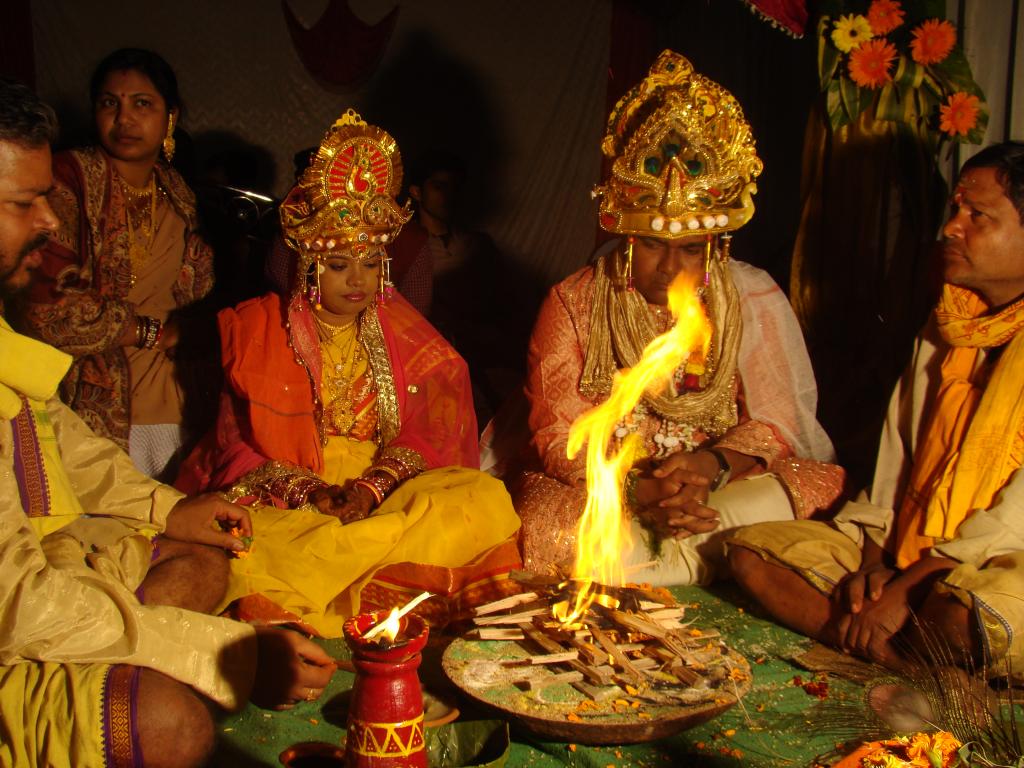
In a village in Odisha, or a hotel ballroom in New Jersey, or a temple courtyard in Jaipur, a priest recites verses that begin with the word satyena, “by truth.” The bride circles a fire. The groom takes her hand. Seven steps are walked. These acts do not merely echo the Rigveda; in many cases, the words being chanted are the Rigveda, drawn from a single hymn composed somewhere in the Punjab perhaps thirty-five centuries ago.
RV 10.85, known in the tradition as the Suryasukta or the Vivahasukta (the “wedding hymn”), is the most sustained account of social and ritual life anywhere in the Rigvedic corpus. Its forty-seven verses narrate the celestial marriage of Surya (the Sun-maiden, daughter of Savitr) to Soma, and in doing so they lay down a template for every human wedding that followed. No other hymn in the collection describes clothing, chariots, bridal attendants, apotropaic charms against evil spirits, the giving of gifts to priests, the bride’s journey to her new home, and the expectation that she will “address the assembly” as a figure of household authority. It is, in the strict sense, a liturgical script: the Grhya Sutras (the later manuals of domestic ritual) take this hymn and build an entire wedding ceremony around it, verse by verse.
What makes this remarkable is not just the hymn’s antiquity. It is the unbroken continuity. The saptapadi (seven steps around the fire), the panigrahana (grasping of the hand), the invocation of Agni as witness: these are not revivals or reconstructions. They are the same ritual acts, performed with the same (or closely related) words, that RV 10.85 prescribes. The hymn is one of the longest-lived liturgical texts in human history. It has outlived the civilisation that composed it, the language in which it was first spoken, and many of the gods to whom it was addressed. What follows is a close reading: what the hymn says, what scholars have argued about it, and what it reveals about how the Vedic poets understood the joining of two lives.
Cosmic Architecture: Verses 1 to 5
The hymn opens not with a bride or a groom but with a cosmological declaration. Truth sustains the earth; the sun sustains the sky; rta (cosmic order) secures the Adityas in their stations; and Soma holds his place in heaven. The poet begins, in other words, by insisting that a wedding is not a private affair. It is an act grounded in the same principle that keeps the cosmos running.
“Truth is the base that bears the earth; by Surya are the heavens sustained. By Law the Adityas stand secure, and Soma holds his place in heaven.”
(RV 10.85.1, after Griffith)
The first five verses establish Soma as the bridegroom, but they do so obliquely. Verse 3 draws a sharp distinction between the ritual Soma plant, which is pressed and drunk, and the cosmic Soma “whom the Brahmans truly know,” of whom “no one ever tastes” [1]. This is a theological move. The groom in the wedding is not the botanical soma discussed in the Soma problem; he is the celestial Soma, the Moon, a cosmic figure of equal standing with Surya, the Sun-maiden.
Verse 5 makes the identification explicit: “Vayu is Soma’s guardian god. The Moon is that which shapes the years.” The equation Soma = Moon is not universal in the Rigveda (it appears primarily in late hymns of Mandala 10), but here it is stated plainly. The wedding of Surya and Soma is the wedding of Sun and Moon, and every human marriage re-enacts it [2].
Aside. The Anukramani (the traditional verse-index) attributes this hymn to Surya Savitri, a female seer (rishika). Whether this attribution reflects genuine female authorship or is a later inference from the hymn’s subject matter remains debated. For more on women as Vedic poets, see Rishikas and Goddesses.
The Bride’s Preparation: Verses 6 to 12
The cosmic prologue ends at verse 5. From verse 6, the hymn shifts register, and we are suddenly in the middle of a wedding. Raibhi is the bride’s dear friend; Narasamsi leads her home. The poet names her attendants, her garments, her cosmetics. “Thought was the pillow of her couch, sight was the unguent for her eyes; her treasury was earth and heaven when Surya went unto her lord” (10.85.7, Griffith).
The imagery is deliberately double-layered. The “unguent for her eyes” is at once a literal cosmetic practice (collyrium, anjana, applied to a bride’s eyes) and a cosmic metaphor: sight itself adorns the Sun-maiden. The bridal car is described in verse 8 with similar doubling: “Hymns were the cross-bars of the pole, Kurira-metre decked the car; the bridesmen were the Asvin Pair, Agni was leader of the train.” The chariot of the cosmic bride is literally constructed from liturgical elements: chandas (metre) forms its frame; Vedic hymns are its crossbars.
| Verse | Element | Cosmic Meaning | Ritual Parallel |
|---|---|---|---|
| 6 | Raibhi, Narasamsi | Bridal attendants | Bridesmaids, wedding party |
| 7 | “Thought was the pillow” | Mind adorns the bride | Cosmetic preparations |
| 8 | Hymns as cross-bars | Liturgy constructs reality | Vedic chanting during procession |
| 9 | Soma as wooer, Asvins as groomsmen | Celestial courtship | Groom’s party, proposal |
| 10 | “Her spirit was the bridal car” | Inner self as vehicle | Decorated wedding chariot |
Verse 9 introduces the key narrative: “Soma was he who wooed the maid: the groomsmen were both Asvins, when the Sun-God Savitar bestowed his willing Surya on her lord.” Notice the verb: Savitar bestows his daughter. This is kanyadana, the “gift of a maiden,” a concept that the Dharmasastra literature would later codify as the highest form of marriage. The Rigvedic hymn already treats it as the paradigmatic act [3].
The Chariot and the Stars: Verses 13 to 19
The bridal procession is described in astronomical terms. Verse 13 names specific naksatras (lunar mansions): “In Magha days are oxen slain, in Arjunis they wed the bride.” The reference to Magha and Arjuni (Phalguni) places the wedding at a particular point in the lunar calendar, linking the ritual to the Vedic astronomical system that governed the timing of sacrifices and rites of passage.
“Surya’s bridal procession, which Savitar despatched, has advanced; the oxen are driven forth in Magha; she is borne to her husband’s house in the Arjuni constellations.”
(RV 10.85.13, after Griffith, with Sayana)
The chariot itself is described in verse 20 with remarkable specificity:
“Ascend the chariot made of kims’uka wood and s’almali, all-shaped, gold-hued, with strong wheels, light-rolling, bound for the world of life immortal; make for thy lord a happy bridal journey.”
(RV 10.85.20, after Griffith and Wisdomlib)
The kimsuka (Butea monosperma, the flame-of-the-forest, known for its brilliant orange-red flowers) and salmali (Bombax ceiba, the silk-cotton tree) are not arbitrary. Both trees were associated with fertility and auspiciousness in Vedic culture. The chariot is “gold-hued” (hiranyavarnam), establishing the solar colour that marks the bride throughout the hymn.
Verses 14 to 16 introduce a puzzling detail: the Asvins arrive on a three-wheeled chariot, but one wheel is hidden. “Where was one chariot wheel of yours?” the poet asks. The Brahmans “who are skilled in highest truths” know its location (10.85.16). Scholarly consensus, following Geldner and Jamison, takes this as a reference to the invisible or esoteric dimension of ritual knowledge: what is visible in the ceremony is not all there is [4].
| Nakshatra | Vedic Name | Ritual Association | Modern Equivalent |
|---|---|---|---|
| Magha | Magha | Cattle sacrifice, pre-wedding rites | Regulus (alpha Leonis) region |
| Phalguni | Arjuni | Wedding timing, auspicious union | Denebola region |
| Chitra | Citra | General auspiciousness | Spica (alpha Virginis) |
For more on the Vedic calendar and its astronomical foundations, see Nakshatra Astronomy in the Rigveda.
Three Husbands Before the Human One: Verses 40 to 41
No passage in the hymn has generated more scholarly debate than verses 40 and 41:
“Soma first obtained the bride; the Gandharva obtained her next. Agni was your third husband; your fourth husband is born of man.”
(RV 10.85.40, after Griffith)
Verse 41 continues: “Soma to the Gandharva, and to Agni the Gandharva gave; and Agni hath bestowed on me riches and sons and this my spouse.”
Three interpretive traditions have emerged around this passage.
The ritual-transfer reading. Jamison (1996) argues that the three divine “husbands” represent a chain of ritual custody. The bride belongs first to Soma (the cosmic principle), then to a Gandharva (the semi-divine being Visvavasu, who is explicitly addressed in verses 21 to 22 and asked to “rise up” and leave the bride), and then to Agni (fire, who witnesses and sanctifies the marriage). The human husband receives her only after these three divine custodians have relinquished their claims. This is not literal polyandry; it is a ritual theology of graduated sanctification [5].
The developmental reading. Some Indian commentators, following a line of interpretation that goes back at least to medieval times, read the three divine husbands as stages of a woman’s maturation. Soma represents infancy and nourishment (milk); Gandharva represents adolescence and the arts (music, dance); Agni represents the domestic fire, cooking, and readiness for marriage. Under this reading, the verse describes not sequential marriages but sequential developmental phases [6].
The astronomical reading. A third interpretation, less widely accepted in mainstream Indology, maps Soma, Gandharva, and Agni onto celestial bodies or atmospheric phenomena, treating the entire passage as an encoded description of the Moon’s relationship to other heavenly forces.
graph TD
    A["Soma (cosmic principle)"] -->|"transfers bride to"| B["Gandharva / Visvavasu"]
    B -->|"transfers bride to"| C["Agni (sacred fire)"]
    C -->|"transfers bride to"| D["Human husband"]
    E["Ritual reading: chain of sacred custody"] -.-> A
    F["Developmental reading: stages of maturation"] -.-> A
    G["Astronomical reading: celestial mapping"] -.-> A
Aside. The Gandharva Visvavasu appears also in verses 21 to 22, where he is directly asked to leave the bride: “Rise up from hence, Visvavasu: with reverence we worship thee. Seek thou another willing maid, and with her husband leave the bride.” This is an apotropaic formula: it ensures that the divine claimant relinquishes his hold before the human wedding proceeds.
Stephanie Jamison’s Sacrificed Wife/Sacrificer’s Wife (1996) provides the most sustained treatment of this passage, arguing that the three-custodian model reflects a broader Vedic pattern in which women move through ritual “ownership” by divine forces before entering human social structures. Jamison emphasises that this is a ritual logic, not a social description of actual polyandry [5].
Apotropaic Protections: Verses 28 to 32
A striking section of the hymn, often overlooked in popular treatments, consists of verses designed to ward off evil. These are apotropaic charms, embedded directly in the wedding liturgy.
Verse 28: “Her hue is blue and red: the fiend who clingeth close is driven off.” Verse 29: “Give thou the woollen robe away: deal treasure to the Brahman priests. This female fiend hath got her feet, and as a wife attends her lord.” Verse 31: “Consumptions, from her people, which follow the bride’s resplendent train, these let the Holy Gods again bear to the place from which they came.”
| Verse | Threat | Protective Measure |
|---|---|---|
| 28 | “Fiend who clings” (raksas) | Driven off by ritual colour/identification |
| 29 | “Female fiend” on the garment | Garment given to Brahman priests |
| 30 | Impurity clinging to husband | Removal of bride’s blood-stained cloth |
| 31 | “Consumptions” following the bride | Gods return them to their origin |
| 32 | Highway thieves, ambush | Prayer for safe passage |
The Vedic wedding, for all its cosmic grandeur, was also an occasion of acute anxiety. The bride was leaving her natal family. The journey was literal (by chariot, along roads that might be dangerous) and symbolic (from one ritual sphere to another). The apotropaic verses address both registers. They protect against actual bandits on the road and against invisible malevolences that might attach themselves to the bride’s garments or body.
The reference to the bride’s garment being “blue and red” in verse 28 and the instruction to give it to the Brahman in verse 29 have been interpreted by Doniger (1981) and others as referring to the blood-stained cloth of the wedding night, which must be ritually disposed of to prevent spiritual contamination. Jamison and Brereton (2014) are more cautious, noting that the precise referent of the “garment” (vastra) is uncertain and that the verse may refer to an outer robe rather than an undergarment [2][5].
The Bride’s Authority: Verses 26 to 27 and 42 to 47
Perhaps the most striking passage in the hymn, for a modern reader, is the instruction given to the bride as she arrives at her new home:
“Go to your home, to be the lady of the house; with authority you will address the vidatha. Prosper here, beloved, with your children; in your home, watch over the household.”
(RV 10.85.26-27, composite after Griffith and Wisdomlib)
The word vidatha is significant. It refers to a public assembly or gathering where important matters were discussed. The bride is not merely told to manage domestic affairs in private; she is told she will “address the assembly” with authority, even in old age. This is a public role, a recognition of social voice [7].
The closing verses reinforce this:
- Verse 42: “Be ye not parted; dwell ye here, reach the full time of human life. With sons and grandsons sport and play, rejoicing in your own abode.”
- Verse 45: “O Bounteous Indra, make this bride blest in her sons and fortunate. Vouchsafe to her ten sons, and make her husband the eleventh man.”
- Verse 46: “Over thy husband’s father and thy husband’s mother bear full sway. Over the sister of thy lord, over his brothers rule supreme.”
Verse 46 is extraordinary. The bride is told to “rule supreme” (samrajni, a feminine form of the word for sovereign) over her husband’s parents and siblings. Whether this reflects actual social practice or an idealised ritual aspiration is debated, but the language is unambiguous. The Vedic wedding hymn confers authority, not merely permission, on the bride within her new household [7].
For a broader treatment of women’s voices in the Rigvedic corpus, see The Hidden Women of the Rigveda.
The Parallel Text: Atharva Veda 14
The Rigvedic wedding hymn does not stand alone. Atharva Veda Book 14 contains two extended hymns (AV 14.1 and 14.2) that closely parallel and expand upon RV 10.85. Many verses are shared verbatim between the two collections, while the Atharva Veda adds material that is more explicitly concerned with the physical details of the ceremony.
AV 14.1.1, for example, opens with the same cosmological declaration as RV 10.85.1: “By truth is the earth established; by the sun is the sky established.” But the Atharva Veda adds extended passages on the hand-grasping ceremony (panigrahana): “Wherewith Agni grasped the right hand of this earth, therewith grasp I thy hand; do not stagger in company with me, with both progeny and riches” (AV 14.1.48). This is a direct ritual instruction, specifying what the groom says as he takes the bride’s hand.
| Feature | RV 10.85 | AV 14.1-2 |
|---|---|---|
| Cosmological opening | Verses 1-5 (Soma, truth, cosmic order) | Verse 1 (nearly identical) |
| Bridal chariot | Verse 20 (kimsuka, salmali) | Parallel verse with identical description |
| Three divine husbands | Verses 40-41 | Expanded with additional commentary |
| Apotropaic charms | Verses 28-32 | Greatly expanded (25+ protective verses) |
| Hand-grasping formula | Not explicit | AV 14.1.48 (detailed ritual script) |
| Garment disposal | Verses 29, 34-35 | Verses 25-29 (more detail on undergarment) |
| Bride’s household authority | Verses 26-27, 46 | Parallel, with additional blessings |
The relationship between the two texts is a matter of scholarly debate. The dominant view, following Bloomfield and Whitney, holds that the Atharva Veda hymns represent a later, expanded version of the Rigvedic original, incorporating additional ritual material from local traditions and the emerging Grhya Sutra literature [8]. An alternative view, articulated by some Indian scholars, suggests that both texts draw on a common earlier liturgical tradition that predates either collection.
What is clear is that by the time the Atharva Veda was compiled, the wedding ceremony had grown considerably more elaborate than what RV 10.85 alone describes. The Rigvedic hymn is a seed; the Atharva Vedic version is the same ceremony in fuller bloom.
From Hymn to Handbook: The Grhya Sutras
The Grhya Sutras (literally “threads of domestic ritual”), composed roughly between the eighth and fourth centuries BCE, take the raw material of RV 10.85 and the Atharva Veda wedding hymns and systematise them into step-by-step procedural manuals. The most important of these for the wedding ceremony are the Ashvalayana Grhya Sutra (associated with the Rigveda), the Paraskara Grhya Sutra (associated with the Shukla Yajurveda), and the Gobhila Grhya Sutra (associated with the Samaveda) [9].
The structure that emerges from these manuals is recognisable to anyone who has attended a Hindu wedding:
- Varapuja (honouring the groom): The bride’s family welcomes the groom, corresponding to the Rigvedic scene of Savitar bestowing Surya.
- Kanyadana (gift of the maiden): The father gives away the bride, echoing RV 10.85.9 where Savitar bestows his daughter.
- Panigrahana (hand-grasping): The groom takes the bride’s right hand, formalised in the Grhya Sutras from AV 14.1.48.
- Agni Parikrama (circumambulation of fire): The couple circles the sacred fire, with Agni as witness, directly drawn from the Rigvedic insistence on Agni as “leader of the train” (RV 10.85.8).
- Saptapadi (seven steps): The couple takes seven steps together, each representing a vow. The Paraskara Grhya Sutra (I.8.1-2) prescribes seven steps northward, each with its own invocation.
- Laja Homa (offering of parched grain): The bride offers grain into the fire, a rite that echoes the broader Vedic fire ritual tradition.
- Ashmarohana (stepping on a stone): The bride places her foot on a stone, symbolising steadfastness.
Methods note. The saptapadi (seven steps) is not explicitly described in RV 10.85 itself, though the hymn’s references to walking with the husband and the injunction to “reach the full time of human life” (verse 42) provide the conceptual basis. The formalised seven-step ritual appears in the Grhya Sutras, which codify what the hymn implies. P.V. Kane, in History of Dharmasastra Vol. II, traces this development in detail [3].
The continuity is striking. The core ritual acts (fire-witnessing, hand-taking, circumambulation) have survived largely intact for over three millennia. Regional variations exist, but the structural skeleton remains that of the Vedic ceremony. As Kane observed, “The vivaha samskara is perhaps the most conservative of all the Hindu samskaras, preserving in its essentials the form laid down in the Rigvedic and Grhya Sutra period” [3].
What the Hymn Does Not Say: Consent, Dowry, and the Bride-Price
Modern readers often approach the Vedic wedding hymn looking for evidence of practices that would later become central to Hindu marriage: the dowry system, child marriage, the absence of female consent. What RV 10.85 actually says, and what it conspicuously does not say, is instructive.
On consent. The hymn describes a bride who is “willing” (subhaga, verses 33, 37). Savitar bestows his daughter, but the word used implies willing bestowal, not forced transfer. The bride is addressed as an agent: she is told to “go to your home,” to “address the assembly,” to “rule supreme.” The Grhya Sutras similarly describe the parties to marriage as “grown up persons competent to woo and be wooed, qualified to give consent and make choice” [10]. Whether this reflects universal practice or an idealised priestly norm is impossible to determine from the text alone, but the hymn’s language does not describe coercion.
On dowry and bride-price. The hymn mentions gifts flowing in both directions. The bridal garment is given to the Brahman priest (verse 34). The groom receives “riches and sons and this my spouse” from Agni (verse 41). Macdonell and Keith, in their Vedic Index (1912), argue that the Vedic period primarily practised sulka (bride-price, paid by the groom’s family) rather than dowry (paid by the bride’s family). The shift from bride-price to dowry appears to be a post-Vedic development [11].
On the age of marriage. The hymn describes a bride who is clearly of mature age: she has attendants, she is given cosmetics, she is told she will “address the assembly even when you are old” (verse 27). The practice of child marriage, which became widespread in later periods, finds no support in this text. Altekar and other historians have argued that the Vedic evidence consistently points to adult marriage as the norm during the Rigvedic period [10][12].
Three cautions are worth noting for the modern reader. First, the hymn is a prescriptive liturgical text, not a sociological survey; it tells us what the poets thought a wedding should be, not necessarily what all weddings were. Second, the Rigveda is the product of a priestly elite, and its norms may not have applied to all social strata. Third, the hymn’s vision of the bride’s authority does not preclude patriarchal structures; the bride is given authority within a system where she moves from her father’s household to her husband’s.
The Solar Myth Behind the Ritual
The marriage of Surya and Soma is not the only solar marriage myth in the Rigveda. RV 10.17 tells the story of Saranyu (also known as Samjna in later texts), the daughter of Tvastr, who marries Vivasvat (the Sun). In that myth, Saranyu, unable to bear Vivasvat’s brilliance, substitutes a shadow-double (Chhaya) for herself and flees, transforming into a mare. Vivasvat pursues her as a stallion, and from their union the Asvins are born [13].
The two myths share a common structure: a solar daughter given in marriage, a journey, a transformation, and the birth of divine offspring. But RV 10.85 is far more grounded in ritual practice. Where RV 10.17 is myth, 10.85 is myth and liturgy. The Saranyu story explains origins; the Surya wedding hymn prescribes actions. This difference may explain why 10.85, not 10.17, became the basis for the actual wedding ceremony.
The connection between the two myths also illuminates the Asvins’ role in 10.85. The divine twins appear as groomsmen (verse 9), wooers who arrive on a three-wheeled chariot (verse 14), and escorts who carry the bride to her new home (verse 26). In the Saranyu myth, they are born from the same solar marriage complex. Their presence in the wedding hymn is not decorative; they are, mythologically speaking, products of the very pattern the hymn enacts.
graph LR
    A["Savitr (Sun-father)"] --> B["Surya (Sun-maiden)"]
    B --> C["Marriage to Soma (Moon)"]
    C --> D["Human marriages model this pattern"]
    A --> E["Tvastr (divine artisan)"]
    E --> F["Saranyu / Samjna"]
    F --> G["Marriage to Vivasvat (Sun)"]
    G --> H["Birth of the Asvins"]
    H -.-> C
A Living Text
There is a useful thought experiment for reading RV 10.85. Imagine any other liturgical text from roughly 1500 BCE, from any culture on earth. The Egyptian Book of the Dead, the Hittite ritual tablets, the Ugaritic hymns. Now ask: is that text still being recited, in a recognisable form, at actual ceremonies today?
The answer, in every other case, is no. These texts survive as artefacts, studied by scholars, preserved in museums. RV 10.85 survives as a living liturgy. The priest who chants satyenottabhita bhumih (“truth sustains the earth”) at a wedding in Mumbai in 2026 is chanting the same opening that a priest chanted at a wedding in the Punjab in 1500 BCE. The accent system may have shifted. The surrounding ceremony has accumulated layers. But the words, transmitted orally through the Vedic schools with extraordinary fidelity, are the same.
This is not a sentimental observation. It is a fact about textual transmission and ritual conservatism that demands explanation. The most convincing explanation, offered by scholars from Kane to Staal, is that the Vedic wedding ceremony was embedded so deeply in the samskara system (the sequence of life-cycle rituals) that it became self-perpetuating. Each generation performed the ceremony because the previous generation had performed it, and the chain stretches back to the composition of the hymn itself [3][14].
The hymn also survives because it is, by any standard, a good poem. The image of thought as a pillow, sight as an unguent, earth and heaven as a treasury (verse 7) is not merely pious formula. It is a poet’s compression of an entire vision of what a marriage means: that the inner life of the bride is as real and as structured as the outer ceremony. The chariot built from hymns and metres (verse 8) is a metaphor for the Vedic conviction that ritual speech constructs reality, that the world the priests chant into being is as solid as wood and gold.
Read RV 10.85 at a wedding if you can. Not for devotional reasons (this is a scholarly recommendation), but because the hymn was composed to be heard in that setting, with fire and flowers and the anxiety of two families watching. It was not written for the page. It was written for the moment when a hand reaches for another hand, and a priest tells the bride: you will speak in the assembly. You will rule in this house. You will reach old age with this person beside you. That these words have been spoken, with minor variations, for three and a half thousand years is not a miracle. It is a testament to what happens when a poem is precise enough, and true enough, to outlast the world that made it.
References
Jamison, Stephanie W. & Brereton, Joel P. The Rigveda: The Earliest Religious Poetry of India. 3 vols. Oxford University Press, 2014.
Griffith, Ralph T.H. The Hymns of the Rigveda. E.J. Lazarus and Co., 1896. Wikisource.
Kane, Pandurang Vaman. History of Dharmasastra (Ancient and Mediaeval Religious and Civil Law). Vol. II, Parts 1-2. Bhandarkar Oriental Research Institute, 1941. archive.org.
Geldner, Karl Friedrich. Der Rig-Veda: Aus dem Sanskrit ins Deutsche ubersetzt und mit einem laufenden Kommentar versehen. 3 vols. Harvard Oriental Series, 1951.
Jamison, Stephanie W. Sacrificed Wife/Sacrificer’s Wife: Women, Ritual, and Hospitality in Ancient India. Oxford University Press, 1996.
Sayana. Rigveda Bhashya. Commentary on RV 10.85. Various editions.
Altekar, A.S. The Position of Women in Hindu Civilization: From Prehistoric Times to the Present Day. Motilal Banarsidass, 1938.
Whitney, William Dwight (trans.). Atharva Veda Samhita. Harvard Oriental Series, 1905. Revised by Charles Rockwell Lanman.
Oldenberg, Hermann (trans.). The Grihya-Sutras: Rules of Vedic Domestic Ceremonies. 2 vols. Sacred Books of the East, vols. 29 and 30. Oxford University Press, 1886-1892. archive.org.
Macdonell, Arthur A. & Keith, Arthur Berriedale. Vedic Index of Names and Subjects. 2 vols. John Murray, 1912. archive.org.
Doniger O’Flaherty, Wendy. The Rig Veda: An Anthology. Penguin Classics, 1981. archive.org.
Keith, Arthur Berriedale. The Religion and Philosophy of the Veda and Upanishads. 2 vols. Harvard Oriental Series, 1925.
Macdonell, Arthur A. Vedic Mythology. Karl J. Trubner, 1897. archive.org.
Staal, Frits. Rules Without Meaning: Ritual, Mantras and the Human Sciences. Peter Lang, 1989.
Bloomfield, Maurice. Hymns of the Atharva-Veda. Sacred Books of the East, vol. 42. Oxford University Press, 1897.
Oldenberg, Hermann. Die Religion des Veda. Wilhelm Hertz, 1894.
Renou, Louis. Etudes vediques et panineennes. 17 vols. Paris: Editions de Boccard, 1955-1969.
Witzel, Michael. “Tracing the Vedic Dialects.” In Dialectes dans les litteratures indo-aryennes, ed. C. Caillat. Paris: College de France, 1989, pp. 97-265.
Comments (0)
No comments yet. Sign in to start the discussion.