Karma Was a Verb First: What the Rigveda Actually Says About What You Do
The deposit waiting in heaven
Somewhere in the Punjab, roughly three thousand years ago, a man is dying and a priest is talking him through the route.
The instructions are practical, almost like directions to a house. Go by the old roads. The fathers went that way before you. You will meet two kings sitting together, Yama and Varuṇa, enjoying themselves. And then, in the eighth verse of RV 10.14, comes a line that has no parallel anywhere else in the collection:
sáṃ gachasva pitṛ́bhiḥ sáṃ yaména iṣṭāpūrténa paramé vyòman
“Unite with the fathers, with Yama, with your offerings-and-public-works, in the highest heaven.”
Rigveda 10.14, verse 8. After Jamison and Brereton (Oxford 2014), with diacritics standardised.[16]
Read the middle term slowly, because it is doing something no other Rigvedic word does. Iṣṭāpūrtá (Sanskrit: इष्टापूर्त) is a compound of two past participles: iṣṭá, “what has been sacrificed”, and pūrtá, “what has been filled up”, the second referring in practice to wells dug, tanks built, and fees paid out to priests. The dying man is not being told that he will be judged. He is being told to go and meet something he made. His own accumulated doing has gone on ahead of him and is sitting in the highest heaven like a deposit in a foreign bank, waiting for the account holder to arrive.
That word occurs exactly once in the entire Rigveda. Once, in something over ten thousand verses.
This is the strange fact at the centre of any honest account of karma’s origins. The Rigveda does not have a doctrine of karma, and saying otherwise is either wishful reading or bad philology. What it has is stranger and, I would argue, considerably more interesting: a scattered set of components, each individually attested and countable, that a later tradition will pick up and reassemble into something none of the Vedic poets would recognise. This essay follows those components. First, what the word kárman actually meant to the people who used it. Second, the Rigveda’s real vocabulary for good and bad action, which turns out to be borrowed wholesale from a workshop. Third, the one thing the Rigveda has that karma cannot tolerate, and the moment, several centuries later, when two men step away from a crowded hall to whisper about it.
Methods note. The counts above come from searching the electronic Saṃhitā text of Aufrecht’s Rigveda (the van Nooten and Holland data, distributed through GRETIL) for word-initial forms of each stem.[1][15] They are lower bounds, not exact totals: vowel sandhi hides some forms inside the preceding word, which is precisely why iṣṭāpūrténa in RV 10.14.8 has to be found as yaménéṣṭāpūrténa. Compounds where the stem sits in second position are excluded. Anyone with the text and a search box can reproduce these numbers in about ten minutes, and I would rather you did than take my word for it.
Thirty-six work orders
Here is the sentence that should be printed on the inside cover of every popular book about karma: in the Rigveda, kárman means work.
Not merit. Not consequence. Not an invisible residue attaching to a soul. Work, in the flatly physical sense a foreman would use. The word is a -man stem built on the root √kṛ, “to make, to do, to construct”, the same root that gives Sanskrit kṛtá (“done, made”) and, through Proto-Indo-European *kʷer-, sits somewhere behind English words for shaping and cutting. When a Rigvedic poet says kárman, he is usually talking about one of two things: the ritual he is currently performing, or a feat Indra performed on his behalf.
The formulaic phrase makes this unmistakable. Three times, in three different hymns of the third maṇḍala, the poets of the Viśvāmitra family sing the same line:
índrasya kárma sukṛtā́ purū́ṇi
“Indra’s many well-crafted works.”
Rigveda 3.30, verse 13; 3.32, verse 8; 3.34, verse 6. My rendering, following Jamison and Brereton.
Kárma sukṛtā́: the deeds are well-made. That is not an ethical assessment. It is the language you would use about a chariot wheel. Indra’s works are praiseworthy the way a good joint is praiseworthy, because they hold. The verse that follows in RV 3.32.8 keeps the register exactly: he propped up the earth and this sky, he begot the sun and the dawn, and the gods do not violate his vratāni, his standing commitments. Cosmic engineering, reviewed for workmanship.
The rest of the thirty-six occurrences behave the same way. In RV 1.11.4 Indra is “upholder of everything that is done”. In RV 3.4.9 and its verbatim twin at RV 7.2.9, an Āprī litany asks for a son who is karmaṇyaḥ, “capable at the work”, which in context means competent at the ritual. In RV 9.46.3 the priests “strengthen Indra with their works”, meaning with their liturgy, and in RV 3.36.1 Indra is famous “through great works”. The word is a job description.
| Vedic term | Root | Rigvedic sense | Later doctrinal sense |
|---|---|---|---|
| kárman | √kṛ “make” | ritual act; feat; craftsmanship | act plus its moral residue |
| sukṛtá | su- + √kṛ | well-made; well-performed | good deed, merit |
| duṣkṛ́t | duṣ- + √kṛ | badly-making, botching | evildoer |
| iṣṭāpūrtá | √yaj + √pṝ | offerings and public works | accumulated merit |
| púṇya | uncertain | auspicious, pleasant (2x) | merit, the standard word |
| ṛtá | √ṛ “fit, move” | the fitted order of things | truth, later absorbed into dharma |
The last two rows deserve a pause. Púṇya, which in classical Sanskrit is the word for religious merit, appears twice in the Rigveda, and in neither place does it mean merit. At RV 2.43.2 a poet asks a bird to call out something púṇya, auspicious, from every direction; at RV 7.55.8 it describes women who are puṇyagandhāḥ, sweet-smelling. Henk Bodewitz, who worked through the whole family of Vedic merit-terms in a long and characteristically deflating study, concluded that púṇya only becomes a technical merit-word well after the Rigveda, and that in the older layer the load is carried almost entirely by sukṛtá.[2][3] The vocabulary of Indian ethics was not there at the start. It got assembled.
The word for good is “well-made”
Now put the counts side by side, because the ratio is the argument.
Sukṛt- and its derivatives: seventy-nine occurrences. Duṣkṛt-: ten. The Rigveda talks about doing things well roughly eight times as often as it talks about doing things badly.
That imbalance would be unremarkable in a hymn collection whose business is flattery, except for what the words literally say. Su-kṛtá is “well-done” in the sense a carpenter means it. Duṣ-kṛ́t is “badly-made”. These are not the words of a tradition thinking in terms of sin and punishment; they are the words of a tradition thinking in terms of competence and botching. The Rigvedic poets, who describe their own hymns as objects they have fashioned (a metaphor traced in the companion piece on the poet as carpenter), reached for the same workshop vocabulary when they needed to say that a life had gone well.
And a life that has gone well has somewhere to go. The phrase is sukṛtā́m u lokám, “the world of those who have made well”:
yā́s te śivā́s tanvò jātavedas tā́bhir vahainaṃ sukṛtā́m u lokám
“With those bodies of yours that are kindly, Jātavedas, carry this man to the world of the well-doers.”
Rigveda 10.16, verse 4. After Jamison and Brereton.
This is the cremation fire being asked to behave. Agni has a set of bodies, some of them carnivorous and terrible, and the mourners want the gentle ones used. The destination they name is a loka defined by workmanship. Compare RV 5.4.11, where Agni makes a syoná, a comfortable world, specifically “for the man who has made well”; and RV 10.85.24, the wedding hymn, where the bride is settled “in the womb of ṛtá, in the world of the well-made” (a verse read closely in the essay on the Sūryā wedding hymn).
Bodewitz’s point about these passages is precise and worth stating exactly. Sukṛtám, he argues, does not merely describe the person; it comes to denote the reward for particular good actions, stored in heaven, which qualifies a person for continued life after death there.[3] The loka is the place of the merit as much as it is the place of the meritorious. Which is to say that by the time of the tenth maṇḍala, the Vedic poets have an accumulation model. They just do not have a recycling model, and the difference between those two is the whole history of Indian religion.

The pūrta half of the compound is the part modern readers tend to skip, and it is the half that makes the idea concrete. Sacrifice is the priestly contribution; pūrta, “what has been filled”, covers the layman’s: the well, the water tank, the grove, the fee handed to the officiants. Later Dharmaśāstra will spell this out at length. The Rigveda mentions it once, in passing, to a dying man, as though everyone already knew.
Generosity without metaphysics
If you want to see Rigvedic ethics working at full strength, do not go to a philosophical hymn. Go to RV 10.117, a short, blunt poem about feeding people.
ná vā́ u devā́ḥ kṣúdham íd vadhám dadur utā́śitam úpa gacchanti mṛtyávaḥ
“The gods have certainly not ordained hunger as the only death-blow. Deaths come upon the well-fed man too.”
Rigveda 10.117, verse 1. After Jamison and Brereton.
That opening is an argument, not a sentiment: you cannot excuse yourself from feeding the hungry on the grounds that death comes for everyone anyway, because death comes for the well-fed as well. The hymn then works through the case with a lawyer’s persistence. He who has food and hardens his heart against a starving suppliant finds no comforter later (verse 2). “He is no friend who gives nothing of his own food to a friend who comes to him” (verse 4). Give to the beggar and look down the longer road (verse 5). And then the line that has outlived every other in the hymn:
kevalā́gho bhavati kevalādī́
“He who eats alone is alone in his guilt.”
Rigveda 10.117, verse 6. After Jamison and Brereton.
Notice what is not there. No mechanism. No accounting entity that receives the deed and pays it back. No next life in which the miser returns as something hungry. The verse simply asserts a moral fact and expects it to land, and it does land, three thousand years later, without any metaphysics propping it up at all. The hymn’s final image is the one I find hardest to forget: two hands are equal, but they do not accomplish the same thing; two cows of the same mother do not yield the same milk (RV 10.117.9). Equal endowment, unequal output. The difference is what you did with it.
Aside. It is tempting to read RV 10.117 as an early sermon on karmic consequence, and popular anthologies often do. Resist it. The hymn threatens the miser with social and existential isolation, not with a future birth or a posthumous ledger. Reading later doctrine backwards into the Rigveda is the single commonest error in writing about Vedic ethics, and the surest way to make an eloquent text sound like a lesser version of what came after it.
The one thing karma cannot allow
Everything so far might look like a doctrine of karma in embryo. Deeds are counted; the well-made ones earn a destination; the badly-made ones have consequences. RV 7.104.3 sends the duṣkṛ́tas down “into the pit, into bottomless darkness”, and RV 9.73.6 says flatly that “the ill-doers do not cross the path of ṛtá”. Varuṇa watches, counts, and binds, as the essay on Varuṇa and cosmic guilt sets out in detail. The parts are all present.
Then you reach RV 8.47.13, and the whole structure falls over.
yád āvír yád apīcyàṃ devāso ásti duṣkṛtám trité tád víśvam āptyá āré asmád dadhātana
“Whatever ill-deed there is, open or hidden, O gods, put all of it far from us, onto Trita Āptya.”
Rigveda 8.47, verse 13. After Jamison and Brereton.
The poets are asking the gods to take their bad deeds and file them under somebody else’s name. Trita Āptya is a shadowy figure who functions here as a scapegoat, an absorber of other people’s misdeeds; the same manoeuvre appears elsewhere in the collection, and the Atharvaveda and Brāhmaṇas keep the machinery running. Compare RV 6.16.32, where Agni is asked to shove the duṣkṛ́t aside with his tongue.
This is what makes the Rigvedic system categorically not karma. Classical karma has exactly one non-negotiable rule: the deed sticks to the doer. That is the entire load-bearing claim. A doctrine in which you can transfer your misdeeds onto a convenient third party is not an early version of karma; it is a different thing that happens to use some of the same words.
And the Rigvedic poets knew the transfer worked in both directions, which worried them:
mā́ va éno anyákṛtam bhujema mā́ tát kárma vasavo yác cáyadhve
“May we not have to suffer for guilt done by another. May we not do, O Vasus, that deed which you punish.”
Rigveda 6.51, verse 7. My rendering; compare the near-identical RV 7.52.2.
Anyákṛtam énaḥ: “guilt made by another”. Two verbs are worth noticing. Bhujema is from √bhuj, “to enjoy, to consume, to undergo”, which is the exact verb classical Sanskrit will later use for undergoing the fruits of one’s own karma. Cáyadhve is from √ci, “to requite, to avenge”. The Rigvedic poet already has the vocabulary of deed and requital. What he does not yet have is the assumption that the two are locked together on one person. He is praying that they will be, which is a different thing, and a much more anxious one.
| Component | Present in the Rigveda? | Evidence |
|---|---|---|
| Deeds have posthumous consequences | Yes | RV 10.16.4; 5.4.11 |
| Merit accumulates and is stored | Yes, marginally | RV 10.14.8 (iṣṭāpūrtá, once) |
| A destination for the good | Yes | sukṛtā́m lokáḥ |
| A pit for the bad | Yes | RV 7.104.3; 9.73.6 |
| Anxiety about whose deed is whose | Yes | RV 6.51.7; 7.52.2 |
| Deeds are non-transferable | No | RV 8.47.13 transfers them to Trita |
| Rebirth into another body | No | absent from the entire collection |
| Action determines the form of that birth | No | absent |
The last three rows are the doctrine. The first five are the raw material.
Sum versus loop
There is a clean formal way to state the difference, and it is worth stating because it clarifies what actually had to be invented.
The Vedic model is an accumulator with a single payout. A person performs some number of ritual and charitable acts, they aggregate into a stock of merit, and that stock determines one outcome, the posthumous destination $D$:
$$D \;=\; f!\left(\sum_{i=1}^{n} m_i\right), \qquad m_i \in {\textit{iṣṭa},\ \textit{pūrta}}$$
The classical model is a recurrence. A state $S$ (your condition, species, caste, fortune) at life $t+1$ is a function of your state at life $t$ and the acts performed during it, with no terminating condition unless you find a way out:
$$S_{t+1} \;=\; g!\left(S_t,\; \sum_{i} k_i^{(t)}\right)$$
Written this way, the innovation is obvious. It is not the idea that acts matter, which the Rigveda has in abundance. It is the closing of the loop: feeding the output back in as the next input, forever. Every distinctive feature of classical Indian soteriology, saṃsāra as a trap, mokṣa as an exit, the entire ascetic project, follows from that one topological change. The Vedic poets had a line. Somebody bent it into a circle.
Aside. The formalism above is mine, offered as a way of seeing the structural difference clearly. No Vedic or Upaniṣadic text argues in these terms, and I would not want a reader to come away thinking otherwise. Its only virtue is that it locates the novelty precisely, which prose discussions of karma’s origins often fail to do.
The whisper in the hall
The moment the loop closes is, unusually for the history of ideas, datable to a specific passage.
In the Bṛhadāraṇyaka Upaniṣad, probably composed some centuries after the latest Rigvedic hymns, Yājñavalkya is fielding hostile questions in a crowded assembly. A man named Jāratkārava Ārtabhāga asks him what remains of a person when speech has gone into fire, breath into wind, eye into sun, and the body into earth. Yājñavalkya does something he does nowhere else in the text. He refuses to answer in public.
The two men leave the hall. And the Upaniṣad, in a line that reads like a stage direction, reports what they discussed:
“What they talked about was action. What they praised was action. One becomes good by good action, bad by bad action.”
Bṛhadāraṇyaka Upaniṣad 3.2.13. My rendering; Sanskrit text in Olivelle (Oxford 1998).[10]
The Sanskrit word for “action” there is kárman, the same word the Rigvedic poets used for the ritual work of the morning. It has acquired a new job. And it has become, for at least one generation, a secret: the passage is the only reason we know the doctrine was once esoteric enough to require stepping outside. By Bṛhadāraṇyaka 4.4.5 the secrecy is gone and the formulation is flat and public: yathākārī yathācārī tathā bhavati, “as one acts, as one conducts oneself, so one becomes”.
graph TD
    A["kárman: ritual work"] --> E["Brāhmaṇa ritual causality"]
    B["sukṛtá: well-made deed"] --> E
    C["iṣṭāpūrtá: stored merit"] --> E
    D["duṣkṛ́t and the dark pit"] --> E
    E --> F["punarmṛtyú: re-death in heaven"]
    F --> G["BAU 3.2.13 and 4.4.5"]
    H["Ascetic milieu east of the Veda"] -.contested route.-> G
    G --> I["Classical karma and saṃsāra"]
The intermediate step in that diagram, punarmṛtyú or “re-death”, is the piece most readers have never heard of and the piece that probably did the work. The Brāhmaṇas develop an anxiety that heaven is not permanent: that the man who reaches the world of the well-doers on the strength of his stored merit will eventually exhaust it and die a second time, up there. Once you have posited a death that happens after the afterlife, you have a sequence rather than a destination, and the distance from a sequence to a cycle is short.
Who invented it, and where
This is where the scholarship gets genuinely contentious, and it would be dishonest to present a consensus that does not exist.
| Position | Principal advocate | Core claim | Main difficulty |
|---|---|---|---|
| Vedic continuity | Herman Tull (1989)[4] | Karma grows out of Vedic ritual causality and the identification of sacrificer with cosmos | Has to explain why rebirth appears so abruptly |
| Vedic precursors, gradual | Paul Horsch (1971)[9]; Bodewitz[2] | Non-ritual karman and merit terms in the Veda supply real antecedents | Antecedents are thin and scattered |
| External origin | Johannes Bronkhorst (2007, 2022)[6][7] | Rebirth and karmic retribution come from the non-Vedic culture of Greater Magadha and were borrowed into Brahmanism | Requires an early dating of the Magadhan milieu |
| Cross-cultural pattern | Gananath Obeyesekere (2002)[8] | Rebirth eschatologies are widespread in small-scale societies; India’s contribution was “ethicization” | Weak on the specific Indian textual sequence |
| Philosophical reconstruction | Wilhelm Halbfass (1991)[19] | The doctrine’s coherence depends on later developments like apūrva | Concerned with systematics more than origins |
Tull’s book remains the strongest case for continuity: he argues that the Brāhmaṇa texts already contain a fully articulated causal system in which correctly performed ritual action produces a specific future result for the actor, and that the Upaniṣadic move consists of generalising a mechanism that was already there.[4] Bronkhorst’s case, restated most recently in 2022, runs the other way. He holds that rebirth and karmic retribution are not Brahmanical in origin at all, that their earliest Vedic testimonies show them arriving from outside, and that the driver was urbanisation: as cities produced visible, unexplained inequality, the doctrine offered an explanation located in the individual rather than in inherited essence.[7] That last point is sharp and uncomfortable, and it is the version I find hardest to dismiss, though its chronology remains disputed.
Obeyesekere’s contribution was to decentre India entirely. Rebirth beliefs turn up in West Africa, Melanesia, Siberia, and the Northwest Coast, generally without any moral component; what distinguishes the Indian and Greek versions is that ethics got introduced into a pre-existing rebirth eschatology, a process he calls ethicization.[8] On this reading the Rigveda’s contribution was never rebirth. It was the moral vocabulary, the counting of deeds, the storing of merit, all of which were sitting there waiting for a rebirth theory to attach to.
[!NOTE] The volume that opened the modern debate is still worth reading whole: Karma and Rebirth in Classical Indian Traditions, edited by Wendy Doniger O’Flaherty (1980), which collects twelve specialists on the Vedas, the Mahābhārata, the Dharmaśāstras, Ayurveda, Tamil literature, Buddhism, Jainism, and the philosophical schools.[5] It is the rare edited volume where the disagreements between chapters are the point.
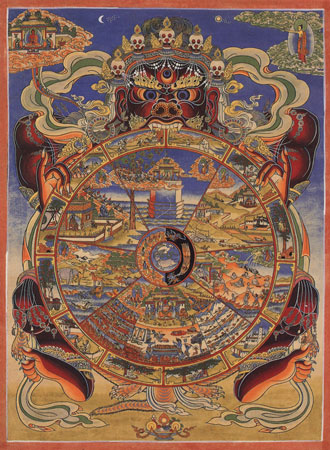
The winning throw
One last piece of evidence, because it is too good to leave out and because it needs a warning label.
The root √kṛ produces the participle kṛtá, “done, made”. It also produces, in Vedic gaming vocabulary, the name of the best throw of the dice. Macdonell and Keith’s Vedic Index lists Kṛta among the named throws alongside Tretā, Dvāpara, and Kali, and those four names were later recycled as the names of the four world ages.[22] The Gambler’s Lament already uses the word in a gaming sense:
akṣā́so asya ví tiranti kā́mam pratidī́vne dádhata ā́ kṛtā́ni
“His dice extend his desire, placing the winning throws with his opponent.”
Rigveda 10.34, verse 6. After Jamison and Brereton. The hymn is read in full in the essay on the Gambler’s Lament.
So in the oldest Indian text, one word means both “the thing you did” and “the throw that wins”, and a later tradition will use the same word for both an era of the world and the moral residue of a life. It is a genuinely remarkable convergence.
Aside. Do not build anything on it. The dice terminology is best studied through Lüders (1907) and Falk (1986), and neither offers any evidence that Vedic speakers heard a moral resonance in the gaming sense of kṛtá.[17][18] Homophony is not doctrine. I include the observation because it shows how much semantic range the root carried, not because the poets were making a pun about fate.
What the older version was for
Strip the later machinery away and something appears that the modern conversation about karma has almost entirely lost.
The Rigvedic system is not punitive. That is the finding that survives all the philology. Its ratio of praise to blame runs about eight to one; its highest term of approval is a word a carpenter would use about a joint; its one piece of afterlife accounting is not a verdict but a deposit; and the destination it names is not a reward for obedience but a loka belonging to people who made things well. The dying man in RV 10.14 is not being audited. He is being told that the wells he dug are already there.
Two things follow, and I will state them plainly rather than leave them implied.
The first is that the Rigveda locates moral weight in production rather than in compliance. What you are judged by, in the loose sense in which anyone is judged in this text, is the quality of what you made: the hymn, the fire, the tank, the meal shared with a stranger who came hungry. That is an unusual place for an ancient religious system to put its emphasis, and it explains why the Rigveda has so little to say about rules and so much to say about craft.
The second is that this version of the idea has no cycle in it, and therefore no trap. Later Indian thought will spend two and a half thousand years working out how to escape saṃsāra, an escape that only becomes necessary once the loop has closed. The Rigvedic poets faced a different and simpler problem: one life, one accumulation, one destination, and a great deal of anxiety about whether the accumulation was good enough. Whether that is a better problem is not a question philology can answer. But it is a different one, and most readers who think they know what karma means have never been shown it.
The whole thing is worth reading with the counts in front of you. Open RV 10.117 first, twenty-nine lines about not eating alone, and notice that the argument never once appeals to a future life. Then read the eighth verse of RV 10.14 and stop at the word iṣṭāpūrtá. Whatever else the tradition later built on top of it, that single occurrence, spoken to one dying man, is the oldest surviving sentence in which an Indian text tells someone that what they did is still out there, and that they will meet it again.
For the surrounding terrain, see the essay on the Rigvedic funeral hymns, which maps the afterlife these verses assume; the study of Varuṇa and cosmic guilt, for the nearest thing the Rigveda has to a moral auditor; the account of amṛta and the hundred autumns, for what the poets actually wanted from death; and the map of Vedic and post-Vedic scripture, for where the Upaniṣads sit in relation to all of this.
References
Aufrecht, Theodor. Die Hymnen des Rigveda. 2nd ed. Bonn: Adolph Marcus, 1877. Electronic Saṃhitā text consulted via GRETIL, Göttingen. gretil.sub.uni-goettingen.de.
Bodewitz, Henk W. Vedic Cosmology and Ethics: Selected Studies. Gonda Indological Studies 19, ed. Dory Heilijgers, Jan Houben and Karel van Kooij. Leiden: Brill, 2019. Open access. brill.com. See especially ch. 19, “Non-ritual kárman in the Veda” (orig. 1993), and ch. 23, “Vedic Terms Denoting Virtues and Merits”.
Bodewitz, Henk W. “Vedic Terms Denoting Virtues and Merits.” Asiatische Studien / Études Asiatiques 67, no. 1 (2013): 31-73.
Tull, Herman W. The Vedic Origins of Karma: Cosmos as Man in Ancient Indian Myth and Ritual. SUNY Series in Hindu Studies. Albany: State University of New York Press, 1989.
Doniger O’Flaherty, Wendy, ed. Karma and Rebirth in Classical Indian Traditions. Berkeley: University of California Press, 1980. ucpress.edu.
Bronkhorst, Johannes. Greater Magadha: Studies in the Culture of Early India. Handbook of Oriental Studies 2/19. Leiden: Brill, 2007.
Bronkhorst, Johannes. “Whence Karma?” Contributions to Indian Sociology 56, no. 3 (2022): 247-71. journals.sagepub.com.
Obeyesekere, Gananath. Imagining Karma: Ethical Transformation in Amerindian, Buddhist, and Greek Rebirth. Berkeley: University of California Press, 2002. jstor.org.
Horsch, Paul. “Vorstufen der indischen Seelenwanderungslehre.” Asiatische Studien / Études Asiatiques 25 (1971): 99-157.
Olivelle, Patrick. The Early Upaniṣads: Annotated Text and Translation. New York: Oxford University Press, 1998.
Grassmann, Hermann. Wörterbuch zum Rig-Veda. Leipzig: F. A. Brockhaus, 1873. archive.org.
Macdonell, Arthur A. Vedic Mythology. Strassburg: Karl J. Trübner, 1897. archive.org.
Keith, Arthur Berriedale. The Religion and Philosophy of the Veda and Upanishads. 2 vols. Harvard Oriental Series 31-32. Cambridge, MA: Harvard University Press, 1925. archive.org.
Oldenberg, Hermann. Die Religion des Veda. Berlin: Wilhelm Hertz, 1894. archive.org.
van Nooten, Barend A., and Gary B. Holland. Rig Veda: A Metrically Restored Text with an Introduction and Notes. Harvard Oriental Series 50. Cambridge, MA: Harvard University Press, 1994.
Jamison, Stephanie W., and Joel P. Brereton. The Rigveda: The Earliest Religious Poetry of India. 3 vols. New York: Oxford University Press, 2014. global.oup.com. Ongoing commentary at rigvedacommentary.alc.ucla.edu.
Lüders, Heinrich. Das Würfelspiel im alten Indien. Abhandlungen der Königlichen Gesellschaft der Wissenschaften zu Göttingen, phil.-hist. Kl., n.F. 9.2. Berlin: Weidmann, 1907.
Falk, Harry. Bruderschaft und Würfelspiel: Untersuchungen zur Entwicklungsgeschichte des vedischen Opfers. Freiburg: Hedwig Falk, 1986.
Halbfass, Wilhelm. Tradition and Reflection: Explorations in Indian Thought. Albany: State University of New York Press, 1991.
Witzel, Michael. “The Development of the Vedic Canon and Its Schools: The Social and Political Milieu.” In Inside the Texts, Beyond the Texts, ed. Michael Witzel. Harvard Oriental Series, Opera Minora 2. Cambridge, MA: Harvard University, 1997, 257-345.
Gonda, Jan. Change and Continuity in Indian Religion. The Hague: Mouton, 1965.
Macdonell, Arthur A., and Arthur B. Keith. Vedic Index of Names and Subjects. 2 vols. London: John Murray, 1912. archive.org.
Griffith, Ralph T. H. The Hymns of the Rigveda. 2nd ed. Benares: E. J. Lazarus, 1896. sacred-texts.com.
Comments (0)
No comments yet. Sign in to start the discussion.