The Rigveda Has No Word for West
A Poet Who Cannot Tell Left From Right
Somewhere in the second Mandala, in a hymn to the Ādityas, a poet admits that he is lost.
na dakṣiṇā vi cikite na savyā, na prācīnam ādityā nota paścā
“I make out neither the right nor the left, neither what is in front, Ādityas, nor what is behind.”
Rigveda 2.27, verse 11a. My rendering, close to the Sanskrit; compare Griffith (1896): “Neither the right nor left do I distinguish, neither the east nor yet the west, Ādityas.”
Griffith’s version is the one almost every English reader meets, and it quietly does something the Sanskrit does not. Where he writes east and west, the poet has written prācīnam and paścā: forward-ish, and behind. Where he writes right and left, the poet really does write right and left. The verse is not a complaint about a missing compass. It is a complaint about a missing body, or rather about a body that has stopped being able to tell where it is pointed. What the poet asks for in the second half of the verse is not a map. It is light: abhayaṃ jyotir aśyām, “may I reach the light that has no fear.”
Read enough of these verses side by side with their translations and a pattern surfaces that is hard to unsee. The Rigveda’s poets talk about direction constantly. They summon gods from every quarter, strew the ritual grass in a particular orientation, walk around fires a particular way, seat the ancestors on a particular side. What they almost never do is name a cardinal point. The word paścimā, which any student of classical Sanskrit learns on the first day as “west,” does not occur anywhere in the Saṃhitā. Neither does the fixed phrase uttarā diś for the northern quarter. The compass rose that later Sanskrit inherits, with its four named sides and eight guardian gods, is not yet built.
Something else is standing in its place, and it is stranger and more interesting than a compass.
Methods note. The counts above and below come from string searches over the Saṃhitā as transmitted in continuous saṃhitāpāṭha form, where sandhi fuses word boundaries and compounds hide simple stems. That means they are floors, not exact totals: a search for diś catches pradiśaḥ and pradiṣṭāḥ but will miss forms swallowed by junction. Where I give a number I have looked at the verses behind it. Where the number would be doing more work than it can bear, I have written “roughly.”
The Word That Means Pointing
Start with the noun. The Rigvedic word for a quarter of space is diś (Sanskrit: दिश्), and it is a deverbal noun from the root diś, “to point out, to show.” Its Indo-European family is unusually well behaved: Greek deíknumi “I show,” Latin dīcō “I say” and index “the pointing finger,” Gothic ga-teihan, English teach, all from Proto-Indo-European *deyḱ-. [1]
A quarter of space, in the oldest Sanskrit, is a pointing. Not a fixed bearing, not an angle off some external axis, but the region you get when somebody extends an arm.
That etymology is not decoration. It predicts how the word behaves. Diś in the Rigveda oscillates between “region” and “instruction,” because both are things that get indicated. When the poets say the sun keeps to its quarters, the phrasing carries both senses at once:
diśaḥ sūryo na mināti pradiṣṭāḥ
“The sun does not violate the quarters as they have been pointed out.”
Rigveda 3.30, verse 12a. My rendering. Griffith renders the line more loosely as “Sūrya transgresses not the ordered limits.”
Pradiṣṭāḥ is a past participle of the same root: assigned, indicated, prescribed. The sun’s path and the sun’s orders are the same word. This is the same conceptual neighbourhood as ṛta, the fitted order that other Rigvedic vocabulary keeps circling, and it is worth reading this verse next to the hymns of Varuṇa, where the sun’s regularity is a matter of obedience rather than physics.
Here is the working vocabulary, with the literal sense first and the directional sense second, because that order is the historical one.
| Rigvedic word | Literal sense | Directional use | Sample verse |
|---|---|---|---|
| purastāt, prāñc, prācīna | in front, forward | east | RV 1.188.4 |
| paścāt, paścā, apāñc | behind, backward | west | RV 1.124.9 |
| dakṣiṇa | right hand, skilled | south | RV 10.15.6 |
| savya | left hand | (rarely directional) | RV 1.82.5 |
| uttara, udak | upper, higher | north | RV 10.36.14 |
| adhara | lower | south | RV 7.72.5 |
| diś, pradiś | a pointing | quarter, region | RV 3.30.12 |
Every item in the left column is a body word or a posture word. Nothing in it is a star, a landmark, or an abstraction.
Front, Back, Above, Below
The Rigveda has a stock formula for “from everywhere,” used when a poet wants a god to arrive without leaving any approach unaccounted for. It appears in Maṇḍalas 6, 7, 8 and 10, and its four members are always the same four words.
savitā paścātāt savitā purastāt, savitottarāttāt savitādharāttāt
“Savitṛ from behind, Savitṛ from in front, Savitṛ from the upper side, Savitṛ from the lower.”
Rigveda 10.36, verse 14a. My rendering, literal. Griffith (1896): “Savitar, Savitar from east and westward, Savitar, Savitar from north and southward.”
Notice what the formula is made of. Two of its members are horizontal and derived from the poet’s facing: front and back. The other two are vertical: upper and lower. To get four points on the ground out of that set, you have to take uttara and adhara, which mean nothing more exotic than “higher” and “lower,” and lay them flat.
The translators know this and cannot agree on what to do about it. Griffith turned the very same pair of words into “north and south” in one hymn and into “below and above” in another, three books apart:
| Verse | The four words in order | Griffith (1896) | Wilson (1850s), following Sāyaṇa |
|---|---|---|---|
| RV 7.72.5 | paścātāt, purastāt, adharāt, udaktāt | “from the west, from the east … from below and from above us” | “from the west, from the east … from the south, from the north” |
| RV 10.36.14 | paścātāt, purastāt, uttarāttāt, adharāttāt | “from east and westward … from north and southward” | (rendered as cardinal points) |
| RV 10.87.20 | adharāt, udaktāt, paścāt, purastāt | “from above and under … from behind us and before us” | (rendered as cardinal points) |
| RV 6.19.9 | paścāt, uttarāt, adharāt, purastāt | “from behind us, before us, from above us or below us” | (rendered as cardinal points) |
This is not a scandal about Griffith. It is evidence about the Sanskrit. A translator wobbles like that when the source text is genuinely doing two things at once, and the ambiguity is not the poet’s confusion; it is the system’s design. The vertical axis and the north-south axis are the same axis, described from a body that is standing up on a plain and facing the sunrise, with the high ground of the Himālaya on one side.
The riddling fifteenth verse of RV 10.27 puts all four together with numbers attached, and it is a useful test case because the sense is opaque enough that no translator can smuggle in a compass without being noticed:
sapta vīrāso adharād ud āyann, aṣṭottarāttāt sam ajagmiran te | nava paścātāt sthivimanta āyan, daśa prāk sānu vi tiranty aśnaḥ
“Seven heroes came up from the lower side, and eight came together from the upper. Nine came from behind carrying winnowing baskets: ten from the front cross over the ridge of the rock.”
Rigveda 10.27, verse 15. After Griffith (1896), lightly adjusted to the literal sense of the direction words.
Whatever this verse is about, and the honest answer is that nobody is certain, its spatial grammar is transparent. People arrive up from below, down from above, from behind, and from the front. The poet is standing in the middle of it.
Aside. English translations of Vedic texts were made overwhelmingly in the nineteenth century, in a scholarly culture where “the four cardinal points” was a fact about the world rather than a convention of one map-making tradition. Griffith and Wilson were not careless; they were rendering a spatial system they had no vocabulary to keep intact. The distortion is systematic and it is still in circulation, which is a reason to read the Sanskrit column of any parallel edition even if you can only sound it out.
Why the Sunrise Is Front
Nothing above proves which way the poet was facing. That comes from the ritual, and the Rigveda is explicit about it.
The barhis, the grass strewn on the ground as a seat for the arriving gods, is laid prācīnam, forward, which is to say eastward:
prācīnaṃ barhir ojasā sahasravīram astṛṇan | yatrādityā virājatha
“Eastward, with force, they have strewn the ritual grass, seating for a thousand men, where you Ādityas shine in your sovereignty.”
Rigveda 1.188, verse 4. After Griffith (1896).
The sacrifice itself is called prācīna (RV 7.7.3), forward-facing. Agni’s flame rises pratyaṅ uṣasam (RV 5.28.1), turned toward the Dawn. And the Dawn, arriving purastāt, from the front, is the instrument that calibrates the whole arrangement:
ṛtasya panthām anv eti sādhu, prajānatīva na diśo mināti
“She follows the path of ṛta straight along; like one who knows the way, she does not mistake the quarters.”
Rigveda 5.80, verse 4cd. After Griffith (1896). The same line appears at RV 1.124.3.
The verb is mināti, “diminishes, violates, gets wrong.” It is used of the sun in RV 3.30.12 and of Uṣas here, and in both cases the point is the same: these two bodies are reliable in a way that a walking human is not, and that is what makes them usable as reference. Uṣas is not merely beautiful in the Rigveda. She is the fixed point that makes “in front” mean something.
Once the front is fixed by the sunrise, the rest follows from anatomy. A person facing the rising sun has the south on the right hand and the north on the left, and the high country of the Himālaya sits on the left and, from the plains, visibly up. Hence uttara, “upper,” for north, and adhara, “lower,” for south, in the formula above.
This also explains a Rigvedic ritual habit that outlived the Rigveda by three thousand years. Five verses describe a movement as pradakṣiṇit, “keeping to the right”:
| Verse | What moves pradakṣiṇit |
|---|---|
| RV 3.19.2 | the offering ladle, choosing the gods’ company |
| RV 3.32.15 | the Soma draughts, turning toward Indra |
| RV 4.6.3 | the ladle again, at the raising of the sacrificial post |
| RV 5.60.1 | the poet’s praise of the Maruts, brought like racing chariots |
| RV 10.22.14 | Indra, circling Śuṣṇa before striking him down |
The word survives as pradakṣiṇā, the clockwise circumambulation performed today around temples, fires and elders across South Asia. Its logic is entirely contained in the analysis above: if you keep an object on your right hand and walk around it, and if right is south because you face the sunrise, then you are tracing the sun’s own path across the sky. The gesture is a small model of the day. That RV 10.22.14 applies it to Indra stalking a demon, rather than to a priest at an altar, is a reminder that the movement was a way of handling anything powerful, not a specifically pious act.
The Right Hand Problem
Dakṣiṇa is the load-bearing word in this system, and it is doing at least three jobs.
Its Indo-European pedigree is one of the most secure in the comparative lexicon, from PIE *deḱs- “right side.” [2] What is striking is the company it keeps.
| Language | Form | “Right hand” | “South” |
|---|---|---|---|
| Vedic Sanskrit | dakṣiṇa | yes | yes |
| Avestan | dašina | yes | yes |
| Ancient Greek | dexiós | yes | no |
| Latin | dexter | yes | no |
| Gothic | taihswa | yes | no |
| Lithuanian | dẽšinas | yes | no |
| Old Irish | dess | yes | yes |
The Old Irish row is the one that matters. Irish, at the far northwestern edge of the family, independently uses dess for both “right” and “south,” and túath for both “left” and “north.” [3] Two branches separated by the entire width of the Indo-European world, with no possibility of borrowing between them, made the same metaphor. The simplest explanation is that both inherited a habit of orienting the body toward the rising sun, and that the habit is older than either language.
That said, three cautions before this gets pushed too far.
First, the Rigveda itself sometimes keeps right-and-left apart from front-and-behind, rather than merging them. RV 2.27.11, the verse this article opened with, lists dakṣiṇā, savyā, prācīnam and paścā as four separate things the poet cannot make out. That looks less like a four-point compass and more like two independent pairs.
Second, dakṣiṇa in the Rigveda far more often means “skilled, capable, adroit,” a sense that runs through dakṣa and is alive in verses like RV 1.91.2. English preserves the same bundle in dexterous and sinister. Most Rigvedic occurrences of the stem are about competence, not compass bearings.
Third, and most consequentially, dakṣiṇā with a long final vowel is the fee given to the officiating priests, a cow or a horse or gold. Why the gift should be named “the right-hand one” is genuinely contested: because it was led up from the right, because the priests sat on the southern side, or because the root sense of “capability” gave a word for what makes a rite effective. Mayrhofer’s etymological dictionary keeps the two strands, “right/southern” and “capable,” within one entry without forcing a resolution. [4] The Rigveda’s own hymn to Dakṣiṇā treats her as a power in her own right, which does not settle the question either.
What the Rigveda does supply is one hard piece of positional evidence, in the funeral liturgy. When the Fathers are summoned to their offering, they are told where to sit:
ācyā jānu dakṣiṇato niṣadyemaṃ yajñam abhi gṛṇīta viśve
“Bending the knee and taking your seats on the right, all of you, receive this sacrifice of ours with favour.”
Rigveda 10.15, verse 6ab. After Griffith (1896), who renders dakṣiṇataḥ as “southward.”
The dead sit on the south side. That single placement is the seed of an elaborate later scheme in which the east belongs to the gods, the south to the Fathers, the southwest to the demons, and the north to the living, a classification H. W. Bodewitz reconstructed in detail from the Brāhmaṇas and Upaniṣads. [5] The Rigveda does not have that scheme yet. It has one seating arrangement, a bird whose cry is auspicious when it comes from dakṣiṇataḥ gṛhāṇām, “the right side of the houses” (RV 2.42.3, the subject of our piece on Rigvedic bird omens), and a road to Yama that the funeral hymns never explicitly point south. The system is visible in outline and not yet in law.
The Past Is in Front of You
The most interesting consequence of a front-based spatial system is what happens when it is used for time.
Pūrva means “in front” and it means “former, earlier, previous.” The two senses are the same word, not homonyms, and the Rigveda uses both constantly. The very second verse of the collection invokes Agni as worthy of praise pūrvebhir ṛṣibhiḥ, “by the seers who came before” (RV 1.1.2). Its opposite, apara, means “behind” and “later.” Put the pair into a verse about successive dawns and the geometry becomes explicit:
āsāṃ pūrvāsām ahasu svasṝṇām, aparā pūrvām abhyeti paścāt
“Among these sister days that went before, the later one comes toward the earlier from behind.”
Rigveda 1.124, verse 9ab. My rendering. Griffith (1896): “To all these Sisters who ere now have vanished a later one each day in course succeedeth.”
The dawn that has not yet arrived is behind. The dawns already spent are in front. Time runs the way a procession runs: the ones who left earlier are further ahead on the road, and you are following them. The funeral liturgy uses exactly this image when it sends the dead man off:
prehi prehi pathibhiḥ pūrvyebhir, yatrā naḥ pūrve pitaraḥ pareyuḥ
“Go forth, go forth by the ancient paths, where our forefathers passed on before.”
Rigveda 10.14, verse 7ab. My rendering, close to Griffith (1896).
Pūrvyebhiḥ pathibhiḥ, the forward paths; pūrve pitaraḥ, the forward fathers. Dying is described as catching up.
This is worth knowing because the reverse mapping, in which the future lies ahead and the past behind, is so nearly universal in the world’s languages that cognitive scientists treated it as a candidate human universal until the Aymara of the Andes turned up doing the opposite. Rafael Núñez and Eve Sweetser documented Aymara speakers using the word for “front” to mean past and “back” to mean future, and, crucially, gesturing that way as well, thumbing over the shoulder when talking about next year. [6]
Aside. Do not turn Vedic Sanskrit into Aymara. The Núñez and Sweetser case rests on gesture as much as on words, and we have no gestures from the Rigvedic poets, only a text. Sanskrit also runs time along a second, vertical axis, where uttara, “upper,” means later: the uttarakāṇḍa is the last book, not the northern one. So the language holds at least two spatial models of time at once, one of which is the ordinary front-and-back sequence of a procession rather than a claim about where the future is stored. The honest statement is narrow and still surprising: in the oldest Sanskrit, the words for prior and forward are one word, and that word also means east.
Getting the Cattle Home
For all the cosmology, orientation in the Rigveda has a practical edge, and the most vivid instance involves livestock.
RV 10.19 is a charm for recovering strayed cattle, addressed to a personified power called nivartana, the Turner-Back. It is one of the plainer hymns in the collection, and its eighth verse names the search area:
ā nivartana vartaya, ni nivartana vartaya | bhūmyāś catasraḥ pradiśas tābhya enā ni vartaya
“Turner-back, turn them back; turner-back, turn them down here. Four are the quarters of the earth: from those, turn these creatures back.”
Rigveda 10.19, verse 8. After Griffith (1896).
The four quarters here are not a cosmological diagram. They are the exhaustive list of places a cow can wander to, and naming all four is how the charm makes sure none is left out. The same logic runs the other way in RV 10.58, a hymn for calling back the consciousness of a man who is dying, which asks where his mind has gone and answers, among other places, catasraḥ pradiśaḥ, to the four quarters, and then fetches it home. Space is being used to make an inventory of everywhere something lost could be.
The commonest count is four. Once, in the ninth Maṇḍala, Soma is credited with five: tavemāḥ pañca pradiśo vidharmaṇi, “these five quarters are within your ordinance” (RV 9.86.29). The fifth is most likely the vertical, the up-and-out that the horizontal four do not cover, and it is the reason later ritual texts settle on an odd number of directions rather than an even one.
And in the Puruṣa hymn, when the cosmic body is dismembered into the parts of the world, the quarters come from a specific organ:
padbhyāṃ bhūmir diśaḥ śrotrāt, tathā lokān akalpayan
“From his feet, the earth; from his ear, the quarters. Thus they fashioned the worlds.”
Rigveda 10.90, verse 14cd. My rendering. Griffith’s 1896 text prints “from his car the regions,” a typographical slip for “ear” that has been reproduced in cheap reprints ever since.
Not the eye. The ear. In a world where the useful information about what is around you at night, in forest, in a raid, arrives as sound, direction is something you hear. Whether the poet of the Puruṣa Sūkta intended that inference or simply needed a body part is unknowable, but the pairing is not random: the ear is the organ with two sides.
graph TD
    A["Poet stands facing sunrise"] --> B["purastāt / prāñc: front"]
    A --> C["paścāt: behind"]
    A --> D["dakṣiṇa: right hand"]
    A --> E["uttara / udak: upper"]
    B --> F["east"]
    C --> G["west"]
    D --> H["south"]
    E --> I["north"]
    B --> J["pūrva: earlier in time"]
    C --> K["apara: later in time"]
    D --> L["dakṣiṇā: the priests' fee"]
    H --> M["seat of the Fathers"]
From Four Quarters to Eight Gods
What happened next is a story of hardening.
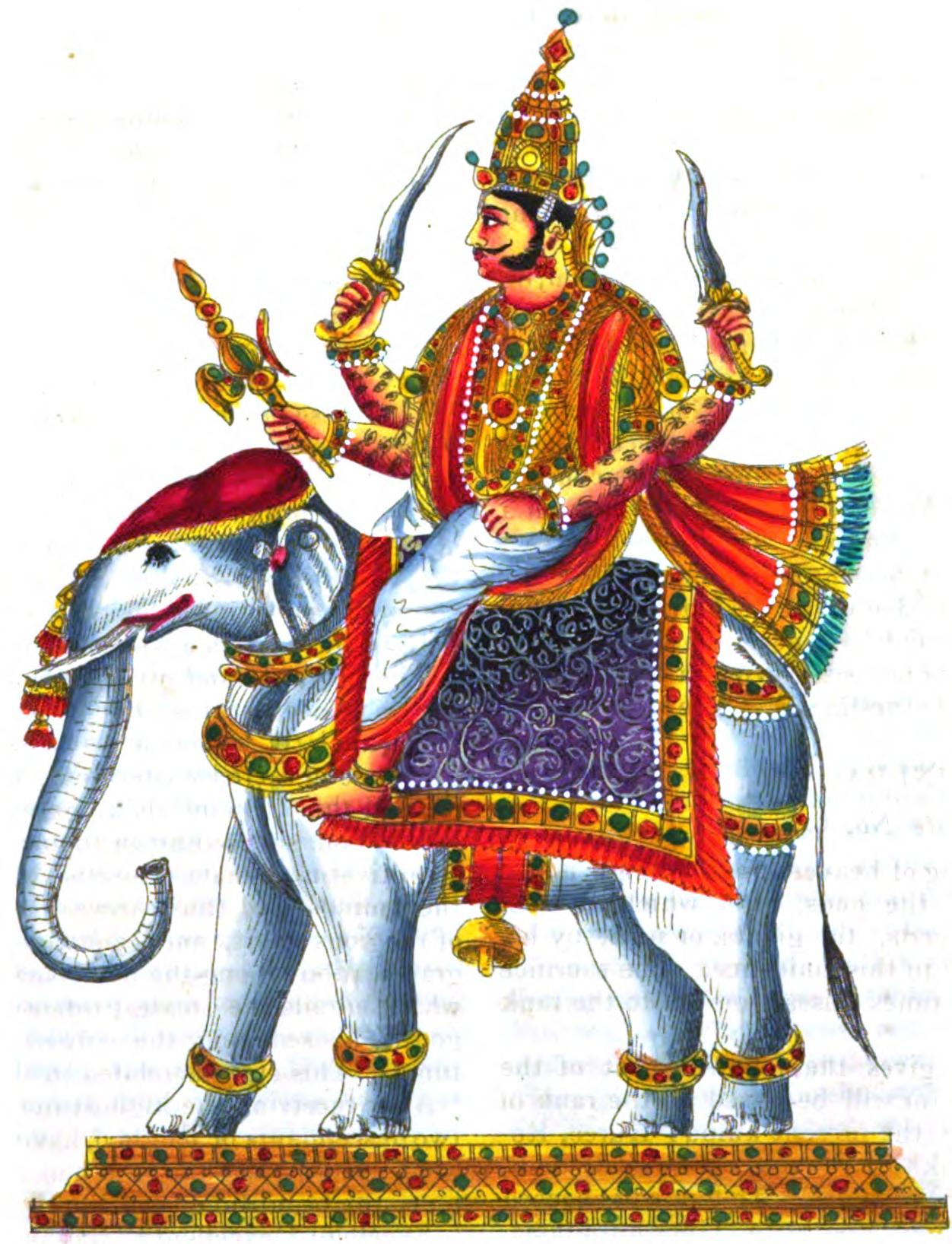
The Rigveda has four quarters, occasionally five, described in body words, with no deity assigned to any of them. By the Brāhmaṇa period the quarters have acquired a classification: gods east, Fathers south, and a dense set of ritual rules about which side of the altar a given act belongs on. Jan Gonda traced how the Vedic vocabulary of place and world hardened into a cosmological architecture over this period, and Michael Witzel showed how the ritual geography of the path to heaven was mapped onto it. [7] [8] By the time of the Purāṇas and the temple manuals, each of eight directions has a named guardian, a dikpāla, with Indra in the east and Yama in the south, and a temple’s outer wall carries their images on the faces they govern.
timeline
    title The quarters, from body words to guardian gods
    Rigveda : four pradiśaḥ, once five : named by front, back, up, down
    Brahmanas : quarters classified : gods east, Fathers south
    Puranas and Shilpa texts : eight dikpalas : a deity posted to each side
Figure 2. The nine-square pīṭha maṇḍala, the simplest of the grid plans in which later Indian architecture fixed the directions and assigned each cell to a power (image reproduced from Wikimedia Commons, File:9 Grid Pitha Mandala Hindu Temple Floor Plan Vastu Purusa Mandala Architecture.svg, CC BY-SA 4.0). The Rigveda has no grid. It has a person, facing the sunrise.
The vocabulary hardened too. Paścimā arrives as a plain word for “west,” and uttara and dakṣiṇa settle into “north” and “south” with the body sense receding into the background, surviving mostly in fossils. Two of those fossils are on any modern map of India: Uttar Pradesh is the “upper” province, and the Deccan plateau takes its name, through Prakrit dakkhiṇa, from the right hand of a person facing the sunrise several thousand years ago.
What Is Actually Being Claimed
Three summary positions, with their confidence levels attached.
The lexical claim is solid. The Rigveda names the quarters with words whose primary sense is bodily and postural, and the classical cardinal vocabulary is either absent from the text or present in a non-cardinal meaning. This can be checked by anyone with a searchable Saṃhitā and an afternoon.
The orientational claim is strong but inferential. The ritual is laid out eastward, the Dawn is the standard of not getting the quarters wrong, and pradakṣiṇa only makes sense if right equals sunwise. Independently, Old Irish made the same right-equals-south equation. Together these point clearly to an inherited habit of facing the sunrise, though no Rigvedic verse states the rule outright.
The cognitive claim should be held loosely. Stephen Levinson’s fieldwork established that languages differ deeply in whether they locate things by an absolute frame, by the speaker’s body, or by an object’s own facets, and that these differences track differences in how speakers remember and reason. [9] It is tempting to file the Rigveda under “relative frame, ego-centred” and draw conclusions about how its poets thought. But Levinson’s categories were built from experiments with living speakers who could be asked to arrange objects on a table, and the Rigvedic poets are not available for testing. What survives is a poetic register, already formulaic, already archaic when it was fixed. It tells us how the language of a ritual elite encoded space. It does not tell us how a herdsman found his way back at dusk.
That last limit is worth sitting with rather than regretting, because the thing that does survive is more specific than a theory of cognition. It is a posture. Somebody is standing on a plain in the Punjab before sunrise, facing the place where the light will come from, with the high ground on the left and the offering grass laid out in front, and their entire vocabulary for where anything is in the world radiates outward from that stance. The words for the world’s four sides are the words for the four sides of that person.
Read the four-fold formula in RV 10.36.14 out loud, standing up, facing east, and let the four words fall where they point: paścātāt, purastāt, uttarāttāt, adharāttāt. Behind, in front, above, below. It is not a translation exercise. It is the arrangement the verse was built to describe, and it works better with a body in it. Then read the Nadīstuti, the river hymn that names the waters of the northwest in geographic order, and notice that even there, with real rivers and real terrain to work from, the poet is not drawing a map. He is walking, and listing what he passes.
References
Bodewitz, H. W. ‘The Dark and Deep Underworld in the Veda.’ Journal of the American Oriental Society 122, no. 2 (2002): 213-223. [5]
Geldner, Karl Friedrich. Der Rig-Veda aus dem Sanskrit ins Deutsche übersetzt. Harvard Oriental Series 33-36. Harvard University Press, 1951-1957.
Gonda, Jan. Loka: World and Heaven in the Veda. Verhandelingen der Koninklijke Nederlandse Akademie van Wetenschappen, Afd. Letterkunde. Amsterdam: N.V. Noord-Hollandsche Uitgevers Maatschappij, 1966. archive.org. [7]
Griffith, Ralph T. H. The Hymns of the Rigveda. 2nd ed. Benares: E. J. Lazarus, 1896. sacred-texts.com.
Jamison, Stephanie W., and Joel P. Brereton. The Rigveda: The Earliest Religious Poetry of India. 3 vols. Oxford University Press, 2014.
Levinson, Stephen C. Space in Language and Cognition: Explorations in Cognitive Diversity. Cambridge University Press, 2003. [9]
Macdonell, Arthur A. Vedic Mythology. Strassburg: Karl J. Trübner, 1897. archive.org.
Macdonell, Arthur A., and Arthur B. Keith. Vedic Index of Names and Subjects. 2 vols. London: John Murray, 1912. archive.org.
Mallory, J. P., and D. Q. Adams. The Oxford Introduction to Proto-Indo-European and the Proto-Indo-European World. Oxford University Press, 2006. [3]
Mayrhofer, Manfred. Etymologisches Wörterbuch des Altindoarischen. 3 vols. Heidelberg: Carl Winter, 1992-2001. [2] [4]
Núñez, Rafael E., and Eve Sweetser. ‘With the Future Behind Them: Convergent Evidence From Aymara Language and Gesture in the Crosslinguistic Comparison of Spatial Construals of Time.’ Cognitive Science 30, no. 3 (2006): 401-450. Wiley. [6]
Oldenberg, Hermann. Die Hymnen des Rigveda, Band I: Metrische und textgeschichtliche Prolegomena. Berlin: Wilhelm Hertz, 1888. archive.org.
Renou, Louis. Études védiques et pāṇinéennes. 17 vols. Paris: Institut de Civilisation Indienne, 1955-1969.
Watkins, Calvert. The American Heritage Dictionary of Indo-European Roots. 3rd ed. Boston: Houghton Mifflin Harcourt, 2011. [1]
Wilson, Horace Hayman. Ṛig-Veda Sanhitā: A Collection of Ancient Hindu Hymns. 6 vols. London: W. H. Allen, 1850-1888.
Witzel, Michael. ‘Sur le chemin du ciel.’ Bulletin des Études Indiennes 2 (1984): 213-279. [8]
Witzel, Michael. ‘Tracing the Vedic Dialects.’ In Dialectes dans les littératures indo-aryennes, edited by Colette Caillat, 97-265. Paris: Collège de France, 1989.
Comments (0)
No comments yet. Sign in to start the discussion.