Metal Jaws, No Statues: The Rig Veda's Imageless Gods
One Word for Image, and It Means Counterweight
Search the Rig Veda for an idol and you get exactly one hit, and it is the wrong kind. The word is pratimā (प्रतिमा), which in most modern Indian languages means a sacred image: the figure that stands in a shrine and is bathed, dressed, garlanded and fed. In the roughly ten and a half thousand verses of the Śākala text the noun occurs once, in a late hymn that asks how the very first sacrifice was assembled, and there it is a term of measurement.
kā́sīt pramā́ pratimā́ kíṃ nidā́nam ā́jyaṃ kím āsīt paridhíḥ ká āsīt
“What were the rule, the order and the model? What were the wooden fender and the butter?”
Rigveda 10.130, verse 3, translation Griffith (1896). [1] The line is a list of the technical components of a rite: pramā́, measure; pratimā́, the counter-measure taken against it; nidā́na, the base.
Everywhere else in the collection the related stem pratimā́na turns up in fourteen verses and means a counterweight, a match, an equal; the verb behind both, prati-mā, is “to measure one thing against another”, and it is used that way at RV 3.60.4 of deeds nobody can match. No god is ever said to have one. “He has no foe, no counterpart,” the poet says of Indra at RV 6.18.12. That is what the word was for.
The other candidates do not appear at all. Mūrti, the ordinary modern word for a divine image, is absent. So is mandira and so is any compound meaning a god’s house. There is no word in the hymns for temple or shrine, and the verb pūj, which gives the name of nearly every Hindu rite performed today, shows up once, inside a compound epithet at RV 8.17.12, and never as the name of an act.
This is a strange result, because the Rig Veda is not shy about what its gods look like. It gives them hands, jaws, tongues, braided hair, oiled faces, lips and bellies, in lines of real descriptive pressure. A tradition that would later cover a subcontinent in carved divinity spent its first several centuries describing bodies in the most minute detail and building none of them. What follows is an attempt to take that absence seriously: what the poets did instead, what they put on the ritual ground in place of a figure, what they said about people who seem to have worshipped an object, and how long it took before anyone in India made a god you could look at.

A Catalogue of Faces
Begin with the descriptions, because they are better than their reputation. Savitṛ, the god of the impelling sun, rises towards evening in a verse that gives him three physical features in six words:
úd u ṣyá deváḥ savitā́ damū́nā hiraṇyapāṇíḥ pratidoṣám asthāt | ayohanúr yajató mandrájihva ā́ dāśúṣe suvati bhū́ri vāmám
“This Savitar the God, the golden-handed, Friend of the home, hath risen to meet the twilight. With cheeks of brass, with pleasant tongue, the Holy, he sends the worshipper rich gifts in plenty.”
Rigveda 6.71, verse 4, translation Griffith (1896). [1] Ayohanú is literally “metal-jawed”, from áyas, the copper or bronze of the Rigvedic world; mandrájihva, “with a pleasing tongue”.
Golden hands, metal jaws, a pleasant tongue. Griffith’s “cheeks of brass” softens it; the compound says jaw, and the material is the hard, bright metal the poets knew from weapons and ornaments. [2] Try to sculpt that figure and you have a problem at once, because the three features belong to three different registers: the hands are the sun’s rays, the jaws are the metallic glare, the tongue is the kindness of a patron. Language can hold them in one line. Stone has to choose.
| Deity | Body detail | Sanskrit epithet | Verse |
|---|---|---|---|
| Savitṛ | golden hands, metal jaws, pleasing tongue | hiraṇyapāṇi, ayohanu, mandrajihva | RV 6.71.4 |
| Savitṛ | golden-handed, moving between earth and sky | hiraṇyapāṇi | RV 1.35.9 |
| Rudra | braided hair, ruddy, the boar of heaven | kapardin | RV 1.114.5 |
| Agni | face bright with melted butter | ghṛtapratīka | RV 1.143.7 |
| Indra | lips or helm, and the jaws behind them | śipriṇ | RV 10.105.5 |
| An unnamed “youthful one” | four braids, oiled, shapely | catuṣkapardā, ghṛtapratīkā | RV 10.114.3 |
Two things are worth noticing about that list. The first is that the epithets are stable, repeated, formulaic: Savitṛ is golden-handed in six separate verses, and the compound survives into later Sanskrit as a name. These are not improvisations but the fixed features of a face the tradition carried for centuries.
The second is that the faces never settle into one figure. Inside the eight verses of RV 1.143, Agni has beams that never age and a lovely face, then jaws sharpened to chew up trees the way a warrior cuts down enemies, then a face bright with melted butter, then a radiant glance. These are not four moods of a single portrait. They are four different things made of fire. Arthur Macdonell, who catalogued this material more carefully than anyone before him, concluded that Vedic anthropomorphism is in many cases “only incipient”, because the natural phenomenon behind the god keeps showing through the human shape. [3] That is usually read as a limitation. Read from the other end it is a capability. A verbal god can be a bird and a bull and a jaw of bronze in the same breath, and the listener holds all three. The moment you carve it, you have thrown two of them away.
Who Has Ever Seen Him?
The Rig Veda is perfectly aware that this raises a problem, and in one hymn it says so out loud. A poet of the eighth Mandala, in the middle of an otherwise ordinary invitation to Indra, reports an objection:
néndro astī́ti néma u tva āha ká īṃ dadarśa kám abhí ṣṭavāma
“‘There is no Indra,’ so some say. Who has ever seen him? Whom are we to praise?”
Rigveda 8.100, verse 3, my rendering. Griffith’s numbering of the eighth Mandala differs from the Saṃhitā’s, so the translations quoted elsewhere here cannot be matched to it verse for verse.
The challenge is specifically visual: not who has met him, not who has been helped by him, but ká īṃ dadarśa, who has seen him. The reply, in the next verse, is a voice:
ayám asmi jaritaḥ páśya méhá víśvā jātā́ny abhy asmi mahnā́
“Here I am, singer. Look at me, here. In greatness I surpass everything that has been born.”
Rigveda 8.100, verse 4, my rendering.
That is the whole Rigvedic answer to divine invisibility, and it concedes almost nothing. The god does not appear. He speaks, in the first person, inside the hymn, and the imperative he uses is páśya, look. The demand to see is answered by an utterance that claims to be the seeing. The unbelievers in that hymn have an article of their own; what matters here is the shape of the reply.
The same logic governs a formula that appears twice in contexts no one would think to connect. When the priests strew the ritual grass, two separate hymns describe the result as a place where a god becomes perceptible:
stṛṇīta barhir ānuṣag ghṛtapṛṣṭhaṃ manīṣiṇaḥ | yatrāmṛtasya cakṣaṇam
“Strew, O ye wise, the sacred grass that drips with oil, in order due, Where the Immortal is beheld.”
Rigveda 1.13, verse 5, translation Griffith (1896). [1] Cakṣaṇa, from the root cakṣ, to look: the beholding, the appearing to sight.
At RV 1.170.4 the parallel line runs tatrāmṛtasya cetanaṃ, “there is the perceiving of the immortal”, at a spot where the altar has just been made ready and the fire kindled in front. The Rig Veda does locate the sight of a god. It locates it on a patch of cut grass, in the presence of fire, at the moment speech begins. The place is real, the seeing is asserted, and there is nothing there to look at.
Where the God Sat
So what was on that ground? A scooped hollow called the vedi; a layer of grass, barhis, cut and spread and sprinkled with ghee; a fire; the equipment for pressing and pouring. That is the whole inventory, and the hymns are full of instructions about it. “Let them prepare the altar, let them kindle fire in front,” says RV 1.170.4. The grass turns up in 186 verses, which in a collection of 1,028 hymns makes it one of the most frequently named objects in Vedic religion, and gives it a companion piece of its own. It is the furniture.
The gods are then asked to come, and to sit:
ā́ no barhī́ riśā́daso váruṇo mitró aryamā́ | sī́dantu manuṣo yathā
“Here let the foe-destroyers sit, Varuṇa, Mitra, Aryaman, Like men, upon our sacred grass.”
Rigveda 1.26, verse 4, translation Griffith (1896). [1]
Manuṣo yathā, in the manner of men. The gods are being asked to behave, for the duration of the rite, like human guests at a human meal: to arrive, to take a seat on the floor covering, to eat, to be praised and thanked, and to go. Imperatives of coming are among the commonest things in the book. A scan of the romanised text finds ā́ gahi, “come here”, in close to sixty verses and ā́ yāhi, “drive here”, in about as many again, with the sitting verbs scattered through several dozen more. The Rigvedic god is in motion almost by definition; what the ritual provides is an address, a chair and a meal, for one afternoon.
Methods note. The counts here come from regular-expression searches over a digitised romanisation of the Śākala Saṃhitā, with each result class spot-checked by hand against Griffith. They are floors, not censuses: a form hidden inside a compound will have escaped. For numbers that will survive a referee, Grassmann’s 1873 Wörterbuch lists every occurrence of every stem, and Lubotsky’s concordance does the same for every word form. [2] [4] The eighth Mandala needs care, because Griffith numbers its hymns differently from the Saṃhitā.
Nothing in that arrangement is built to last, and the tradition kept it that way for a very long time. When Nambudiri Brahmins performed the Agnicayana at Panjal in Kerala in April 1975, filmed by Robert Gardner and Frits Staal and documented by Staal in two volumes, the central act of the twelve-day rite was the construction of a bird-shaped altar out of a thousand bricks, laid in five layers. [5] It was built for that performance. The Smithsonian’s catalogue record of the footage notes that the film ends with the ceremonial burning of the ritual compound. [6] Three thousand years after the hymns, the most elaborate surviving Vedic ritual still ends by setting fire to its own architecture and walking away.
Objects, Yes. Likenesses, No.
Here an objection needs answering, because the Rig Veda is in fact crowded with sacred things. It addresses hymns to the mortar and the pressing stones, to a war drum, to a bow and its string, to the sacrificial post, to the doors of the ritual enclosure. The stones that crush the soma stalks are not merely used; they are praised, and in one hymn they speak.
| Hymn | Addressee | What it is |
|---|---|---|
| RV 1.28 | the mortar and the pressing stones | kitchen and workshop equipment |
| RV 10.94, RV 10.175 | the press-stones, grāvāṇaḥ | stones that are said to sing |
| RV 6.75 | the weapons of war | bow, bowstring, quiver, armour, whip |
| RV 6.47.29 to 31 | the battle drum | an instrument addressed as a power |
| RV 3.8 | the sacrificial post, yūpa | a tree felled, dressed, anointed, raised |
| RV 2.3 and the Āprī hymns | the grass, the doors, Night and Dawn | the fittings of the rite, invoked in fixed order |
So the distinction here is not between a spiritual religion and a material one. These poets will sing to a bowstring, and the bowstring whispers like a woman at RV 6.75.3; the pressing stones get a workshop of their own, and the doors of the enclosure are goddesses in the Āprī litanies.
What is missing is narrower and more interesting than “objects”. It is the likeness: an object made to stand for a god, whose point is resemblance. The mortar is holy because it works. The post is holy because it was cut and raised with the right words. Neither is a picture of anything. In the whole collection no verse asks a god to enter a made form, and no verse describes anyone looking at one. The Rigvedic ritual sacralises instruments, not representations, and that is a real distinction rather than a convenient one.
Two Insults
Twice, and only twice, the Rig Veda uses a word that looks like a reference to someone else’s god being a thing. The word is śiśnadeva, and both occurrences are curses.
mā́ śiśnádevā api gur ṛtáṃ naḥ
“Let not the lewd approach our holy worship.”
Rigveda 7.21, verse 5, translation Griffith (1896). [1] Literally, “let not the śiśna-gods come near our rite”.
Śiśna means penis. The compound therefore reads, on its face, “those whose god is a phallus”, and that is how most modern translators take it. A second word, mūradeva, appears three times in hymns against sorcerers, and the early European translators rendered it along the lines of “fools’ gods” or “worshippers of foolish gods”.
| Verse | Word | Griffith (1896) | Other readings |
|---|---|---|---|
| RV 7.21.5 | śiśnadevāḥ | “the lewd” | literally “whose god is a phallus”; Sāyaṇa: the incontinent |
| RV 10.99.3 | śiśnadevān | “the lustful demons” | as above; the enemy Indra kills by a varpas, a guise |
| RV 7.104.24 | mūradevāḥ | “the fools’ gods” | reported suggestion: “whose god is fixed in place”, hence an idol |
| RV 10.87.2 | muradevān | “the foolish gods’ adorers” | as above |
| RV 10.87.14 | mūradevān | “the foolish gods’ adorers” | as above |
For a century these five verses carried a heavy interpretive load. If śiśnadeva means phallus-worshippers, the poets were looking across a frontier at a cult of the liṅga, and the obvious candidate is the Indus civilisation whose cities had fallen into ruin not long before. A. C. Das’s suggestion about mūradeva, that it named the god who stands fixed in one place, was offered in the same spirit: here, at last, was the Rig Veda noticing idols. [7]
Both readings are weaker than they look. Śiśnadeva occurs in hymns to Indra, surrounded by yātudhāna sorcerers, flesh-eating demons and night-creatures, not by neighbouring peoples with temples. A 2025 study in Vestnik drevnei istorii argues precisely this: that the mythological company the word keeps makes the “phallus-worshippers” reading implausible, and that the śiśnadevāḥ are better understood as mythical beings who defile the sacrifice. (The article is paywalled and I have read only its abstract, which is why it is not in the reference list below.) Sāyaṇa, commenting in the fourteenth century with far more of the living tradition in front of him than anyone has now, read the word as “licentious” and said nothing about images at all. Mūradeva is just as murky; the word belongs to the Rigveda’s stock of terms nobody can translate with confidence.
What survives the deflation is still worth having. Whatever the śiśnadevāḥ were, the poets could form the insult: a compound whose structure is “X is their god”, applied to something a god ought not to be. The category “a god that is the wrong kind of thing” was available to them. They simply never applied it to a statue, because there do not appear to have been any.
Aside. This is an argument from absence, and such arguments fail often. A word can be missing from a text whose speakers used the thing daily; the Rig Veda has no word for west, as a companion piece sets out, and its poets plainly knew where the sun set. The reason the case for aniconism is stronger than that is convergence: no vocabulary for image or shrine, no rite that needs one, no verse that mentions looking at one, and no archaeology of Vedic cult sculpture anywhere. Four kinds of silence, all pointing the same way, is a different thing from one gap in a word list.
The Imageless Cousins
The Rigvedic poets were not the only Indo-Iranian speakers with nothing in their sanctuary. Around 430 BCE Herodotus described Persian practice with some astonishment, in a passage usually cited as 1.131: the Persians, he says, think it unlawful to set up images, temples or altars, and consider those who do so foolish, because they do not suppose the gods to be in the likeness of men. [8] His account has been picked over since, and Achaemenid religion had sacred architecture of its own, but the asymmetry he noticed is real: the Iranian branch of the family also worshipped at fire, in the open.
Arthur Berriedale Keith, surveying the whole field in 1925, put it plainly: apart from the latest stratum of Vedic literature, idols are not recognised in the cult, and Vedic religion is normally aniconic. [9] He also noted that no evidence suggests the Indo-Europeans used images, and that the clear signs of image worship in India appear later, in the epic and in Greek reports from the Mauryan court.
Here is what most popular accounts get backwards. This is not a prohibition. Nobody in the Rig Veda forbids images or expresses the slightest anxiety about them. There is no Vedic iconoclasm, because iconoclasm requires icons to break. The hymns display not a doctrine of the imageless but a practice in which the question never comes up, which is a rarer condition.
The Word That Became a Prohibition
The question does come up later, and when it does, it comes up in the vocabulary we started with. In the thirty-second chapter of the White Yajurveda, at Vājasaneyi Saṃhitā 32.3, stands a line that has done two centuries of hard polemical labour: ná tásya pratimā́ asti, “there is no pratimā of him, whose name is great glory”. [14]
Nineteenth and twentieth-century reformers, the Arya Samaj most prominently, read that as scripture against idolatry: the Veda itself says God has no image. Defenders of temple worship replied that the verse means God has no equal. Both camps are still citing it.
The philology does not settle who should win, but it does something better: it shows where the ambiguity comes from. In the Rig Veda, as we have seen, this stem means a match, a counterweight, an equal; Indra has no pratimāna, and neither does the hero of RV 4.18.4, who has no peer among those born or yet to be born. The sense “likeness” that makes the Yajurvedic line sound like a ban on statues is attested later, as image worship itself becomes a live practice and the word is pressed into service to describe it. A line composed when pratimā probably still meant “counterpart” has been read for two hundred years as if it meant “statue”, by people on both sides of a dispute the poets could not have had.
Aside. A word for an idea that has not arrived yet tends to be recruited from somewhere. Pratīka, which in the Upaniṣads names an emblem used as a support for meditation, occurs in 32 Rigvedic verses meaning simply “face” or “front”: Agni’s ghṛtapratīka, the butter-face. The vocabulary of Indian image worship is largely built out of Rigvedic parts that originally did other jobs, which is a pattern this blog keeps running into, in māyā, in rasa and in tanū́.
Guest or Householder
The deeper difference between Vedic and temple worship is not the presence of a figure. It is the direction of travel.
In the hymns, the human party prepares a site, lights a fire, spreads grass and calls. The god travels. He arrives by chariot, sits like a man, drinks, is praised, and leaves; the site is dismantled or abandoned. The whole grammar of the rite is the grammar of hospitality, which is why the Rigveda’s language for receiving a god and its language for receiving a stranger are the same language, and why homage itself is described as something carried and delivered.
In the temple, the deity is the one with the address. The image is installed, woken in the morning, bathed, dressed, fed several times a day, entertained, and put to bed; the worshipper is the one who travels, who comes to the door, who waits for the curtain to open and takes darśan, the sight of the god, which Diana Eck rightly treats as the central act of the whole system. [10] The courtesies look similar because they descend from the same hospitality etiquette. The householder has changed places.
graph TD
    A[Rigvedic rite] --> B[Humans clear ground and strew grass]
    B --> C[God is called and travels in]
    C --> D[God seated like a guest, fed, praised]
    D --> E[God departs, site abandoned]
    F[Temple worship] --> G[God resident in an image]
    G --> H[Worshipper travels and arrives]
    H --> I[God bathed, dressed, fed, shown]
    I --> J[Worshipper departs, god stays]
The vocabulary follows the move. The Rigvedic rite is yajña, a word that turns up in over five hundred verses and means the offering, the act, the work. The temple rite is pūjā, a word with no Rigvedic career at all and, as Jarl Charpentier argued in 1927, quite possibly no Indo-Aryan ancestry either; he looked to Dravidian for it, in roots to do with flowers or with smearing. [11] His etymology has never been settled. But the shape of the problem is suggestive: the central act of modern Hindu worship is named by a word the Veda did not use.
How the Gods Got Stone Bodies
Between the last Rigvedic hymns and the first surviving Indian cult image lies a gap in which something decisive happened and almost nothing was preserved. The surviving objects allow this much of a sequence.
timeline
    title From hymn to housed image
    1500 to 1000 BCE : Rigvedic hymns : no images, no shrines
    c. 150 BCE : Parkham yaksha : colossal cult statue
    c. 113 BCE : Besnagar pillar : dedication to Vasudeva
    2c BCE to 3c CE : Gudimallam linga : date disputed
    c. 425 CE : Sanchi Temple 17 : a god with a house
The colossal yakṣa figures of the Mathura region, Parkham among them, are among the earliest large stone images of divine beings to survive anywhere in India, and the beings they depict are not Vedic gods. [12] The yakṣas belong to a stratum of Indian religion the hymns barely acknowledge: local powers of place, trees, water and wealth. Whatever drove Indians to start carving gods, it did not start with Indra.

The Besnagar pillar makes the same point from the epigraphic side. The god honoured there is Vāsudeva, who will become Kṛṣṇa and be folded into Viṣṇu, a Rigvedic deity with a modest six hymns and a long career ahead of him. The gods who got images were, with striking regularity, the ones the Rig Veda had least to say about. The partial exception, Rudra, was always a little outside the main rite.
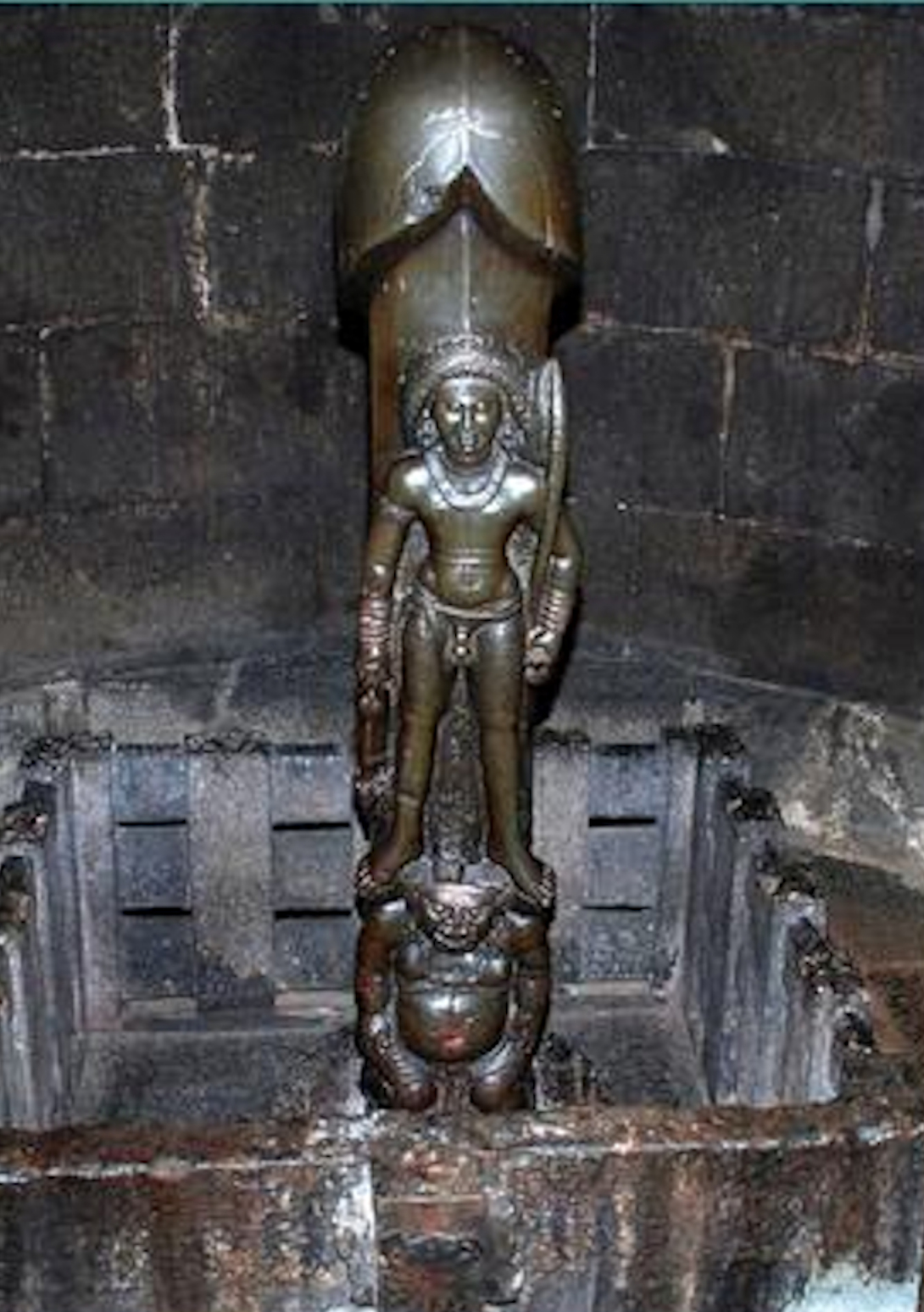
Dating these objects is genuinely hard, and the Gudimallam liṅga is the standard illustration of why. J. C. Harle called it the only sculpture of any importance to survive from ancient South India before the Pallavas, and noted that nothing comparable is known for hundreds of miles in any direction. [13] An object with no neighbours is an object with no stylistic context, which is why its proposed dates span half a millennium. The honest summary is that cult images are securely present in India by the second century BCE, that the earliest ones are yakṣas and liṅgas rather than Vedic deities, and that durable temple buildings for a resident god come later still: the small flat-roofed shrine known as Temple 17 at Sanchi, built around the early fifth century CE, is usually called the oldest surviving complete Hindu temple.
That is roughly a thousand years after the youngest Rigvedic hymns. And the Vedic rite itself never converted. The śrauta ritual as it is still performed, at Panjal in 1975 and in the handful of performances since, uses no image at all. The two systems did not replace one another; they ran in parallel, and the older one simply declined to acquire a face.
What the Hymns Were For
Put together, the Rigvedic position stops looking like an absence at all.
These poets were image-makers of a high order. They built their gods out of fixed epithets, refined over generations into figures of extraordinary specificity: golden hands, metal jaws, braided hair, a face shining with butter, a voice that says look at me. The images were portable, infinitely reproducible, impossible to steal or deface, and they lived in the only medium the tradition fully trusted. This is a culture that built an elaborate error-correcting apparatus for its sound and none at all for its objects. The sound was where the gods were kept.
Which also explains the calm with which later Hinduism took up images and kept the hymns anyway. There was no doctrine to overturn and no commandment against likeness. A religion that had located the sight of the immortal on a patch of strewn grass could locate it in carved stone without contradiction, because what it had committed to was the seeing, not the thing seen.
Read RV 6.71 aloud, then try to draw Savitṛ: golden hands, metal jaws, a pleasing tongue, rising at dusk to send good things to whoever has been generous. You will find that you cannot, and that the failure is not yours. Then read RV 1.13, which takes twelve short verses to prepare a seat for gods who will not be visible, and notice how confidently its fifth verse names the spot where the immortal is beheld. For the furniture of that scene there are companion pieces on the grass itself, on the house the Rigveda never describes, and on the one Rigvedic god whose formlessness is stated outright.
References
Griffith, Ralph T. H. The Hymns of the Rigveda. 2nd ed. Benares: E. J. Lazarus, 1896. sacred-texts.com.
Grassmann, Hermann. Wörterbuch zum Rig-Veda. Leipzig: F. A. Brockhaus, 1873. The standard dictionary-concordance for checking the occurrences and senses of a Rigvedic stem.
Macdonell, Arthur A. Vedic Mythology. Strassburg: Karl J. Trübner, 1897. archive.org. The catalogue of divine attributes and the judgement that Vedic anthropomorphism is frequently incipient.
Lubotsky, Alexander. A Ṛgvedic Word Concordance. 2 vols. New Haven: American Oriental Society, 1997.
Staal, Frits, ed. Agni: The Vedic Ritual of the Fire Altar. 2 vols. Berkeley: Asian Humanities Press, 1983. Documentation of the Agnicayana performed at Panjal, Kerala, in April 1975.
Human Studies Film Archives, Smithsonian Institution. The Agnicayana Ritual in India, collection record HSFA.1976.02, footage by Robert Gardner and Frits Staal, edited as the film Altar of Fire. sova.si.edu.
Das, Abinas Chandra. Rig-Vedic India. Calcutta: University of Calcutta, 1921. Cited here second-hand, for the suggestion that mūradeva denotes a fixed, that is to say an installed, god; the reading has not been generally accepted.
Herodotus. Histories 1.131, trans. G. C. Macaulay. lexundria.com.
Keith, Arthur Berriedale. The Religion and Philosophy of the Veda and Upanishads. Harvard Oriental Series 31 to 32. Cambridge, MA: Harvard University Press, 1925. archive.org.
Eck, Diana L. Darśan: Seeing the Divine Image in India. 3rd ed. New York: Columbia University Press, 1998.
Charpentier, Jarl. ‘The Meaning and Etymology of Pūjā.’ Indian Antiquary 56 (1927): 93 to 99.
Quintanilla, Sonya Rhie. History of Early Stone Sculpture at Mathura, ca. 150 BCE to 100 CE. Leiden: Brill, 2007.
Harle, J. C. The Art and Architecture of the Indian Subcontinent. 2nd ed. New Haven: Yale University Press, 1994.
Griffith, Ralph T. H., trans. The Texts of the White Yajurveda. Benares: E. J. Lazarus, 1899. sacred-texts.com. The source of the much-quoted line at Vājasaneyi Saṃhitā 32.3.
Gopinatha Rao, T. A. Elements of Hindu Iconography. 2 vols. Madras: Law Printing House, 1914 to 1916.
Jamison, Stephanie W., and Joel P. Brereton, trans. The Rigveda: The Earliest Religious Poetry of India. 3 vols. Oxford: Oxford University Press, 2014.
Macdonell, Arthur A., and Arthur B. Keith. Vedic Index of Names and Subjects. 2 vols. London: John Murray for the Government of India, 1912. archive.org.
Gonda, Jan. Vedic Ritual: The Non-Solemn Rites. Handbuch der Orientalistik. Leiden: Brill, 1980.
Davis, Richard H. Lives of Indian Images. Princeton: Princeton University Press, 1997.
Srinivasan, Doris. Many Heads, Arms and Eyes: Origin, Meaning and Form of Multiplicity in Indian Art. Studies in Asian Art and Archaeology 20. Leiden: Brill, 1997.
Oldenberg, Hermann. Die Religion des Veda. Berlin: Wilhelm Hertz, 1894. archive.org.
Witzel, Michael. ‘The Development of the Vedic Canon and its Schools: The Social and Political Milieu.’ In Inside the Texts, Beyond the Texts, ed. Michael Witzel. Harvard Oriental Series, Opera Minora 2. Cambridge, MA: Harvard University, 1997, pp. 257 to 345. On the late position of the hymns in the tenth Mandala, including RV 10.130.
Comments (0)
No comments yet. Sign in to start the discussion.