Who Has Ever Seen Him? The Rig Veda's Own Unbelievers
A Sentence That Should Not Have Survived
Three verses into the hundredth hymn of the eighth book, the praise poetry stops and lets someone else talk.
pra su stomaṃ bharata vājayanta indrāya satyaṃ yadi satyam asti | nendro astīti nema u tva āha ka īṃ dadarśa kam abhi ṣṭavāma
“Striving for strength bring forth a laud to Indra, a truthful hymn if he in truth existeth. One and another say, There is no Indra. Who hath beheld him? Whom then shall we honour?”
RV 8.100.3, translation Griffith (1896) [1]
Read the third quarter of that verse again in the Sanskrit. Nendro astīti, “Indra is not,” is a complete sentence of denial, quoted verbatim, sitting inside a hymn addressed to Indra. Nobody had to keep it. The Rigvedic transmission system was built for exactness rather than for editing, and it worked: the collection was carried by families who could recite it forwards, backwards and in interlocking permutations, a technology of memory so severe that scribes centuries later were copying what reciters had already frozen [2]. That machinery preserved the objection along with the answer, and it preserved the question that follows it, which is the harder one. Ka īṃ dadarśa. Who has seen him?
The question is fair. Indra is the most talked-about figure in the Rig Veda and one of the least visible. Roughly a quarter of the collection is addressed to him. He splits mountains, releases rivers, breaks forts, drinks industrially. None of that is available to inspection at the moment the hymn is being sung, and the singer is asking a patron to spend real cattle on a rite whose beneficiary cannot be produced on demand.
What makes this worth an afternoon is not the sceptical line by itself. It is that the Rig Veda answers it, repeatedly, in several different registers, and that the answers are strange. The poets do not argue that Indra exists. They do something else, and the something else tells you more about how this religion actually worked than any doctrinal statement in the collection.
The Hymn That Hands the Microphone to a Stranger
RV 8.100 is a dialogue hymn, one of that small set in which the Rig Veda drops third-person praise and stages speakers instead. The tradition heard the god and the poet trading lines here; the classical index of authors and deities assigns the hymn jointly to Indra and to Vāc, Speech herself, who takes it over at the end [3].
It opens with a bargain, not a hymn. Someone speaks in the first person and offers terms.
“I come to you in my own body, in front; all the gods come after me, behind. When you hold fast my share, then with me you will do heroic deeds.”
RV 8.100.1, author’s rendering from the Sanskrit; compare Griffith (1896) [1]
The second verse answers in kind: the share of honey is set aside, the soma is pressed, the two parties will stand on each other’s right in battle. This is contract language, the mutual bind of sakhya, comradeship, which the Rig Veda uses for the relation between a man and a god as readily as between two men.
Then verse 3 arrives and the floor is taken by people who are not part of the contract at all. Then verse 4 answers them, and the voice that answers is the god’s.
ayam asmi jaritaḥ paśya meha viśvā jātāny abhy asmi mahnā
“Here am I, look upon me here, O singer. All that existeth I surpass in greatness.”
RV 8.100.4, translation Griffith (1896) [1]
An epiphany, delivered on cue, in reply to a demand for evidence. And it is worth noticing what kind of evidence it is not. Indra does not produce a proof or a sign in the sky. He says paśya mā iha, look at me here, in the place where the hymn is being performed, which is to say: the god appears where the ritual is, and the demand to see him is met by the ritual itself. The next verse turns inward again, and the reply now comes from inside the poet:
“When the seers of truth had climbed up to me, as I sat alone on the back of the beloved (sky), my own mind answered back from my heart: my friends have cried out to me, together with their children.”
RV 8.100.5, author’s rendering; compare Griffith (1896) [1]
Whose mind, whose heart? Translators have gone both ways, because the boundary between the god speaking and the poet speaking is exactly what a dialogue hymn is designed to blur. Read the sequence as a whole and the shape of it becomes clear.
| Verse | Speaking | Move |
|---|---|---|
| 8.100.1 | The god (or his advocate) | Offers a contract: my share, your heroism |
| 8.100.2 | The sacrificer | Accepts: honey, soma, alliance in battle |
| 8.100.3 | The poet, quoting outsiders | “Indra is not. Who has seen him?” |
| 8.100.4 | Indra | “Here I am, singer. Look at me here.” |
| 8.100.5 | The poet, or the god through him | The answer comes from the heart, not the sky |
| 8.100.6 | The poet | Back to third person: recount the old deeds |
| 8.100.10-12 | Vāc and the poets | Speech is born, and the gods generate her |
graph TD
    A[Contract offered] --> B[Contract accepted]
    B --> C["Objection quoted: 'Indra is not'"]
    C --> D["God replies: 'Look at me here'"]
    D --> E[Answer heard in the heart]
    E --> F[Deeds recited again]
    F --> G[Speech herself takes over]
The doubt is not an interruption of the hymn. It is a load-bearing beam. Remove verse 3 and verse 4 has nothing to answer, and the hymn’s whole movement from bargain to presence to speech collapses into ordinary praise.
Aside. Griffith numbers this hymn 8.89, not 8.100, because his edition prints the eleven Vālakhilya hymns separately instead of counting them as 8.49 to 8.59. Anyone chasing the verse through older English scholarship should expect the eleven-hymn offset in the second half of Maṇḍala 8.
Was There a Man Named Nema?
Here the transmission does something revealing. The traditional index, the Anukramaṇī, assigns RV 8.100 to a seer called Nema Bhārgava, a name otherwise almost unattested [4]. And the word nema is sitting right there in verse 3: nema u tva āha, where néma- and tvá- are a paired set of Vedic indefinites, “the one … the other.” The line reports a plurality of voices, not a single named dissenter.
So which came first? Either a poet named Nema composed a hymn that happens to contain his own name as a common noun, or the indexers, needing an author, lifted a word out of the hymn and made a person of it. Modern scholarship generally treats the Anukramaṇī’s attributions as later inference from the text rather than as independent record, which makes the second explanation the economical one [5].
Sāyaṇa’s fourteenth-century commentary took the first road, and H. H. Wilson’s English version, made from Sāyaṇa, follows it: “Nema says, verily there is no Indra” [6]. The tradition, in other words, converted a chorus of anonymous doubters into one man with a patronymic, and then made that man the author of the hymn in which the doubt is answered. The sceptic is absorbed into the lineage of seers. There are less generous ways for a religion to handle its critics.
| Reading | Renders nema as | Effect |
|---|---|---|
| Sāyaṇa, followed by Wilson (1850-88) | A proper name, the ṛṣi Nema | One named doubter, later corrected |
| Griffith (1896) | “One and another” | Two or more unnamed voices |
| Standard modern reading | Indefinite pronoun, “some, many a one” | Diffuse public scepticism, no individual |
Methods note. Counting anything in the Rig Veda is approximate work. The text as transmitted is a continuous stream in which sandhi fuses words at their boundaries, so a search for a form finds what the padapāṭha, the word-by-word analysis, has already separated out. The figures in this article come from counting the standard Saṃhitā text and should be read as close approximations, not census results.
Where Is He? A Grammar of Absence
The denial in 8.100.3 is unusual. The anxiety underneath it is everywhere.
The Rig Veda has a rare interrogative, kuha, “where?”, which turns up in only about fourteen verses out of more than ten thousand. Its distribution is not random. It clusters around gods who have somewhere else to be.
| Verse | Who is missing | What is asked |
|---|---|---|
| RV 6.21.4 | Indra | “He who did those deeds, where is that Indra? Among which people does he move, in which clans?” |
| RV 10.22.1 | Indra | “Where is Indra heard of? Among which people today is he heard, like a friend?” |
| RV 5.74.2 | The Aśvins | “Where are they, where now are those famed gods in heaven? To which people do you two turn?” |
| RV 10.40.2 | The Aśvins | “Where at evening, where at dawn, where do you halt, where do you spend the night?” |
| RV 1.24.10 | The Great Bear | “Those stars set high, seen at night: where have they gone by day?” |
That last one is not about a god at all, and it is the key to the set. The same mind that watches the constellation vanish at sunrise and asks where it went is the mind that asks where Indra is today. This is the empiricism of people who watch things closely and notice, without any theological equipment, that presence comes and goes.
Read the two Indra questions again and something sharper shows through. RV 6.21.4 asks not whether Indra is real but which clans he is currently visiting; RV 10.22.1 asks among which people he is heard of today. The worry is competitive. Rival families are pressing soma at the same hour, and the god has one body and a finite appetite. Absence here is not metaphysical. It is the fear that he is at somebody else’s fire, drinking somebody else’s pressing, and that the cattle spent on this morning’s rite have bought nothing.
“And he who did these things, where is that Indra? among what tribes? what people doth he visit? What sacrifice contents thy mind and wishes? What priest among them all? what hymn, O Indra?”
RV 6.21.4, translation Griffith (1896) [1]
Notice the last line. The poet’s response to the god’s absence is a list of professional questions: which rite, which priest, which hymn? If Indra is elsewhere, the possibility being entertained is that somebody else’s liturgy is better. Doubt about the god and doubt about the craft are the same doubt, seen from two ends. Compare the collection’s more famous vanishing acts in what the Rig Veda hides; a god who conceals himself and a god who might not be there are separated by a thin line.
Ten Cows for a God
The most startling thing said about Indra in the whole collection is not that he might not exist. It is his price.
“Who for ten milch-kine purchaseth from me this Indra who is mine? When he hath slain the Vṛtras let the buyer give him back to me.”
RV 4.24.10, translation Griffith (1896) [1]
Ten cows, hire not purchase, returnable after use. The verse before it is a haggling scene, obscure in its details but unmistakable in its vocabulary: vasna, price; avikrīta, unsold; krīṇāti, buys. “He bid a small price for a thing of value: I was content, returning, still unpurchased. He heightened not his insufficient offer” [1]. Somebody walked away from a deal.
Scholars have read the passage as a metaphor for the rivalry between sacrificers bidding for the god’s attention, and as a bitter joke by a poet whose patron underpaid; the Sanskrit does not settle it, and the honest position is that we have a market scene whose referent is uncertain [7]. What is certain is the register. The relation between a Rigvedic patron and Indra could be described, by a Rigvedic poet, in the language of livestock trading, and nobody in the tradition felt the need to excise the verse.
Set beside it the opposite gesture, from the first hymn of Maṇḍala 8:
“O Caster of the Stone, I would not sell thee for a mighty price, Not for a thousand, Thunderer! nor ten thousand, nor a hundred, Lord of countless wealth!”
RV 8.1.5, translation Griffith (1896) [1]
The word for price here is śulka, which in later Indian usage will mean a toll, a customs duty, a bride-price. One of its earliest appearances in Sanskrit is in a verse about refusing to sell a god. Two poets, two postures, one economy: Indra is the sort of thing that has a market value, and the pious move is not to deny this but to decline the offer ostentatiously. Anyone who has read the dānastuti verses, where hymns end in inventories of cattle received, will recognise the world these poets worked in and the cost accounting that ran through it.
When the Words Miss
There is a second kind of doubt in the Rig Veda, and it is aimed inward. Not “is the god there?” but “is any of this landing?”
“Ye will not find him who produced these creatures: another thing hath risen up among you. Enwrapt in misty cloud, with lips that stammer, hymn-chanters wander and are discontented.”
RV 10.82.7, translation Griffith (1896) [1]
That is a hymn to Viśvakarman, the all-maker, and it says that the professionals of praise are fogbound, muttering, discontented, and looking for a creator they will not find. The line is not aimed at outsiders. Ukthaśāsaḥ, “reciters of verses,” are the poet’s own colleagues.
The same accusation, gentler, is made about Speech herself in one of the collection’s most quoted verses:
“One man hath ne’er seen Vāk, and yet he seeth: one man hath hearing but hath never heard her. But to another hath she shown her beauty as a fond well-dressed woman to her husband.”
RV 10.71.4, translation Griffith (1896) [1]
Two men in the same room, one of whom perceives what the other misses. That verse sits in a hymn about the making of language, and it says plainly that competence in the craft is unevenly distributed. The Rig Veda is not sentimental about its own profession; see the division of ritual labour for how sharply the roles were separated, and how uneven the record of them is.
Then there is RV 1.170.1, which belongs to a quarrel between Indra and the seer Agastya and is one of the darkest lines in the collection:
na nūnam asti no śvaḥ kas tad veda yad adbhutam | anyasya cittam abhi saṃcareṇyam utādhītaṃ vi naśyati
“There is no now, and no tomorrow. Who knows the wondrous? One must go along with another’s mind, and what was worked out vanishes.”
RV 1.170.1, author’s rendering; the verse is famously difficult and translations vary widely [8]
Whoever is speaking, the content is a collapse of certainty about time, knowledge and other minds, in four lines, inside a liturgy. Take the three passages together and the Rig Veda’s internal criticism is more radical than the sceptic’s line in 8.100.3. Outsiders say the god is not there. Insiders say that the god may be there and the poets are still missing him.
What the Poets Actually Did About It
Now go to RV 2.12, which is the most sustained answer to doubt in the collection and, read attentively, an odd one.
Fourteen of its fifteen verses end with the same three words: sa janāsa indraḥ, “he, O peoples, is Indra.” Each verse is a relative clause hung in front of that refrain. Who fixed the shaking earth and steadied the mountains, he is Indra. Who slew the serpent and let the seven rivers run, he is Indra. Who made the sun and the dawn, he is Indra.
graph LR
    A[Deed in the world] --> B[Relative clause: 'who did X']
    B --> C["Refrain: 'he, O peoples, is Indra'"]
    C --> D[Identification, not proof]
    D --> E["Imperative: 'put your heart on him'"]
The logic runs from effects to identity. The hymn never says that Indra exists. It says that the agent behind a list of observable facts, and mountains, rivers and the sunrise were observable, is the one called Indra. The doubter’s question, “who has seen him?”, is answered by redescribing what everyone has already seen.
And in the middle of the catalogue, the objection is quoted a second time, and answered with an instruction:
“Of whom, the Terrible, they ask, Where is He? or verily they say of him, He is not. He sweeps away, like birds, the foe’s possessions. Have faith in him, for He, O men, is Indra.”
RV 2.12.5, translation Griffith (1896) [1]
Śrad asmai dhatta: put your śrad on him. The idiom is old enough to be shared across the Indo-European family, and this is one of the better etymological facts in comparative philology. Vedic śrad-dhā-, “to place one’s śrad,” corresponds formally to Latin crēdō, from an inherited compound of the same two elements, the noun meaning something like “heart” and the verb “to put” [9]. The English word creed and the Rigvedic imperative in this verse are, at a distance of three thousand years, the same phrase.
Which makes the Vedic sense of the word worth pausing over, because it is not “belief” in the modern propositional sense. Śraddhā in the Rig Veda is closer to trust extended in a transaction: the confidence that the outlay of soma, cattle and labour will be reciprocated [10]. It is what you place when you commission a rite, and it is placed in a partner, not in a proposition. That is why the answer to “Indra does not exist” can be an imperative rather than an argument. The doubter has framed the issue as a question of fact. The hymn reframes it as a question of whether you are in the relationship.
By the tenth maṇḍala this has been abstracted into a goddess: RV 10.151 is a short hymn to Śraddhā herself, in which fire is kindled by trust and the offering is poured by trust. That development, and the other late deifications of ritual attitudes, is traced in the Rig Veda’s abstract deities.
Three Cautions
What kind of doubt is this, then? The honest answer is that we cannot fully determine it, and the reasons are worth stating.
| Reading | What it claims | Evidence for | Problem |
|---|---|---|---|
| Rhetorical foil | The sceptic is invented so the hymn can beat him | The objection appears only where an answer follows | Foils are usually caricatured; this one is stated fairly and never mocked |
| Rival polemic | The “doubters” are competing groups whose rites are being dismissed | The kuha verses show intense competition for the god | The line denies existence, not efficacy, which is a strange weapon between rivals |
| Real scepticism | Some people did not think Indra was there | The formulation is blunt and specific: no one has seen him | Nothing outside the quotation survives to tell us who they were |
Three cautions for the modern reader.
First, this is not atheism in the modern sense. The doubters in 8.100.3 and 2.12.5 are quoted denying one god, the invisible one, in a world where fire, dawn, the rivers and the sun were unarguably present and were also gods. Denying Indra in that setting is closer to doubting a claim about an absent patron than to rejecting a metaphysics. The systematic Indian materialism of the Cārvāka and Lokāyata schools arrives a millennium later and does not need this verse.
Second, we hear the sceptics only in quotation, inside a text composed by their opponents. That is the same evidentiary problem historians face with every heresy known from refutations. What we can say is that the objection was current enough that hymns found it worth answering, twice, in two different families of poets.
Third, the interrogative form of these hymns is partly a genre. Vedic ritual included the brahmodya, a formal contest of riddling questions, and the culture of poetic competition around it has been traced back into the Indo-Iranian period [11]. The Gāthās of the Avesta contain a famous run of questions put directly to the god in Yasna 44, each opening with a formula meaning “This I ask you, tell me truly.” Asking hard questions in verse was a professional skill, not a crisis of faith, and both branches of the family inherited it. The Rig Veda and Avesta share more of this apparatus than is usually noticed.
None of that dissolves 8.100.3. A genre of questioning explains why the poet was fluent in doubt. It does not explain why he chose to quote a flat denial and then have the god answer it in the first person.
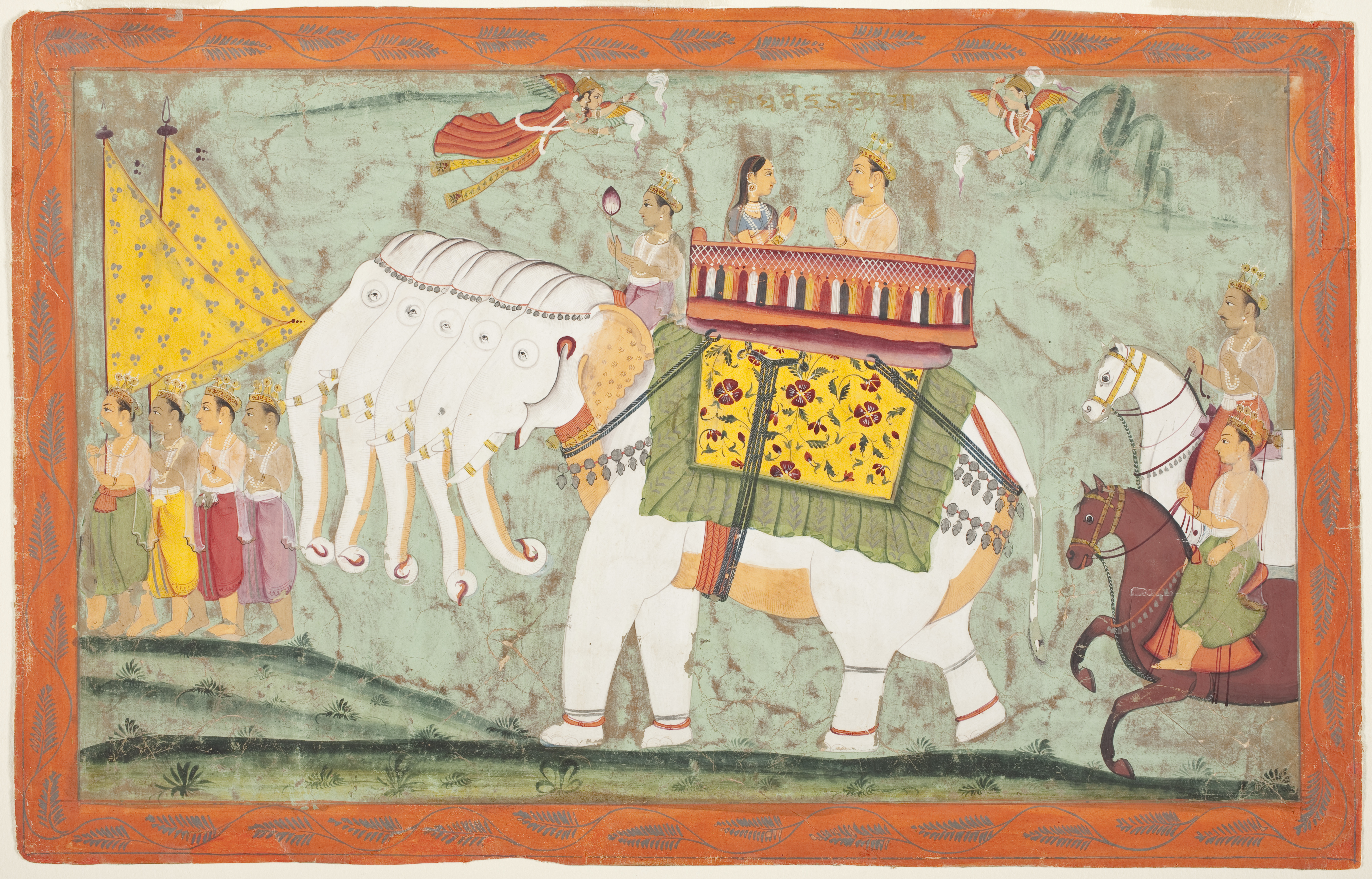
Figure 2. For the material afterlife of Indra in stone, see the sixth-century relief of Indra and Indrāṇī on their elephant in the Badami cave temples, Karnataka (Wikimedia Commons, File:6th century Indra and Indrani on elephant, Badami Hindu cave temple Karnataka.jpg; licence details on the file page). A thousand years after the hymn, the god who could not be seen has a face, a consort and an address.
What the Tradition Did With the Question Afterwards
The Rigvedic sceptic left no school. The question he asked, though, kept being asked in more sophisticated grammar.
Yāska’s Nirukta, the oldest surviving Indian treatise on etymology and the interpretation of Vedic words, devotes its seventh chapter to the nature of deities and reports live disagreement about it, including the position that what we actually see of the gods is not anthropomorphic at all: the sun is visible, the earth is visible, and the human-shaped god of the hymns is a construction of the poets [12]. That is not the sceptic’s denial. It is the same discomfort, professionalised.
Sāyaṇa, commenting a millennium and a half after Yāska, took the third option available to a tradition confronted with its own dissent: he identified the dissenter. Under his reading the words are Nema’s, Nema is a ṛṣi, and the ṛṣi is corrected inside his own hymn. Wilson’s Victorian English carries that reading into the first complete European translation from the commentarial tradition [6]. Griffith, working with the German philology of his day, dropped the proper name and restored the anonymous chorus [1].
There is a pattern worth naming here. A liturgical text that has kept an objection alive in performance for three thousand years is doing something structurally different from a text that suppresses one. The verse was chanted by people who were, by chanting it, quoting unbelief in a rite intended to work. That is a peculiar and durable arrangement, and it goes some way towards explaining why later Indian philosophy could hold radically opposed positions inside one canon of debate without the canon breaking.
Read the Refrain Again
Go back to RV 2.12 and read it aloud, all fifteen verses, listening for the refrain.
Sa janāsa indraḥ. He, O peoples, is Indra.
The hymn never once asserts that Indra exists. It points at a world that its listeners already accept, the settled mountains, the running rivers, the returning dawn, and it attaches a name to the agency behind them. That is an identification, not an existence proof, and it is the move the Rig Veda makes whenever it is pressed. When the doubter in RV 8.100 demands to see the god, the answer is not a sign but an invitation: look here, at this fire, at this pressing, at this speech. And within a few verses of that answer the hymn stops talking about Indra altogether and turns to Vāc, Speech, whom the gods generate and the animals repeat, the goddess treated at length in the Devī Sūkta. The last word on whether the invisible god is real turns out to be a hymn about language.
Modern readers arrive at the Rig Veda expecting reverence and find bargaining, competition, professional insecurity and a quoted heckler. That is not a flaw in the collection or a scandal to be managed. It is what a living liturgy looks like when it has not yet been tidied by orthodoxy: an argument in progress, with the other side allowed to speak.
Read RV 8.100 in one sitting, straight through, without looking at the commentary. Twelve verses: a contract, a heckle, an epiphany, and then Speech. It is the shortest route into the Rigvedic mind that I know.
References
Griffith, Ralph T. H. The Hymns of the Rigveda. Benares: E. J. Lazarus, 1896. archive.org. Griffith numbers hymns of the second half of Maṇḍala 8 eleven lower than the standard text, printing the Vālakhilya separately.
Jamison, Stephanie W. & Brereton, Joel P. The Rigveda: The Earliest Religious Poetry of India. 3 vols. Oxford University Press, 2014. OUP.
Jamison, Stephanie W. & Brereton, Joel P. The Rigveda: A Guide. Oxford University Press, 2020.
Macdonell, Arthur A. & Keith, Arthur B. Vedic Index of Names and Subjects. 2 vols. London: John Murray, 1912. archive.org.
Oldenberg, Hermann. Prolegomena zur Metrik und Textgeschichte des Ṛgveda. Berlin: Wilhelm Hertz, 1888.
Wilson, Horace Hayman. Ṛig-Veda Sanhitā: A Collection of Ancient Hindu Hymns. 6 vols. London: W. H. Allen, 1850-1888. Translated from the Sanskrit with Sāyaṇa’s commentary as its guide.
Geldner, Karl Friedrich. Der Rig-Veda aus dem Sanskrit ins Deutsche übersetzt. Harvard Oriental Series 33-36. Harvard University Press, 1951.
Renou, Louis. Études védiques et pāṇinéennes. 17 vols. Paris: Éditions de Boccard, 1955-1969.
Benveniste, Émile. Indo-European Language and Society. Trans. Elizabeth Palmer. London: Faber and Faber, 1973. Originally Le vocabulaire des institutions indo-européennes, Paris: Minuit, 1969. The śrad-dhā / crēdō correspondence is treated in the section on credit and belief.
Köhler, Hans-Werbin. Śrad-dhā- in der vedischen und altbuddhistischen Literatur. Ed. Klaus L. Janert. Glasenapp-Stiftung 9. Wiesbaden: Franz Steiner, 1973.
Kuiper, F. B. J. “The Ancient Aryan Verbal Contest.” Indo-Iranian Journal 4, no. 4 (1960): 217-281. archive.org.
Visigalli, Paolo & Kawamura, Yūto. “Classifying and Defining Deities in the Late Vedic Age: A Study and an Annotated Translation of Yāska’s Nirukta Chapter 7.” Journal of the Royal Asiatic Society (published online 10 December 2020).
Brereton, Joel P. “Edifying Puzzlement: Ṛgveda 10.129 and the Uses of Enigma.” Journal of the American Oriental Society 119, no. 2 (1999): 248-260.
Macdonell, Arthur A. Vedic Mythology. Strassburg: Karl J. Trübner, 1897. archive.org.
Aufrecht, Theodor. Die Hymnen des Rigveda. 2nd ed. Bonn: Adolph Marcus, 1877. The standard critical text of the Saṃhitā.
Gonda, Jan. The Vision of the Vedic Poets. The Hague: Mouton, 1963.
Elizarenkova, Tatyana J. Language and Style of the Vedic Ṛṣis. Albany: State University of New York Press, 1995.
Doniger O’Flaherty, Wendy. The Rig Veda: An Anthology. Harmondsworth: Penguin, 1981.
Witzel, Michael & Gotō, Toshifumi. Rig-Veda: Das heilige Wissen. Erster und zweiter Liederkreis. Frankfurt: Verlag der Weltreligionen, 2007.
Basham, A. L. The Wonder That Was India. London: Sidgwick and Jackson, 1954.
Comments (0)
No comments yet. Sign in to start the discussion.