What the Rigveda Hides: Concealment, Speech and the Limits of Knowing
The god who ran away
Somewhere late in the composition of the Rigveda, a poet wrote a scene that no summary of Vedic religion prepares you for. The god of fire has quit. Agni, who carries every offering from the human hearth to the gods and without whom the entire sacrificial economy stops, has walked off the job and gone into hiding. He is in the water. He is in the plants. He has, the hymn says, distributed his bodies in several places so that no one can find all of him at once.
The gods go looking. They search the waters and the vegetation and they cannot find him, and it is Yama, of all the gods, the lord of the dead, who finally spots him glowing inside his hiding place. What follows is not a scene of divine authority. It is a negotiation. Varuṇa asks him to come back. Agni explains himself:
hótrād aháṃ váruṇa bíbhyad āyaṃ
“I fled in fear from sacrificial worship, Varuṇa, lest the Gods should thus engage me. Thus were my forms laid down in many places. This, as my goal, I Agni saw before me.”
Rigveda 10.51, verse 4. Translation Griffith (1896); the Sanskrit is given in standardised IAST.
He is afraid of the work. His elder brothers, he says, went down that road before him, the way a charioteer follows a route, and he bolted from it the way a wild ox bolts from a bowstring. The gods offer him terms: unaging life, protection from exhaustion, a guaranteed share of every offering, first and last. Only then does he agree to come back and do the job.
Read RV 10.51 once and it looks like an oddity, a piece of theological comedy. Read it against the rest of the collection and it looks like the clearest statement of something the Rigveda does constantly and almost never explains. Its gods hide. Its truths are stored out of sight. Its speech keeps three of its four parts back. And its poets have an unusually precise, unusually large technical vocabulary for the fact of being covered over.
That vocabulary is the subject of this piece. I want to argue that the thing modern readers respond to when the Rigveda strikes them as deep is not chiefly its answers, and not only its famous questions. It is that these poets had already built a working language for the withheld, and a craft for approaching it.
A vocabulary for what is not shown
Sanskrit has a root, guh, meaning to cover, to conceal, to stow away. The Rigveda uses it hard. The commonest form is the adverb gúhā, “in hiding, in secret”, which appears in fifty-three verses. Alongside it run the adjective gúhya, “to be concealed, secret” (thirteen verses), the past participle gūḷhá, “hidden” (twelve), and a separate word, apīcya, “secret, concealed” (twelve). Counting generously across the whole family of forms, something on the order of eighty verses in the collection are built around the idea of a thing that has been put out of sight.
Methods note. These counts come from searching the romanised Saṃhitā text for forms of the root, then checking each hit by hand against the verse. They are approximate at the edges: the root guh and the unrelated raghú, “swift”, produce lookalike strings in some transliteration schemes, and a compound can bury a form where a search will not reach it. Treat the figures as an order of magnitude, not a concordance entry.
What makes this a technical vocabulary rather than an ordinary one is redundancy. When the Rigveda wants to say that something is hidden, it frequently says so several times in a single line, using different words, in a way that no casual speaker would bother to do. Indra’s serpent enemy is described in one breath as:
gúhā hitáṃ gúhyaṃ gūḷhám apsú apīvṛtám
“concealed in depths, mysterious, great enchanter, dwelling enveloped deep within the waters”
Rigveda 2.11, verse 5, translation Griffith (1896). Literally: set in hiding, to-be-hidden, hidden in the waters, covered over.
Four words for covered, stacked. The same stack recurs at RV 3.39.6, where Indra finds the honey “that lay secret, hidden in the waters”. This is the language of a tradition that thinks about concealment often enough to have developed shades of it.
| Term | Root / form | Sense | Representative verse |
|---|---|---|---|
| gúhā | adverb from guh | in hiding, in secret | RV 1.65.1, RV 5.11.6 |
| gúhya | gerundive of guh | to be kept secret | RV 5.3.3 |
| gūḷhá | past participle of guh | hidden, covered over | RV 10.129.3 |
| apīcya | conventionally api + añc | secret, out of the way | RV 1.84.15 |
| ápihita | api + dhā | covered over, lidded | RV 10.129.3 |
| níhita | ni + dhā | set down, deposited | RV 1.164.45 |
| niṇya / niṇik | uncertain | secret thing, hidden store | RV 4.5.8 |
Two of these deserve a note. Níhita, “set down”, is not a word for hiding at all in ordinary use; it is what you do with a pot. The Rigveda pairs it with gúhā so often that “set down in secret” becomes almost a fixed phrase, and the choice matters: the hidden thing has been deposited somewhere by someone. It is not lost. It is stored.
And apīcya is the word used at RV 1.84.15 of a name: the poets there attain, or trace, “the terrible secret name of Tvaṣṭṛ”. Hold on to that. Names are going to matter.
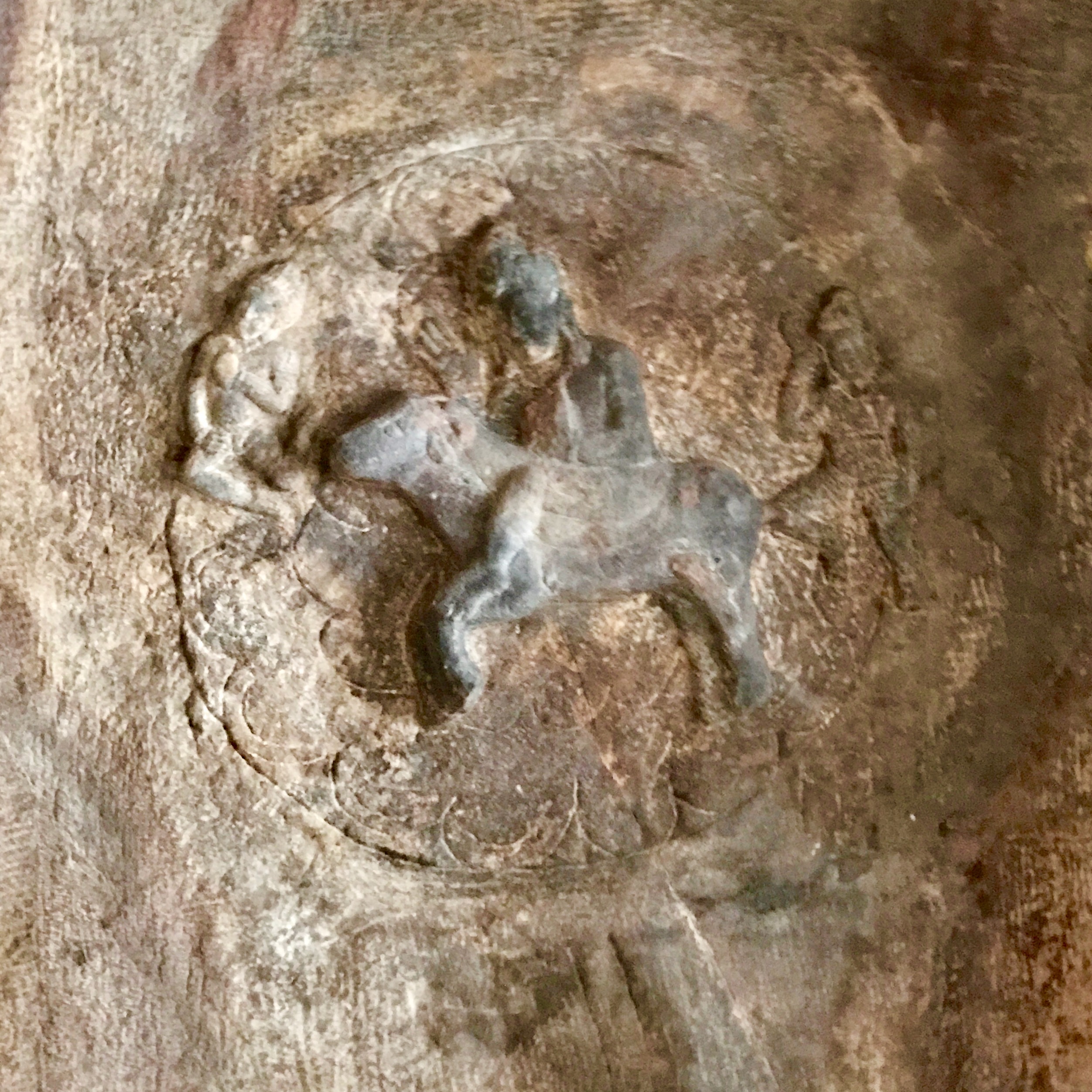
Tracking
If things are hidden, someone has to find them, and the Rigveda is remarkably consistent about how finding works. It works by tracking.
The opening line of RV 1.65 is one of the strangest similes in the collection. The gods are approaching Agni, and the poet reaches for an image of pursuit:
paśvā́ ná tāyúṃ gúhā cátantaṃ … sajóṣā dhī́rāḥ padaír ánu gman
“One-minded, wise, they tracked thee like a thief lurking in dark cave with a stolen cow; bearing oblation, offering homage, they sat down beside thee, all the Holy Ones.”
Rigveda 1.65, verse 1, translation Griffith (1896).
The gods approach their own fire god the way a search party approaches a cattle thief: silently, in agreement with one another, following the footprints. Padaíḥ ánu gman, “they went along by the tracks”. The word padá, footprint or track, is one of the busiest nouns in Rigvedic poetry, and this is why. In a world where the thing you want is hidden, the only access is the trace it leaves.
The same grammar governs the collection’s other discovery narratives. Pūṣan, the god of roads and lost property, “has found the King, concealed and hidden in a cave” (RV 1.23.14). The Aṅgirases find Agni “what time thou layest hidden, fleeing back from wood to wood” (RV 5.11.6). Indra and the Aṅgirases break open the rock where the Paṇis have stored the cows and the light, a story the tradition tells over and over (RV 1.130.3, RV 2.24.6; see The Vala Myth).
| Hidden thing | Hiding place | Who finds it | Verse |
|---|---|---|---|
| Agni | waters and plants | Yama | RV 10.51.3 |
| Agni | wood, “from wood to wood” | the Aṅgirases | RV 5.11.6 |
| Agni | in the deep, in the Steer’s form | Mātariśvan | RV 1.141.3 |
| the king | a cave | Pūṣan | RV 1.23.14 |
| cows and light | rock, “never-ending rock” | Indra, the Aṅgirases | RV 1.130.3 |
| honey (mádhu) | the waters | Indra | RV 3.39.6 |
| the secret name of Tvaṣṭṛ | the house of the moon | the poets | RV 1.84.15 |
Notice who does the finding in that last row. Not a god. The poets. This is the move that turns a mythological motif into an intellectual position, and it is worth being careful about it, because the Rigveda is careful about it. Composing a hymn is described in this literature as a form of finding. The verb used of Indra breaking into the rock, vid, “to find”, is the same verb used of a poet who has come upon the right formulation. Jan Gonda spent a long book on the family of words around dhī, the poet’s visionary insight, arguing that Vedic dhī is not abstract thought but something closer to a sighting, a seeing-into that arrives.[1] The hymn is what the poet brings back from the search.
Aside. It is tempting to read all this as metaphor: the gods are “really” the natural world, the cave is “really” a poetic device. The Rigvedic poets show no sign of drawing that line. Agni genuinely is in the wood and in the water; the fire drill genuinely does bring him out; the poem genuinely does find something. Flattening any of these into figure of speech is a modern convenience, not a Vedic one.
The paradox at the centre
Here is where the material stops behaving like a simple mystery cult. If the Rigveda merely held that divine things are hidden, it would be one of a hundred ancient traditions with a secret at the centre. What it actually says is stranger.
In a short hymn to Agni in the fourth maṇḍala, the poet describes his god as concealed in the trees, unapproachable, kept out of sight. Then he adds two words that undo the whole picture:
citráṃ sántaṃ gúhā hitáṃ suvédaṃ kū́cid arthínam
“In his Eternal Mothers, in the wood, concealed and unapproached, kept secret though his flames are bright, seeking on all sides, quickly found.”
Rigveda 4.7, verse 6, translation Griffith (1896). The key phrase is gúhā hitáṃ suvédam: “set down in secret, easy to find.”
Set down in secret, easy to find. The Rigveda puts those two descriptions in the same breath and does not resolve them. Elsewhere it says of Agni, in a single line, that he goes “from lair to lair” and that “he stayed not hidden” (RV 1.67.3, RV 3.1.9). The god is concealed and available at once, and the poets seem to find nothing embarrassing about saying so.
The best short statement of the pattern is a line from a hymn to the All-Gods:
padé iva níhite dasmé antás táyor anyád gúhyam āvír anyát
“Within a wondrous place the Twain are treasured: the one is manifest, the other hidden. One common pathway leads in two directions.”
Rigveda 3.55, verse 15, translation Griffith (1896). The image is of two footprints set down inside something: one to be kept secret, one revealed.
Two tracks, one visible and one not, on a single road. That structure, the visible half and the withheld half of the same thing, is the Rigveda’s default picture of reality. It recurs at RV 3.56.2, where three great ones stand near and “two are concealed from sight, one is apparent”. It is why the collection can be so confident and so unresolved at the same time. There is nothing contradictory, on this picture, about knowing a great deal and knowing that most of it is out of view.
graph TD
    A["Something is set down in secret"] --> B["gúhā hitám"]
    B --> C["It leaves a trace: padá"]
    C --> D["A tracker follows the trace"]
    D --> E["Gods and heroes: Indra, Pūṣan, Yama"]
    D --> F["Poets: dhī, the sighting"]
    F --> G["The hymn is what is brought back"]
    G --> H["One part shown, the rest withheld"]
    H --> A
    E --> H
The god who is plural because he is hidden
Return to Agni’s excuse in RV 10.51. He says, twice, that his bodies were laid down bahudhā, “in many places”. Verse 2 has him asking, almost plaintively, which god ever saw all his forms at once. Nobody had. That is the point of hiding that way.
This is not a marginal idea. It underwrites one of the features of Vedic religion that most confuses new readers: the sheer instability of divine identity. Agni is in every hearth in the settlement simultaneously and is also one god. He is called by the names of other gods outright. The poets shift, hymn by hymn, to treat whichever deity they are addressing as the greatest, the maker, the one on whom the rest depend. Max Müller gave that habit a name in his Hibbert Lectures of 1878, henotheism, the worship of one god at a time without denying the others.[2] The word has stuck, and it describes the surface behaviour accurately enough.
But describing is not explaining, and the concealment vocabulary suggests a reason the label does not reach. If a god’s forms are deposited in many places, and no one has seen them all, then no single hymn can be the complete account of him, and the next hymn’s different account is not a contradiction. It is another footprint. The plurality of Vedic gods, and the plurality of claims about each one, follows from the premise that the thing itself is not on display.
Names carry the same logic. The Rigveda repeatedly speaks of a name that is kept back. Rudra “guards the secret name of the cows” (RV 5.3.3); the poets trace the apīcya name of Tvaṣṭṛ (RV 1.84.15). Jan Gonda, in a monograph devoted to the subject, argued that a Vedic name is not a label attached to a being but something closer to a share in what the being is, which is precisely why a name can be withheld.[3] To know the hidden name is to have got hold of the thing.
Aside. Griffith’s 1896 rendering of RV 1.84.15 gives “the essential form of Tvaṣṭar’s Bull” where the Sanskrit has nā́ma … apīcyam, “the hidden name”. He is not wrong about the sense; a hidden name and an essential nature are close in Vedic thinking. But the English quietly removes the word name, and with it the whole question of why a name would be the thing you had to hunt for. This is a good, small illustration of why no single translation exhausts a Rigvedic line, and why comparing two is rarely wasted effort.
There is one more consequence, and it is the most surprising thing in the collection’s theology. A hidden god can be doubted. In the second maṇḍala a poet says so flatly, in a hymn whose whole business is to insist on Indra’s reality:
“Of whom, the Terrible, they ask, Where is He? or verily they say of him, He is not. … Have faith in him, for He, O men, is Indra.”
Rigveda 2.12, verse 5, translation Griffith (1896).
People said Indra did not exist. The poet who reports this is not conceding anything; he is arguing. But he records the objection in the text, in the god’s own hymn, and the objection follows straight from the premise. A deity you cannot see is a deity someone can deny.
Speech keeps three quarters back
The most consequential application of the concealment idea is not to gods at all. It is to language.
In the long riddle hymn of the first maṇḍala comes a verse that later Indian thought would never stop citing:
catvā́ri vā́k párimitā padā́ni tā́ni vidur brāhmaṇā́ yé manīṣíṇaḥ
gúhā trī́ṇi níhitā néṅgayanti turī́yaṃ vācó manuṣyā̀ vadanti
“Speech hath been measured out in four divisions, the Brahmans who have understanding know them. Three kept in close concealment cause no motion; of speech, men speak only the fourth division.”
Rigveda 1.164, verse 45, translation Griffith (1896).
Read it with the vocabulary we have been assembling and the verse loses none of its strangeness but gains a context. Gúhā … níhitā: the three quarters are not missing, they are set down in secret, deposited exactly like Agni in the waters or the cows in the rock. They “cause no motion”, na iṅgayanti, which most readers take to mean they do not stir, are not put into play. What human beings do when they talk is operate the one quarter that is out in the open.
Notice what this verse does not do. It does not tell you what the other three quarters are. The Rigveda does not say. Later traditions supplied answers with great enthusiasm and considerable disagreement, and it is worth resisting the urge to import any of them here. The verse as it stands is a claim about the proportion of language that is available, and the proportion it gives is one in four.
The other great meditation on speech is RV 10.71, a hymn the tradition titles Jñānam, “knowledge”. It is one of the few places in the collection where the poets look directly at their own instrument. It begins with naming, at the moment when “men, Bṛhaspati, giving names to objects, sent out Vāk’s first and earliest utterances”. Then comes an image drawn from the kitchen:
“Where, like men cleansing corn-flour in a cribble, the wise in spirit have created language, friends see and recognize the marks of friendship: their speech retains the blessed sign imprinted.”
Rigveda 10.71, verse 2, translation Griffith (1896). A “cribble” is a sieve; the Sanskrit compares the making of speech to sifting grain.
Speech is sifted. Something is kept, something falls through and is discarded, and the product carries a mark that those who share the practice can recognise. Two verses later the hymn makes the consequence explicit, in what may be the single most quietly devastating line in the Rigveda:
“One man hath ne’er seen Vāk, and yet he seeth: one man hath hearing but hath never heard her. But to another hath she shown her beauty as a fond well-dressed woman to her husband.”
Rigveda 10.71, verse 4, translation Griffith (1896).
Everyone in the room hears the same words. Some of them do not receive Speech at all. She discloses herself selectively, and the hymn goes on, for six more verses, to sort the poets’ own community by whether they have got anything: the laggard who “wanders on in profitless illusion”, the man who has abandoned a friend and therefore has no share in Vāc, the ones who “spin out their thread in ignorance”, the friends “unequal in the quickness of their spirit” though “endowed alike with eyes and hearing” (RV 10.71, verses 5 to 9).
That is a theory of understanding, delivered as a portrait of a guild. Meaning is not distributed by the words. It is distributed by what the listener brings, and it can fail to arrive without anyone noticing that it has failed. For the Rigveda’s account of how a hymn gets built in the first place, see The Poet as Carpenter; for Vāc’s own first-person hymn, see Vāc, Goddess of Speech.

Obscurity as technique, and the honest caution
A tradition that thinks meaning is withheld will produce poetry that withholds. The Rigveda does, constantly, and one of the pleasures of reading it is that you cannot always tell whether a passage is difficult on purpose.
Louis Renou devoted a long study to the deliberate ambiguity of Rigvedic vocabulary, arguing that the poets exploited multiple senses of a word simultaneously rather than choosing between them.[4] Tatyana Elizarenkova’s work on the language and style of the ṛṣis makes the related case that the obscurity is structural, built into how the hymns are composed, not an accident of our distance from them.[5] And the ritual literature preserves an institution that assumes all of this: the brahmodyá, a formal verbal contest in which priests posed enigmas to one another and answered in kind. F. B. J. Kuiper reconstructed the contest as an ancient inheritance,[6] and George Thompson has examined how its questions and answers actually work as discourse.[7]
Aside. A caution I try to keep in front of me. Some Rigvedic obscurity is craft, aimed at an audience that was meant to work for it. Some of it is our problem: a lost referent, a dead technical term, a ritual object nobody has held for three thousand years. The two are not always separable, and a reader who assumes every difficulty is intentional profundity will end up admiring their own confusion. Where a passage resists, the honest first hypothesis is that we are missing something the original audience had.
When the hiding reaches the beginning
Everything so far has concerned hidden things inside a world. The Rigveda’s most famous hymn takes the same vocabulary and turns it on the origin of the world itself, which is why RV 10.129 is not the anomaly it is usually presented as. It is this way of thinking pushed to the place where it breaks.
Look at the third verse in the Sanskrit and the words are already familiar:
táma āsīt támasā gūḷhám ágre … tucchyénābhv ápihitaṃ yád ā́sīt
“Darkness was hidden by darkness in the beginning; with no distinguishing sign, all this was water. The life force that was covered with emptiness, that one arose through the power of heat.”
Rigveda 10.129, verse 3, translation Wendy Doniger O’Flaherty (1981).
Gūḷhá, hidden, the past participle we met inside Indra’s serpent hymn. Ápihita, covered over, lidded. The creation hymn describes the state before anything with the same two words the collection uses for a fire god in a lake and a treasure in a rock. And then the fourth verse describes the poets doing exactly what poets do everywhere else in this literature: “sages who searched with their heart’s thought discovered the existent’s kinship in the non-existent”. They searched. They found. The verb is vindanti, from vid, the tracking verb.
The difference is what happens at the end. Everywhere else, the search closes: Indra opens the rock, Yama spots the glow, the poets trace the name. Here the hymn turns and asks who could possibly have been in a position to know, and answers that the gods came afterwards, and then finishes:
“He, the first origin of this creation, whether he formed it all or did not form it, whose eye controls this world in highest heaven, he verily knows it, or perhaps he knows not.”
Rigveda 10.129, verse 7, translation Griffith (1896).
The last clause, yádi vā ná véda, is usually translated “or perhaps he does not know”, and the grammar supports that reading without difficulty. What the concealment vocabulary adds is a sense of why this ending is not nihilism and not a shrug. The hymn has followed the standard procedure. It has described a covered thing, it has sent the trackers out, and it has reported honestly that the trail runs out before the quarry. Joel Brereton has argued that the puzzlement is the hymn’s purpose rather than its failure: the unresolved question hands the work of creation over to the audience, who must do something with it.[8]
| Rendering of RV 10.129.3a | Translator | Note |
|---|---|---|
| “Darkness there was: at first concealed in darkness this All was indiscriminated chaos.” | Griffith, 1896 | Adds “chaos”, a Greek concept not in the Sanskrit |
| “Darkness was hidden by darkness in the beginning; with no distinguishing sign, all this was water.” | Doniger O’Flaherty, 1981 | Keeps salilám, “water”, where Griffith generalises |
| Literal gloss: “darkness was, hidden by darkness, in the beginning; without distinguishing mark, all this was flood” | after the Saṃhitā text | gūḷhám, “hidden”, is a form of guh |
The table is there to make one point. Griffith’s “indiscriminated chaos” and Doniger’s “all this was water” are describing the same half-line. A reader who only ever meets one English Rigveda is meeting one reading of a text that supports several, and on the specific question this article is about, the word choice matters: gūḷhám is not “chaotic”, it is hidden.
For a reading of the hymn on its own terms, see The Nāsadīya Sūkta; for the collection’s other unanswered questions, The God Named “Who”.
What the later tradition did with the cave
One test of whether an idea belongs to a text or has been read back into it is to watch what happens to the idea afterwards. Guhā survives into the Upaniṣads, and it changes.
In the Kaṭha Upaniṣad, a work several centuries younger than the hymns, the divine is described as durdarśam, hard to see, gūḍham anupraviṣṭam, entered in and hidden, and guhāhitam, set down in the cave. That last phrase is the Rigvedic formula almost exactly. But the Upaniṣad means something the Rigveda never says: the cave is the interior of the human being, and the search is conducted inward, by adhyātma-yoga.
The Rigveda’s hiding places are not interior. They are the waters, the wood, the plants, the rock, the cattle stall, the house of the moon. Agni is not hidden in your heart in RV 10.51; he is hidden in a lake, and he is hiding on purpose because he does not want the job. The move from a cave in the landscape to a cave in the self is one of the most important developments in Indian religious thought, and it happens after the Saṃhitā, not in it.
This matters for how we read the whole family of resemblances between the Rigveda and later Indian philosophy. RV 10.129 is not the Upaniṣads in draft. RV 1.164.45 is not a theory of the four levels of speech, though it later became the seed of several. What the Rigveda supplies is a vocabulary and a habit; what the later traditions supply is a metaphysics that the vocabulary turned out to fit. Both facts are interesting. Collapsing them into one loses the more interesting of the two. On that trajectory in particular, see One Without a Second.
What we are actually responding to
So what is it that makes this collection feel larger than the phrase “ancient hymns” allows?
Not, I think, its answers. The Rigveda’s cosmological answers are of their time and are not always consistent from hymn to hymn. Not simply its questions either, though the questions are real and the tradition of asking them is well developed.
It is that these poets worked with an explicit theory of the withheld, and built a craft on it. They had words for the difference between a thing that is absent and a thing that has been set down out of sight. They assumed that whatever is most worth having has been deposited somewhere, that it leaves traces, that following traces is what both gods and poets do for a living, and that the retrieval is always partial. From that premise, most of what looks strange about the Rigveda stops looking strange. The instability of its gods, the density and difficulty of its poetry, the riddle contests, the insistence that speech itself keeps three parts back, the willingness to record that some people said Indra did not exist, and the readiness to end the greatest hymn in the collection by admitting the trail has gone cold: these are not separate features. They are one idea, worked out over centuries by people who were unusually unwilling to pretend.
There is also, quietly, an ethical shape to it. If the visible is one quarter, then confident totalising claims about the whole are a category error, and the Rigveda mostly does not make them. It makes local, specific, gorgeous claims, and it leaves the edges open.
Read RV 10.51 straight through in any translation, and then read RV 10.129 immediately after, in the same sitting. The first is a god hiding in a lake because he is tired and afraid, negotiating hazard pay before he will come back to work. The second is a poet standing at the edge of everything and reporting that the one who might know may not know either. It is difficult to believe at first that these belong to the same collection. They belong to the same idea. Something has been set down in secret; you can follow the tracks a long way; and the poets who went furthest are the ones who tell you where the tracks stop.
References
Gonda, Jan. The Vision of the Vedic Poets. The Hague: Mouton, 1963. archive.org.
Müller, F. Max. Lectures on the Origin and Growth of Religion, as Illustrated by the Religions of India (Hibbert Lectures). London: Longmans, Green, 1878. archive.org.
Gonda, Jan. Notes on Names and the Name of God in Ancient India. Amsterdam: North-Holland, 1970. archive.org.
Renou, Louis. ‘L’ambiguïté du vocabulaire du Ṛgveda.’ Journal Asiatique 231 (1939): 161-235.
Elizarenkova, Tatyana J. Language and Style of the Vedic Ṛṣis. Albany: State University of New York Press, 1995.
Kuiper, F. B. J. ‘The Ancient Aryan Verbal Contest.’ Indo-Iranian Journal 4, no. 4 (1960): 217-281. Brill.
Thompson, George. ‘The Brahmodya and Vedic Discourse.’ Journal of the American Oriental Society 117, no. 1 (1997): 13-37. JSTOR.
Brereton, Joel P. ‘Edifying Puzzlement: Ṛgveda 10.129 and the Uses of Enigma.’ Journal of the American Oriental Society 119, no. 2 (1999): 248-260.
Jamison, Stephanie W., and Joel P. Brereton. The Rigveda: The Earliest Religious Poetry of India. 3 vols. New York: Oxford University Press, 2014.
Griffith, Ralph T. H. The Hymns of the Rigveda. 2nd ed. Benares: E. J. Lazarus, 1896. Wikisource.
Doniger O’Flaherty, Wendy. The Rig Veda: An Anthology, One Hundred and Eight Hymns. Harmondsworth: Penguin, 1981.
Geldner, Karl Friedrich. Der Rig-Veda aus dem Sanskrit ins Deutsche übersetzt. Harvard Oriental Series 33-36. Cambridge, MA: Harvard University Press, 1951.
Renou, Louis. Études védiques et pāṇinéennes. 17 vols. Paris: de Boccard, 1955-1969.
Macdonell, Arthur A. Vedic Mythology. Strassburg: Karl J. Trübner, 1897. archive.org.
Macdonell, Arthur A., and Arthur B. Keith. Vedic Index of Names and Subjects. 2 vols. London: John Murray, 1912. archive.org.
Oldenberg, Hermann. Die Religion des Veda. Berlin: Wilhelm Hertz, 1894. archive.org.
Oldenberg, Hermann. Prolegomena zur Metrik und Textgeschichte des Rigveda. Berlin: Wilhelm Hertz, 1888.
Aufrecht, Theodor. Die Hymnen des Rigveda. 2nd ed. Bonn: Adolph Marcus, 1877.
Keith, Arthur B. The Religion and Philosophy of the Veda and Upanishads. Harvard Oriental Series 31-32. Cambridge, MA: Harvard University Press, 1925. archive.org.
Olivelle, Patrick. The Early Upaniṣads: Annotated Text and Translation. New York: Oxford University Press, 1998.
Jamison, Stephanie W. The Rig Veda between Two Worlds / Le Ṛgveda entre deux mondes. Publications de l’Institut de Civilisation Indienne 74. Paris: Collège de France, 2007.
Comments (0)
No comments yet. Sign in to start the discussion.