Hymns to Nouns: The Rigveda's Gods of Faith, Fury and the Fee
A man asks his own rage to come back
Somewhere near the end of the Rigveda, a poet admits he has lost a fight. Not a battle exactly; something closer to a share-out that went badly. He has come away with nothing, and he knows whose fault it is.
abhāgaḥ sann apa pareto asmi tava kratvā taviṣasya pracetaḥ
“I have departed, still without a portion, wise God! according to thy will, the Mighty. I, feeble man, was wroth with thee, O Manyu. I am myself; come thou to give me vigour.”
RV 10.83.5, Griffith (1896)
Two verses later he asks this god to take up a very specific position:
“Approach, and on my right hand hold thy station: so shall we slay a multitude of foemen.”
RV 10.83.7, Griffith (1896)
The right hand is where a chariot-fighter’s companion stands. The poet is asking a deity to fall in beside him like a comrade in arms. And the deity he is asking is manyu, which is not the name of anybody. It is the ordinary Vedic word for rage. It appears across the earlier books of the Rigveda in perfectly flat sentences about the anger of Indra, the anger of enemies, the anger of the poet’s own patron. Here, and in the hymn that follows, that common noun has been put into the vocative and given a set of epithets, a thunderbolt, and a request for battle spoils.
This is not a one-off. The tenth maṇḍala of the Rigveda contains a hymn addressed to Trust, a hymn addressed to the fee paid to priests, and verses addressed to Dissolution, to the Life-Breath-Leading, and to Divine Consent. Somewhere in the last stratum of the collection, Vedic poets acquired the habit of praying to abstract nouns, and once acquired the habit never went away. What follows is an attempt to watch that habit form.
What the index calls a god
Open any translation of the Rigveda and each hymn carries a heading naming its deity: Agni, Indra, Uṣas, the Maruts. Those headings are not in the hymns. They come from the Anukramaṇīs, the indices compiled centuries later, of which Kātyāyana’s Sarvānukramaṇī is the standard one: for each of the 1,028 hymns it records the opening word, the number of verses, the poet’s name and family, the metre, and the devatā, the divinity addressed.[1] Griffith’s headings, and the deity fields in most digital editions, reproduce that ancient index.
Methods note. The deity assignments are the tradition’s reading of the hymns, not the hymns’ own labels. For an obvious case, a hymn calling on Agni in every verse, the index simply records what anyone can see. For an odd case it is making a judgment, and that judgment is itself evidence about how later ritualists understood the text. Where the index says devatā manyuḥ, someone in the last centuries BCE was satisfied that Rage counted as a god.
Sort the maṇḍala X index by what it names and a small, strange cluster falls out.
| Hymn | Deity as indexed | Literal sense of the word | Grammatical shape |
|---|---|---|---|
| RV 10.83, 10.84 | Manyu | rage, battle-fury, high spirit | masc. -yu stem from √man, “think, be roused” |
| RV 10.151 | Śraddhā | trust, credence | fem. -ā noun from the phrase śrad + √dhā |
| RV 10.107 | Dakṣiṇā | the gift given to officiating priests | fem. adjective, “right-hand, southern”, turned substantive |
| RV 10.59 | Nirṛti, Asunīti, Anumati | dissolution; life-breath-leading; consent | fem. -ti abstracts |
| RV 10.117 | indexed as liberality (dhanānnadāna) | the giving of wealth and food | verbal-noun compound |
| RV 10.71 | indexed as jñāna, knowledge | knowing, sacred understanding | neut. -ana action noun |
Arthur Macdonell, writing in 1917, drew the same boundary and counted the same way. Alongside the older “agent” gods formed with the suffix -tṛ (Dhātṛ the Placer, Trātṛ the Protector, Netṛ the Leader, and behind them Savitṛ the Impeller), there is, he wrote, “a second and smaller class of abstract deities” comprising “personifications of abstract nouns,” of which “there are seven or eight of these occurring in the tenth book.”[2] The distinction matters. An agent noun already points at somebody: a Placer is a person who places. An abstract noun points at nothing but itself. To address one, you have to make a person out of a quality, and that is a different kind of act.
Fury, and what it is like to be short of it
The two Manyu hymns are war poetry, and they are unembarrassed about it. The second opens by asking Fury to lead the army:
“Flashing like fire, be thou, O conquering Manyu, invoked, O Victor, as our army’s leader. Slay thou our foes, distribute their possessions: show forth thy vigour, scatter those who hate us.”
RV 10.84.2, Griffith (1896)
and it closes by asking Fury and Varuṇa, of all pairings, to hand over the wealth gathered from both sides of the field (RV 10.84.7). Across the two hymns Manyu is called svayambhū, self-existent (RV 10.83.4), an adjective with a long career ahead of it in Indian metaphysics, and sahajā vajra sāyaka, born together with power, thunderbolt, missile (RV 10.84.6).
The identification in the first hymn is the boldest line in either poem:
manyur indro manyur evāsa devo manyur hotā varuṇo jātavedāḥ
“Manyu was Indra, yea, the God, was Manyu, Manyu was Hotar, Varuṇa, Jātavedas.”
RV 10.83.2, Griffith (1896)
Read that as theology and it is startling: the great gods collapsed into a psychological state. Read it as poetry and it is doing something more precise. Indra’s defining act, the killing of Vṛtra, is an act of fury; the priest’s fire is fury; Varuṇa’s punishment is fury. The verse is not saying Manyu replaces them. It is saying that what all of them share, the thing that makes a god effective at the moment of striking, has a name, and the name is an ordinary word for a feeling any warrior has felt.
Which is why RV 10.83.5, the verse about coming away portionless, is the most interesting line in the Rigveda’s whole experiment with abstractions. The speaker is not describing an external power. He says abhāgaḥ san, “being without a share,” and then, in the next verse, ayaṃ te asmi, “here I am, yours.” A man who has been humiliated is asking his own capacity for rage to return and stand at his shoulder. Modern readers reach for the vocabulary of psychology here, and it is hard to avoid; but the Vedic move is stranger and more literal than a metaphor. If rage can be absent, and can be summoned, and can arrive, then rage is the kind of thing that can be addressed.
The word itself carries the argument. Manyu is built on √man, the root behind manas, mind, with the -yu suffix that forms nouns of state. Its exact Iranian cognate is Avestan mainiiu, and that word does not mean anger at all. It means spirit, mentality, the animating principle, and it survives in the most famous pair of names in Zoroastrianism: Spəṇta Mainiiu and Aŋra Mainiiu, the Bounteous and the Destructive Spirit, the latter the ancestor of Ahriman.[3] One inherited Indo-Iranian word for a roused state of mind became, on one side of the divide, a battle deity invoked by a fighter, and on the other, the metaphysical principle on which an entire dualist cosmology rests. The shared Indo-Iranian inheritance rarely shows its hand this clearly.
Aside. The Manyu hymns did not fossilise. They are recited today as the Manyu Sūktam, a fourteen-verse unit combining both hymns, chanted for courage and protection; and a strand of Vaiṣṇava commentary, following Madhva’s reading of the Mahābhārata episode in which Bhīma kills Duḥśāsana, takes Manyu throughout as a name of Narasiṃha. A hymn to an emotion became a hymn to a lion-headed avatar who did not exist when the hymn was composed. Reception history in the Vedic tradition is rarely tidy.
Trust: from a verb to a goddess
The hymn to Śraddhā is five verses long and sits at RV 10.151, forty hymns from the end of the collection. It begins with a claim about ritual causation:
śraddhayāgniḥ sam idhyate śraddhayā hūyate haviḥ | śraddhāṃ bhagasya mūrdhani vacasā vedayāmasi
“By Faith is Agni kindled up, by Faith is oblation offered up. We celebrate with praises Faith upon the height of happiness.”
RV 10.151.1, Griffith (1896)
and it ends with a line whose grammar is worth slowing down for:
śraddhāṃ prātar havāmahe śraddhāṃ madhyaṃdinam pari | śraddhāṃ sūryasya nimruci śraddhe śrad dhāpayeha naḥ
“Faith in the early morning, Faith at noonday will we invocate, Faith at the setting of the Sun. O Faith, endow us with belief.”
RV 10.151.5, Griffith (1896)
The final clause is śraddhe śrad dhāpaya iha naḥ: “O Śraddhā, make us place śrad here.” The poet addresses the noun and then, in the same breath, uses the verb the noun was made from. You can watch the abstraction being formed inside the line.
That verb is old, and not late at all. Generations before this hymn, in the family books, a poet of the Gṛtsamada clan wrote about people who doubt whether Indra exists, and answered them with an imperative:
“Of whom, the Terrible, they ask, Where is He? or verily they say of him, He is not. He sweeps away, like birds, the foe’s possessions. Have faith in him, for He, O men, is Indra.”
RV 2.12.5, Griffith (1896)
The Sanskrit of that last clause is śrad asmai dhatta sa janāsa indraḥ: “place your śrad in him.” The older books have the action; the newer book has the agent. This is the clearest single case in the Rigveda of an idiom hardening into a noun and the noun then being called by name.
And śrad is one of the great fossils of Indo-European. The compound ḱred-dʰeh₁-, “to place the heart,” survives as Vedic śrad-dhā-, Avestan zrazdā-, Latin crēdō, and Old Irish creitid.[4] Benveniste’s chapter on credence and belief made the case that the underlying image is not intellectual assent but a deposit: you place something of your own with another party, in the expectation of return.[5]
| Language | Form | Attested sense |
|---|---|---|
| Vedic | śrad-dhā-, śraddhā | to place trust in; trust, confidence |
| Avestan | zrazdā- | devoted, trusting |
| Latin | crēdō | to entrust, to lend, to believe |
| Old Irish | creitid | believes |
| Proto-Indo-European | ḱred-dʰeh₁- | to place one’s heart (in) |
That etymology explains why the hymn to Śraddhā is not, as an English reader primed by the word “faith” expects, about belief in gods. Four of its five verses are about giving. Śraddhā is asked to bless “the man who gives” and the man who would like to give; the poet asks her to make his own spoken wish come true among the liberal patrons who sacrifice. Hans-Werbin Köhler’s monograph on the term, still the standard study, traces exactly this: in the Rigveda śraddhā is confidence in the efficacy of the rite and in the reciprocity between the patron who pays and the priest who chants.[6] It is closer to credit than to creed. The Latin cognate kept the commercial sense. The Vedic one kept it too, and then went on to become something else.
Aside. Translators disagree about how to render śraddhā, and the disagreement is substantive rather than stylistic. “Faith” imports two thousand years of Christian usage. “Trust” and “confidence” are more accurate and lose the religious weight the word later acquired. Where this article quotes Griffith’s “Faith,” read it as a nineteenth-century convention rather than a definition.
The Anukramaṇī then does something quietly remarkable with this hymn. It assigns the poem a poet, and the poet it assigns is Śraddhā Kāmāyanī: Trust, daughter of Desire. The hymn to the abstraction is credited to the abstraction. The Manyu hymns get the same treatment, ascribed to Manyu Tāpasa, Fury son of Heat. Traditional attribution is not historical authorship, and nobody should read these as records of who actually composed the verses. But as evidence of how the tradition thought about personified qualities they are precise: a quality real enough to be addressed is real enough to speak.
graph LR
    A["śrad + √dhā (verb)"] --> B["RV 2.12.5: place trust in Indra"]
    B --> C["śraddhā (noun)"]
    C --> D["RV 10.151: goddess in the vocative"]
    D --> E["Kaṭha Up. 1.1.2: enters a boy"]
    D --> F["śrāddha: the rite for the dead"]
    E --> G["A technical term of doctrine"]
A goddess made out of an honorarium
The third case is the one that reliably makes modern readers laugh, and then stop laughing.
Dakṣiṇā is the payment made to the priests who perform a sacrifice: most often cattle, sometimes horses, gold, cloth or cooked food. It is a fee. RV 10.107, eleven verses long, is addressed to it.
“High up in heaven abide the Guerdon-givers: they who give steeds dwell with the Sun for ever. They who give gold are blest with life eternal. They who give robes prolong their lives, O Soma.”
RV 10.107.2, Griffith (1896)
The hymn tracks what Dakṣiṇā gives back: horse, ox, gold, food, armour. It says the generous do not die, are not brought low, do not suffer, do not waver (RV 10.107.8); that they win fragrant dwellings and well-dressed brides; that horses carry them and the gods stand behind them. Read cynically, it is priests explaining to patrons why patrons should pay priests, which is roughly what the dānastuti verses do more bluntly at the ends of hymns elsewhere.
Something else is happening as well. Deifying the fee turns a transaction into a cosmological principle. Once Dakṣiṇā is a goddess, the exchange between patron and priest stops being an economic arrangement embedded in ritual and becomes the thing that makes ritual work at all. Charles Malamoud’s studies of the ancient Indian thinking about exchange follow this line forward into the Brāhmaṇas, where debt, gift and counter-gift become the grammar of the relation between humans and gods.[7] The Rigvedic hymn is where the fee first steps out of the accounts and into the pantheon.
Its companion piece is RV 10.117, indexed under liberality, which is the closest thing in the Rigveda to a sustained piece of ethical argument. It opens with a flat denial of any theology of deserved hunger:
“The Gods have not ordained hunger to be our death: even to the well-fed man comes death in varied shape.”
RV 10.117.1, Griffith (1896)
and it contains a line later Indian literature never stopped quoting, kevalāgho bhavati kevalādī, which Griffith renders “All guilt is he who eats with no partaker” (RV 10.117.6). Notice that this hymn has no deity in any ordinary sense. It reasons. The wealthy man who turns away the beggar will find nobody to comfort him; riches roll from one person to another like chariot wheels; the two hands are alike but their labour differs. A collection that began by praising fire and dawn ends up, in places, arguing about obligation.
What the family books did instead
It would be tidy to say the older Rigveda never personified anything abstract. It did, and the evidence should be stated plainly, because it sharpens the point rather than weakening it.
Nirṛti, whose name means something like dissolution, the undoing of order, appears scattered through maṇḍalas V, VI and VII long before book X. Aramati, devotion or right-thinking, turns up in isolated verses in books V, VII and VIII. Puraṃdhi (abundance, plenitude) and Dhiṣaṇā (a hard word, something like inspiration or the vessel that holds it) appear across the family books. And Bhaga, one of the Ādityas, with a hymn of his own at RV 7.41, has a name that simply means “share, apportionment,” from √bhaj, “to divide out.” Bhaga is not a late experiment. His name is inherited, with cognates in Old Persian and Avestan baga and, by a route that probably runs through Iranian, in Slavic bogŭ, “god.”[8]
Personification of qualities is therefore old. What is new in maṇḍala X is scale and address. Compare what the two strata do with the same material:
| Family books (II-VII) | Maṇḍala X | |
|---|---|---|
| Abstractions named | Nirṛti, Aramati, Puraṃdhi, Dhiṣaṇā, Bhaga | the same, plus Manyu, Śraddhā, Dakṣiṇā, Asunīti, Anumati |
| How they appear | a verse or two inside hymns to other gods | whole hymns, sustained vocative address |
| Hymns indexed to a personified quality | RV 7.41 (Bhaga), an inherited Āditya | at least six |
| Other non-divine hymn subjects | ghee (RV 4.58), food (RV 1.187), the seasons (RV 1.15) | dice, press-stones, herbs, the forest, the mind |
The pattern in the older layer is that a poet can give a whole hymn to a thing: to clarified butter, to food, to the seasons. Those are substances and cycles, present to the senses. Book X extends the same courtesy to a quality, which is not present to the senses at all, and does it often enough that it looks like a method rather than an accident.
Aside. The chronology here rests on the standard stratification of the Rigveda: books II-VII are the oldest core, book X the latest addition, on grounds of language, metre, geography and the arrangement of the collection itself. Witzel’s work on the development of the Vedic canon lays out the evidence.[9] Nothing in this article requires a precise date for book X, only that it is later than the family books, which is about as close to consensus as Vedic studies gets.
graph TD
    A[Rigvedic divinities] --> B[Nature powers]
    A --> C["Agent gods in -tṛ"]
    A --> D[Inherited abstract names]
    A --> E["Hymned abstractions, book X"]
    B --> B1["Agni, Uṣas, Parjanya"]
    C --> C1["Savitṛ, Dhātṛ, Trātṛ"]
    D --> D1["Bhaga, Aditi, Aryaman"]
    E --> E1["Manyu, Śraddhā"]
    E --> E2["Dakṣiṇā, Nirṛti"]
    E --> E3["Asunīti, Anumati"]
Everyone else was doing it too
Vedic India was not unusual in making gods out of qualities. It was unusual in leaving such an early record of the process.
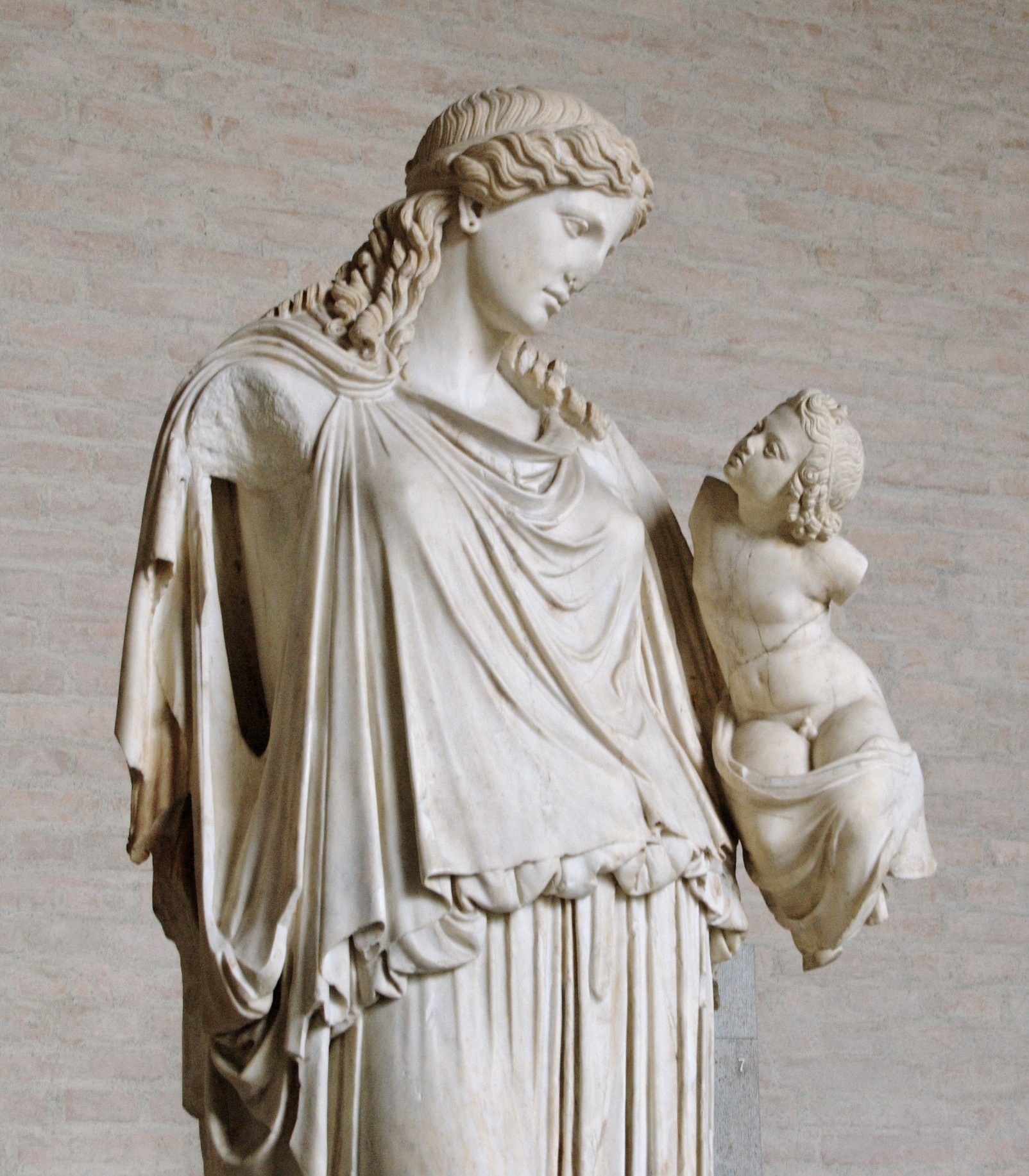
Athens put up a public statue of Peace holding the infant Wealth. Rome went much further: Fides, Concordia, Salus, Victoria, Libertas, Pietas and their colleagues received temples, priesthoods, coin types and vows. Harold Axtell catalogued the whole phenomenon from literature and inscriptions in 1907, and Anna Clark’s more recent study argues that these divine qualities were not simple reflections of pre-existing Roman values but were claimed, contested and reshaped by competing individuals and groups, precisely because public cult made them public property.[10][11]
The closest parallel, though, is not Mediterranean. It is next door.
| Tradition | Personified abstraction | Literal sense |
|---|---|---|
| Rigveda, book X | Manyu, Śraddhā, Dakṣiṇā | fury, trust, priestly fee |
| Gāthās (Old Avestan) | Vohu Manah, Aša Vahišta, Spəṇta Ārmaiti | good thought, best truth, holy devotion |
| Republican Rome | Fides, Concordia, Victoria | trust, concord, victory |
| Classical Greece | Eirene, Dikē, Nikē | peace, justice, victory |
The Avestan column is not a coincidence of the same kind as the Roman one. Spəṇta Ārmaiti is the exact linguistic cognate of Vedic Aramati, the “devotion” who flickers through the family books in a handful of verses.[3] In Iran that flicker became one of the six Aməša Spəntas, the Bounteous Immortals, and the Gāthās of Zarathustra construct almost an entire divine order out of such abstractions: Good Thought, Best Truth, Desirable Dominion, Holy Devotion, Wholeness, Immortality.[12] The Vedic and Iranian branches inherited the same raw material, the same words, the same willingness to address a quality, and then went in different directions with it. Iran built a systematic theology of abstractions; India kept its older nature gods and let the abstractions accumulate at the edges. The asura-daeva reversal is the famous case of the two traditions diverging from shared vocabulary. This one is less famous and, arguably, more consequential.
The habit that outlived the gods
Here is why any of this matters beyond taxonomy.
The Rigveda’s abstractions are minor deities. Nobody built a cult around Śraddhā; Manyu has fourteen verses against Indra’s roughly two hundred and fifty hymns. Counted by ritual importance they are a footnote. Counted by what they made possible, they are the hinge.
Once you can address a quality in the vocative, you can ask what a quality is. That question, asked persistently, is what produces the Upaniṣads. The tenth maṇḍala is already full of the intermediate steps: the Nāsadīya hymn reasoning about what existed before existence, the hymn to Vāc in which Speech herself declares her sovereignty in the first person, the hymn to a god named Who whose refrain is a question about which god deserves the offering. These are usually discussed as the beginnings of Indian philosophy. They are also, grammatically, the same operation the Manyu poet performs: take a word that does the work of describing, and promote it to the position of subject.
The payoff arrives in a text composed centuries later, and it arrives with two of our abstractions in the same sentence. The Kaṭha Upaniṣad opens with a boy watching his father give away worn-out cattle as the sacrificial fee:
taṃ ha kumāraṃ santaṃ dakṣiṇāsu nīyamānāsu śraddhāviveśa
“While the sacrificial gifts were being led away, trust entered him, boy though he was.”
Kaṭha Upaniṣad 1.1.2, after Olivelle (1998)
Dakṣiṇā and śraddhā, the fee and the trust, both of them Rigvedic goddesses; and śraddhā is the grammatical subject of a verb of entering. It comes into a person the way Manyu was asked to come and stand at the poet’s right hand. The boy then challenges his father, is sent to Death in a fit of temper, and asks the question the Upaniṣad exists to answer. The whole dialogue is set in motion by an abstraction behaving like an agent.
The same word went in a third direction as well. Śrāddha, the rite performed for the ancestors and still performed across India, is a derivative of śraddhā: a ceremony named for the trust it enacts. A word that began as a gesture of placing the heart became, in turn, an idiom, a goddess, a technical term of doctrine, and the name of a funeral.
Reading it again
The received story about the Rigveda is that it is a book of nature worship: fire, dawn, storm, river, the sun in its course. That is true of most of it, and the hymns to rivers and dawn are where its poetry is most immediately beautiful. But it is not the whole book, and the part usually left out is the part that mattered most for everything that came after.
Two observations to end with. First, the abstractions are not consolation. Manyu is asked for spoils, Dakṣiṇā for cattle, Śraddhā for the fulfilment of a specific spoken wish. These are working gods, invoked by people who wanted things. The move from concrete to abstract is not a move from crude to refined; it is a change in what the poets thought could be addressed, not in what they wanted.
Second, the experiment is visibly unfinished. Śraddhā gets five verses and no mythology. Manyu gets fourteen and no birth story. Dakṣiṇā gets eleven and no consort. Set beside the richly narrated older gods, these are sketches, and they read like a technique being tried out rather than a cult being maintained. The Rigveda’s most consequential innovation is also its least developed, which is often how innovations look from inside.
Read RV 10.83 straight through, then read the first page of the Kaṭha Upaniṣad. A thousand years and an entire intellectual revolution separate them, and the same grammatical trick is running underneath both: a quality, put in a position normally reserved for a person, and then taken seriously.
References
[1] Macdonell, Arthur A. & Keith, Arthur B. Vedic Index of Names and Subjects. 2 vols. John Murray, 1912. archive.org.
[2] Macdonell, Arthur A. A Vedic Reader for Students. Oxford University Press, 1917, Introduction, section 7 (“Religion of the Rigveda”). archive.org.
[3] Boyce, Mary. ‘ARMAITI.’ Encyclopaedia Iranica, vol. II, 1986. iranicaonline.org.
[4] Mayrhofer, Manfred. Etymologisches Wörterbuch des Altindoarischen. 3 vols. Carl Winter, 1992-2001, s.v. śrad-.
[5] Benveniste, Émile. Indo-European Language and Society. Trans. Elizabeth Palmer. Faber & Faber / University of Miami Press, 1973, Book 2, ch. 15 (‘Credence and Belief’). Originally Le vocabulaire des institutions indo-européennes, Éditions de Minuit, 1969.
[6] Köhler, Hans-Werbin. Śrad-dhā- in der vedischen und altbuddhistischen Literatur. Ed. Klaus L. Janert. Glasenapp-Stiftung Bd. 9. Wiesbaden: Franz Steiner Verlag, 1973.
[7] Malamoud, Charles. Cooking the World: Ritual and Thought in Ancient India. Trans. David Gordon White. Oxford University Press, 1996.
[8] Sims-Williams, Nicholas. ‘BAGA ii. In Old and Middle Iranian.’ Encyclopaedia Iranica, vol. III, 1988. iranicaonline.org.
[9] Witzel, Michael. ‘The Development of the Vedic Canon and its Schools: The Social and Political Milieu.’ In Inside the Texts, Beyond the Texts, ed. M. Witzel. Harvard Oriental Series, Opera Minora 2, 1997, pp. 257-345. michaelwitzel.org.
[10] Axtell, Harold L. The Deification of Abstract Ideas in Roman Literature and Inscriptions. University of Chicago Press, 1907. archive.org.
[11] Clark, Anna J. Divine Qualities: Cult and Community in Republican Rome. Oxford Classical Monographs. Oxford University Press, 2007. OUP.
[12] Boyce, Mary. A History of Zoroastrianism, Vol. I: The Early Period. Handbuch der Orientalistik. E. J. Brill, 1975.
Jamison, Stephanie W. & Brereton, Joel P. The Rigveda: The Earliest Religious Poetry of India. 3 vols. Oxford University Press, 2014. OUP.
Griffith, Ralph T. H. The Hymns of the Rigveda. E. J. Lazarus, 1896. archive.org.
Geldner, Karl F. Der Rig-Veda aus dem Sanskrit ins Deutsche übersetzt. Harvard Oriental Series 33-36. Harvard University Press, 1951.
Macdonell, Arthur A. Vedic Mythology. Karl J. Trübner, 1897. archive.org.
Oldenberg, Hermann. Die Religion des Veda. Wilhelm Hertz, 1894. archive.org.
Keith, Arthur B. The Religion and Philosophy of the Veda and Upanishads. Harvard Oriental Series 31-32. Harvard University Press, 1925.
Gonda, Jan. Die Religionen Indiens I: Veda und älterer Hinduismus. W. Kohlhammer, 1960.
Olivelle, Patrick. The Early Upaniṣads: Annotated Text and Translation. Oxford University Press, 1998.
Doniger O’Flaherty, Wendy. The Rig Veda: An Anthology. Penguin Classics, 1981.
Renou, Louis. Études védiques et pāṇinéennes. 17 vols. Publications de l’Institut de Civilisation Indienne, 1955-1969.
Comments (0)
No comments yet. Sign in to start the discussion.