Three Thousand Three Hundred and Thirty-Nine
A Census in the Middle of a Hymn
The ninth hymn of the third book of the Rigveda is an ordinary invitation to Agni. Bring the fire, kindle it, seat it as priest. Then, in the last verse, the poet does something no other Bronze Age hymnist I know of does. He counts the congregation.
trī́ṇi śatā́ trī́ sahásrāṇy agníṃ triṃśác ca devā́ náva cāsaparyan
“Three hundreds, three thousands, thirty gods and nine served Agni. They anointed him with ghee, they strewed the ritual grass for him, and then they seated him as their Hotar.”
RV 3.9.9, after Griffith (1896) and Jamison and Brereton (2014), with diacritics standardised.
Three thousand three hundred and thirty-nine. The verse was thought worth keeping: it turns up again, word for word, at RV 10.52.6, seven books away.[1]
What makes it strange is not the size of the number. Mesopotamian scribes were handling far larger quantities a thousand years earlier, and doing arithmetic with them. What makes it strange is the shape. A poet working in a culture with no writing, in a hymn meant to be memorised and chanted, stops to specify a figure to the last digit, and the figure is not round. It is not “a thousand gods”, which the metre would have accepted happily. It is 3,339, assembled in front of you out of thousands, hundreds, tens and units, in that order, like a number being read off a page that does not exist.
Elsewhere the same text says there are thirty-three gods. The tradition noticed the discrepancy early and has been explaining it ever since.
Numbers in the Rigveda have been left to the historians of mathematics, who mine the text for early evidence of decimal counting and then move on to the geometry of altars, and to the translators, who render the figures and rarely pause on them. Read through the corpus with the numbers highlighted, though, and a small unexpected portrait appears: of what these people counted, how accurately, how honestly, and what they did when a quantity was too large or too holy to count at all.
A Language Built to Count in Tens
Start with the vocabulary, because the vocabulary is the whole surprise.
Vedic has separate, unanalysable words for one through ten. Everything above ten is built out of those ten words plus a small set of multipliers: daśa (ten), śatá (hundred), sahásra (thousand). Eleven is ekādaśa, one-ten. Twenty is viṃśatí, thirty triṃśát, and so on up through navatí, ninety, each of them transparently the unit word wearing a suffix. There are no special words for twelve or eighty, no residue of an older base-twelve or base-twenty system lurking in the paradigm, no counting by scores.
That regularity is worth pausing on, because it is not the normal condition of a Bronze Age number vocabulary. Babylonian mathematics ran on base sixty with an internal decimal sub-structure, which is why we still cut an hour into sixty minutes. Egyptian hieroglyphic numerals were decimal but wrote each power of ten as a separate repeated sign, so writing 3,339 meant drawing thirty-nine symbols. Latin kept a subtractive habit so ingrained that eighteen was normally duodēvīgintī, “two from twenty”. French still counts eighty as four twenties. The Vedic system multiplies and adds and does nothing else.
| Number | Vedic | Avestan | Greek | Latin | English |
|---|---|---|---|---|---|
| 2 | dvá | dva | dúo | duo | two |
| 3 | tráyas | θrayō | treîs | trēs | three |
| 4 | catvā́ras | caθwārō | téttares | quattuor | four |
| 5 | páñca | panca | pénte | quīnque | five |
| 7 | saptá | hapta | heptá | septem | seven |
| 8 | aṣṭáu | ašta | oktṓ | octō | eight |
| 9 | náva | nava | ennéa | novem | nine |
| 10 | dáśa | dasa | déka | decem | ten |
| 100 | śatám | satəm | hekatón | centum | hundred |
The table is the ordinary comparative evidence for Indo-European, and it holds one quiet pleasure for a modern reader: when you count to ten in English you are using the same words the Rigvedic poets used, worn down by four thousand years of different mouths. Saptá and “seven” are the same word. So are náva and “nine”, dáśa and “ten”. The number one is the odd case: the branches built it from the same root with different suffixes, which is why éka and “one” do not line up the way saptá and “seven” do.[2]
Sahásra, thousand, has a tidy Iranian cousin in Avestan hazaŋra-, which becomes Persian hazār and turns up in the Urdu and Hindi of any bazaar today. Above a thousand the Rigveda has ayúta, ten thousand, which appears only in a handful of passages. That is where the text’s number words stop.
Aside. The decimal structure here is spoken, not written. Amartya Kumar Dutta, who has traced the Indian decimal system through its Vedic and post-Vedic stages, separates the two firmly: India developed an oral decimal nomenclature very early, and a written place-value notation very much later, and we do not know how, or whether, numbers were written down at all in Vedic times.[3] The Rigveda gives us the grammar of a decimal system with the notation missing.
The Arithmetic Inside the Line
Look again at what the poet of RV 3.9.9 actually says, in the order he says it:
$$3 \times 10^3 \;+\; 3 \times 10^2 \;+\; 3 \times 10 \;+\; 9 \;=\; 3339$$
That is a decomposition by descending powers of ten. It is what a place-value notation encodes silently by column position, done out loud, with the multipliers named. The same habit shows up in the riddle hymn, where the year appears as saptá śatā́ni viṃśatíḥ, “seven hundreds and twenty”, for the 720 days and nights of a 360-day year:
“Formed with twelve spokes, by length of time unweakened, the wheel of Law rolls round on heaven. Therein established, joined in pairs together, seven hundred sons and twenty stand.”
RV 1.164.11, translation Griffith (1896). On the hymn as a whole, see The Riddle Hymn.
Dutta singles out that phrase as an early example of verbal decimal terminology, and it is easy to see why: 720 is expressed as seven hundreds plus twenty, exactly the way you would read the digits 7-2-0 aloud if you had them.[3] You do not. That is the point.
The most enjoyable demonstration that the system was genuinely operational, rather than a few frozen formulas, is a hymn where the poet simply runs the ladder. In RV 2.18 the poet invites Indra to arrive with a chariot team, and then keeps adding horses.
| Step of the ladder | Horses invited |
|---|---|
| Counting by twos | two, four, six, eight |
| The first round unit | ten |
| Counting by tens | twenty, thirty, forty, fifty, sixty, seventy |
| The last rungs | eighty, ninety, a hundred |
The whole sequence runs across four consecutive verses (RV 2.18.4 onward), one ascending group per verse.
“Indra, come hitherward with two Bay Coursers, come thou with four, with six when invocated. Come thou with eight, with ten, to drink the Soma.”
RV 2.18.4, translation Griffith (1896).
Nothing in the theology requires this. Indra’s team is conventionally two bay horses, and the passage finishes by heaping a hundred on him because a hundred is the limit of enthusiasm, not because anyone imagines a hundred-horse chariot. What the passage does show is a poet in full command of the number series, walking up it by twos, then by tens, for the pleasure of the ascent. Counting was available as a poetic device. It is being used as one here, in front of us, in a hymn about horses.
The Biggest Numbers Are Receipts
Here is the result that changed how I read the text. If you sort the Rigveda’s numbers by size, the top of the list is not cosmology. It is accounting.
The largest explicit quantities in the corpus occur in dānastuti, the gift-praise appended to a hymn in which the poet names what a patron gave him. The genre is frank about its purpose and specific about its figures.
“Vibhindu, thou hast helped this man, giving him thousands four times ten, and afterward eight thousand more.”
RV 8.2.41, translation Griffith (1896). The Sanskrit gives the sum as catvā́ry ayútā, four ten-thousands, plus eight sahásra.
Forty thousand and eight thousand. Whether the cattle were ever assembled in one place is a separate question from whether the number could be stated, and the number is stated cleanly, using the largest unit the language offered and then falling back to the next one down. On gift economics and what a patron bought with a herd, see Dānastuti and Cattle as Wealth.
The other place big numbers cluster is the battle report, and there the precision becomes almost comic:
“With all-outstripping chariot-wheel, O Indra, thou far-famed, hast overthrown the twice ten kings of men, with sixty thousand nine-and-ninety followers, who came in arms to fight with friendless Suśravas.”
RV 1.53.9, translation Griffith (1896).
Sixty thousand and ninety-nine. Not sixty thousand. Not “a host beyond counting”, which is what a Homeric poet would reach for and what the Rigveda itself reaches for in other moods. The figure carries an odd tail, and the tail is what makes it feel like a quotation from a record that no longer exists.
Two readings are available, and the honest answer is that the evidence does not decide between them. The first is that these numbers descend from something real: tribute lists, herd counts, casualty tallies kept by the people whose business it was to keep them, entering the poetry secondhand. The second is that exactness is itself a rhetorical register, a way of sounding like a record, the way a modern advertisement says 99.7 percent rather than “nearly all”. Michael Witzel’s reconstruction of Rigvedic political life gives the first reading room to breathe: the poems were composed inside a working system of chiefly patronage in which the size of a gift was a public fact with consequences for everyone’s reputation.[4] A poet who inflated his patron’s generosity beyond recognition would have been caught by the audience that watched the cattle leave.
Methods note. Sorting the Rigveda’s figures by size is less straightforward than it sounds. Many quantities are adjectives rather than counts (sahasrín, “thousandfold”), several are compressed compounds whose arithmetic is a translator’s judgement call, and the corpus has no concordance organised by number. The figures cited here are the ones I can point to in a specific verse in a published translation. Treat “the largest number in the Rigveda” as a claim about what I found, not a census.
Ninety-Nine Forts
So the Rigveda can be exact. It is also, constantly, and without apology, approximate, and it uses the same vocabulary for both. The demon Śambara’s fortresses are the classic case.
“He, Indra, opened the ninety-nine forts of Śambara.”
RV 2.19.6, Sanskrit navatíṃ ca náva índraḥ púro ví airac chámbarasya, rendering after Griffith (1896).
Ninety-nine in one hymn, ninety in another, a hundred in a third.[5] Nobody was counting forts. The number is doing work of a different kind: a hundred means “as many as there could be”, ninety-nine means “a hundred, and I am telling you so with a straight face”.
| Number | Where it runs | What it means |
|---|---|---|
| śatá, 100 | hundred forts, hundred autumns, hundred aids | the full extent of a thing |
| sahásra, 1,000 | thousand-headed Puruṣa, thousandfold wealth | beyond the full extent |
| 99 | Śambara’s forts, Vṛtra’s coils | a hundred, delivered as testimony |
| 3,339 / 60,099 | gods, enemy dead | precision as a rhetorical effect |
| 7 | rivers, priests, sages, flames | a complete set, not a count |
The Rigveda’s most famous hundred is the one everyone still quotes: śatáṃ śarádaḥ, may we see a hundred autumns, discussed at length in A Hundred Autumns. Nobody in the Vedic world expected to live a hundred years. The number is a shape for a wish, not a projection.
And the thousand-headed, thousand-eyed, thousand-footed Puruṣa of RV 10.90 is not a creature with an inventory. Sahásra has been promoted out of arithmetic into the vocabulary of the boundless, the same way “myriad” left Greek ten-thousand behind and became a word for a lot. See The Cosmic Sacrifice for what that hymn is doing with the rest of its anatomy.
Three, Seven, and the Numbers That Sort the World
There is a third register, distinct from both the exact and the approximate, in which a number is not a quantity at all but a filing system.
Three worlds. Three soma pressings a day. Three sacrificial fires. Viṣṇu’s three strides. Jan Gonda devoted a 246-page monograph to the pattern, arguing that triadic structuring in the Veda is systematic rather than decorative: the triad is how Vedic thought divides a totality into a complete and manageable set.[6] Once you have noticed it you cannot stop noticing it, and the same is true of seven, which is what the Rigveda uses when it wants completeness with a different flavour: seven rivers, seven priests, seven sages, seven flames of Agni, seven metres. The division of ritual labour among a fixed set of priests is itself a counting scheme, described in Seven Cups.
Then the two combine. Tríḥ saptá, thrice seven, appears across the corpus as a formula for a set that is complete twice over, and the sum, twenty-one, matters less than the operation. This is the one place in the Rigveda where you can watch multiplication happening in the open, and its purpose is not calculation. It is emphasis.
Notice what this means for anyone trying to read Vedic numbers as data. The same numeral system serves three jobs at once: it counts cattle, it exaggerates enemies, and it classifies the furniture of the cosmos. Nothing in the grammar marks which job is in play. The reader has to judge, verse by verse, and translators quietly do exactly that on every page.
Fractions Are Theological
Vedic has no fractional notation and very little fractional vocabulary. What it has instead is the word pāda, foot, which also means a quarter: the quarter of an animal that touches the ground, the quarter-line of a four-line verse, the quarter of anything divisible by four.
That single word carries almost all of the Rigveda’s fractional thinking, and it turns up at two of the highest-pressure moments in the whole corpus.
“A quarter of him is all beings; three quarters of him is the immortal in heaven.”
RV 10.90.3, tripā́d asyāmṛ́taṃ diví, after Griffith (1896).
“Speech has been measured out in four parts. Those Brahmins who are wise know them. Three kept in close concealment cause no motion; of speech, men speak only the fourth part.”
RV 1.164.45, translation Griffith (1896).
In both verses the fraction is doing metaphysical work that no other device in the language could do as economically. The visible world is one quarter of what exists. Human speech is one quarter of what speech is. A ratio is being used to say that reality exceeds its appearance, and the ratio is the same ratio, three to one, in both places. On the second verse and the Rigveda’s habit of hiding things, see What the Rigveda Hides.
Smaller fractions exist but are rare and practical. A verse in the tenth book asks that a bad dream be gathered up yáthā kalā́ṃ yáthā śaphám, like a sixteenth, like an eighth, the vocabulary of part-payment applied to a nightmare (RV 10.164.5; the arithmetic is unpacked in Bad Dreams). Śaphá means hoof, and the standard explanation is that four cloven feet give eight parts. The fractions of the Rigveda are the fractions of a cattle economy, which is to say they are fractions of a cow.
The verse itself is a counting machine
The deepest numeracy in the Rigveda is not in any of its numbers. It is in its metre.
| Metre | Lines | Syllables per line | Total |
|---|---|---|---|
| Gāyatrī | 3 | 8 | 24 |
| Anuṣṭubh | 4 | 8 | 32 |
| Triṣṭubh | 4 | 11 | 44 |
| Jagatī | 4 | 12 | 48 |
Every verse in the corpus is a fixed syllable count, and a reciter who loses one syllable knows immediately that something is wrong, because the shape of the line collapses. That is an error-detection system built out of counting, running continuously, for three thousand years, across a text of more than ten thousand verses. The tradition then counted the verses, counted the hymns, and recorded the totals in its index literature. A culture without writing had no other way to know that its text was intact. See Meters of the Rig Veda and The Syllable Clock for how much historical information those counts turn out to carry.
How Many Gods, Then?
Back to the census. The Rigveda’s usual answer is thirty-three. The number is stated plainly at RV 8.30.2, and RV 1.139.11 gives its internal structure: eleven gods in heaven, eleven on earth, eleven in the waters. Arthur Macdonell, whose Vedic Mythology is still the reference work for this kind of question, treats thirty-three as the standard Rigvedic figure and the threefold division into terrestrial, atmospheric and celestial as its organising principle.[7]
So what is 3,339 doing?
The first Indian attempt to answer is also the earliest surviving commentary on the Veda. Yāska, in the Nirukta, proposes that the gods are really three, one for each of the three worlds: Agni on earth, Vāyu or Indra in the middle air, Sūrya in the sky. The rest of the pantheon consists of names given to those three “in consequence of their greatness, or of the diversity of their functions”, the way one priest is called hotṛ, adhvaryu, brahman or udgātṛ depending on which office he is performing at that moment.[8] It is a strikingly modern move: multiplicity of names is not multiplicity of beings.
Sāyaṇa, commenting in fourteenth-century Vijayanagara, applies the same logic to the arithmetic directly, treating the larger figure as an expression of the gods’ manifestations rather than as a rival census.[9] The Veda counts 3,339 and means 33, in the way that a count of appearances is not a count of persons.
graph TD
    A["RV 3.9.9: 3,339 gods"] --> B{Reconcile with 33?}
    B --> C["Yaska, Nirukta 7.5"]
    B --> D["Sayana, 14th c."]
    B --> E["Modern philology"]
    C --> F["Really three deities, many names"]
    D --> G["Manifestations, not persons"]
    E --> H["Two conventions, both formulaic"]
The modern reading is less tidy and probably closer to the truth. Thirty-three is a formula, with the neat threefold structure that formulas acquire. Three thousand three hundred and thirty-nine is a different kind of formula, one that says “all of them, more than you can hold in your head”, and says it in the most emphatic way the language allows: by naming every power of ten it has, in order, with the digit three at each level and a nine to finish. The number is a rhetorical crescendo wearing the costume of a headcount.
Aside. A popular reading decomposes 3,339 as 3,003 plus 303 plus 33 and connects those terms to calendrical intercalation. It appears widely online and in devotional literature. I have not found it in the scholarly literature on Vedic astronomy, and the arithmetic is compatible with almost any grouping one likes, which is the usual sign of a pattern imposed rather than found. Treat it as modern interpretation, not as Vedic evidence.
What Is Not There
Set out what this counting system lacks and the achievement comes into focus rather than dissolving.
There are no numeral symbols. The earliest surviving numeral signs in India are the Brahmi numerals of roughly the third to second centuries BCE, a thousand years or more after the Rigveda’s core hymns, and even those are not a place-value system: they use separate signs for the tens and hundreds rather than reusing the digits by position.[10]
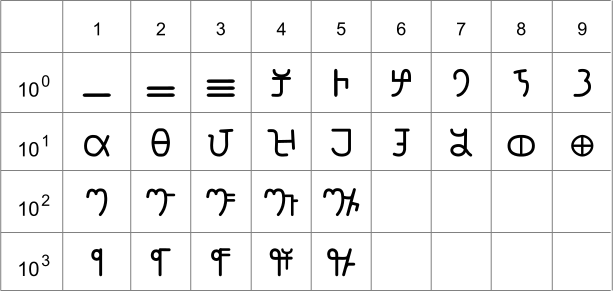
There is no zero, as a word or as a concept. The mathematical sense of śūnya belongs to a much later world, and the surviving evidence for a written zero used as a numeral is later still, in inscriptions and manuscripts of the mid to late first millennium CE whose dating is in several cases disputed.
There is no arithmetic. The Rigveda never adds, subtracts, divides or solves anything. The closest it comes is tríḥ saptá, and that is a figure of speech. Calculation enters the Vedic record with the ritual geometry of the Śulba Sūtras, centuries later, when someone had to build an altar of exactly a thousand bricks in the shape of a falcon and the problem became technical (The Mathematics of Vedic Altars).
And the number words themselves stop at ten thousand. That ceiling did not last. By the time of the Yajurveda Saṃhitā, a few centuries after the Rigveda’s core, the tradition had produced a named series of powers of ten running from eka up to parārdha, ten to the twelfth, recited in the ritual as a formula.[3] Nothing in between required it. Nobody was counting to a trillion of anything. Somebody had simply noticed that the naming system was extensible in principle, and extended it.
That is the shape of the whole story, and it is visible already in the hymn about Agni’s congregation. The Rigvedic poets inherited a counting language of unusual regularity, used it for cattle, enemies, horses, syllables and gods, and then, having no way to write it, left its logic sitting in the grammar where the next thousand years of Indian mathematics could find it.
timeline
    title Decimal counting, from speech to notation
    Rigveda : Decimal number words : ceiling at ayuta
    Yajurveda : Powers of ten to parardha : recited as formula
    Sulba Sutras : Ritual geometry : calculation begins
    c. 3rd-2nd c. BCE : Brahmi numerals : written, not positional
    Mid-1st millennium CE : Place value with zero : notation catches up
What Counting Was For
The Rigveda counts what it takes seriously, and the list is revealing: gods, cattle, horses, forts, enemies, syllables, years of a hoped-for life. It does not count people, or days, or distances, or possessions of any kind that a household would recognise as an inventory. Whatever bookkeeping existed in Vedic society, and something must have, the poems are not it. Numbers reach the hymns only when they carry prestige: when a patron’s generosity needs a figure attached to it, when an enemy’s defeat needs to be made vast, when the gods need to be understood as more numerous than the small, tidy thirty-three.
That last case is the one I keep returning to. A poet in the third book had a theological problem, that the divine is larger than any list of it, and he solved the problem with arithmetic. He did not say “beyond number”, which every religious tradition says. He gave a number so large and so specifically built that it performs its own excess: three thousands, three hundreds, thirty and nine, each power of ten named in turn, the whole structure of the decimal system laid out in a single line of verse before anyone in India had written down a digit.
The Rigveda records everything, and this piece of everything happens to be the earliest clear view we have of how the counting system that the world now uses actually sounded, in the mouths of people who used it to praise a fire.
Read RV 2.18 aloud and count the horses as they arrive: two, four, six, eight, ten, twenty, thirty, forty, and on to a hundred. The ladder is three thousand years old, and you already know every rung of it. For the Rigveda as a dataset rather than a set of hymns, see The Rig Veda by the Numbers; for what the text’s proper names accidentally record about the people who used those numbers, see An Accidental Census.
References
[1] Jamison, Stephanie W., and Joel P. Brereton. The Rigveda: The Earliest Religious Poetry of India. 3 vols. Oxford University Press, 2014. global.oup.com.
[2] Mallory, J. P., and D. Q. Adams. The Oxford Introduction to Proto-Indo-European and the Proto-Indo-European World. Oxford University Press, 2006.
[3] Dutta, Amartya Kumar. ‘Decimal System in India.’ In Encyclopaedia of the History of Science, Technology, and Medicine in Non-Western Cultures, Springer, 2015. link.springer.com.
[4] Witzel, Michael. ‘Rgvedic History: Poets, Chieftains and Polities.’ In The Indo-Aryans of Ancient South Asia, ed. George Erdosy. Berlin: de Gruyter, 1995, pp. 307-352.
[5] Griffith, Ralph T. H. The Hymns of the Rgveda. Benares: E. J. Lazarus, 1896. Widely reprinted; the standard older English rendering, used here where a literal parallel was wanted.
[6] Gonda, Jan. Triads in the Veda. Verhandelingen der Koninklijke Nederlandse Akademie van Wetenschappen, Afd. Letterkunde, Nieuwe Reeks vol. 91. Amsterdam: North-Holland Publishing Company, 1976. openlibrary.org.
[7] Macdonell, Arthur A. Vedic Mythology. Strassburg: Karl J. Trübner, 1897. archive.org.
[8] Yāska. The Nighaṇṭu and the Nirukta. Ed. and trans. Lakshman Sarup. Oxford University Press, 1920-27. (Nirukta 7.5 on the three deities and the multiplicity of divine names.) archive.org.
[9] Sāyaṇa. Ṛgveda-bhāṣya. 14th century. Cited here through the summaries in the modern commentarial literature rather than from the Sanskrit directly; readers wanting the primary text should consult Max Müller’s edition of the Saṃhitā with Sāyaṇa’s commentary (London, 1849-74).
[10] Plofker, Kim. Mathematics in India. Princeton University Press, 2009. press.princeton.edu.
[11] Macdonell, Arthur A. A Vedic Grammar for Students. Oxford: Clarendon Press, 1916. (Numerals and their inflection.) archive.org.
[12] Whitney, William Dwight. Sanskrit Grammar. 2nd ed. Leipzig: Breitkopf and Härtel, 1889. (Sections on the numerals and their syntax.) archive.org.
[13] Macdonell, Arthur A., and Arthur B. Keith. Vedic Index of Names and Subjects. 2 vols. London: John Murray, 1912. archive.org.
[14] Geldner, Karl Friedrich. Der Rig-Veda aus dem Sanskrit ins Deutsche übersetzt. Harvard Oriental Series 33-36. Harvard University Press, 1951.
[15] Oldenberg, Hermann. Prolegomena zur Metrik und Textgeschichte des Rigveda. Berlin: Wilhelm Hertz, 1888. (On metre and the syllabic structure of the text.) archive.org.
[16] Doniger O’Flaherty, Wendy. The Rig Veda: An Anthology. Penguin Classics, 1981.
[17] Sen, S. N., and A. K. Bag. The Śulbasūtras. New Delhi: Indian National Science Academy, 1983. (Edition and translation of the ritual geometry texts.)
[18] Keith, Arthur Berriedale. The Religion and Philosophy of the Veda and Upanishads. Harvard Oriental Series 31-32. Harvard University Press, 1925. archive.org.
Comments (0)
No comments yet. Sign in to start the discussion.