Counting the Sacred: The Meters of the Rig Veda
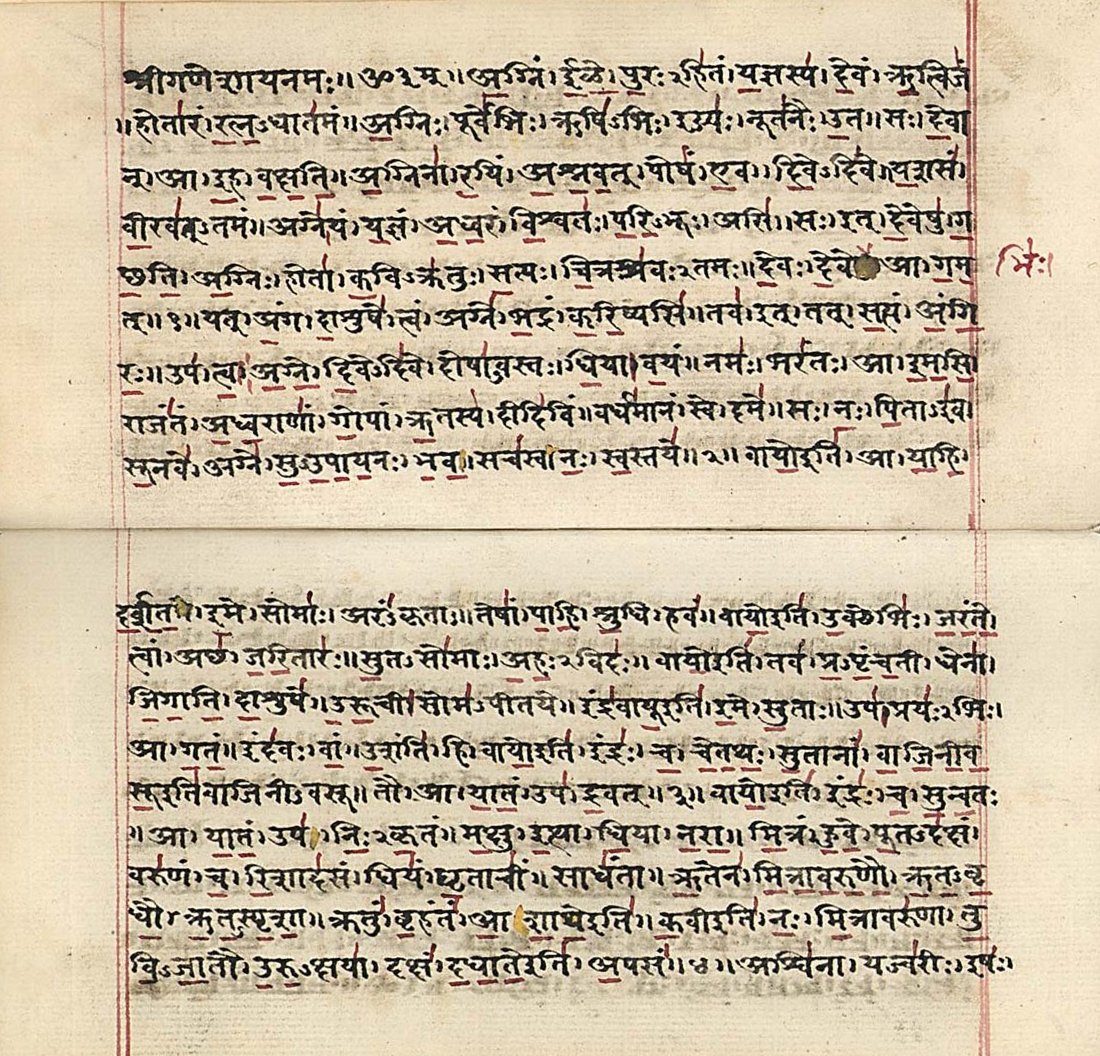
The Rig Veda was never prose. Every one of its roughly 10,600 verses is built to a syllable count, and the poets who shaped it counted those syllables the way a carpenter counts boards. The Sanskrit word for this craft is chandas, and the later tradition treated chandas as one of the six vedangas, the ‘limbs of the Veda’ a student had to master before the text could be recited correctly.
If you only remember three names, remember these: Gayatri, Tristubh and Jagati. Together they account for the overwhelming majority of the hymnbook.
Counting, not stressing
Vedic meter is quantitative and syllabic. A line, called a pada (‘foot’ or ‘quarter’), has a fixed number of syllables, and stanzas are classified by adding those padas together. The system climbs in steps of four syllables, which is why the named meters line up so neatly.
Here is the family of common meters, ordered by length:
| Meter | Padas x syllables | Total syllables |
|---|---|---|
| Gayatri | 3 x 8 | 24 |
| Ushnih | 8 + 8 + 12 | 28 |
| Anushtubh | 4 x 8 | 32 |
| Brihati | 8 + 8 + 12 + 8 | 36 |
| Pankti | 5 x 8 | 40 |
| Tristubh | 4 x 11 | 44 |
| Jagati | 4 x 12 | 48 |
The opening (the early syllables of a pada) is treated as relatively free, while the cadence (the closing syllables) tends toward a fixed rhythm, often an iambic close. A.A. Macdonell and, in greater statistical detail, E.V. Arnold showed that these cadences are regular enough to help date hymns, since the older family books are metrically stricter than the later additions.
The three workhorses
Tristubh is the single most frequent meter in the Rig Veda. Its eleven-syllable line carries the great hymns to Indra and much of the heroic, narrative material. Gayatri, with its three short lines, is the meter of brisk, repeated invocation; it dominates the Soma book and many Agni hymns. Jagati, one syllable longer per line than Tristubh, often appears mixed into Tristubh hymns for variety.
The most famous single stanza in all of Sanskrit, the Gayatri mantra (RV 3.62.10, attributed to the seer Vishvamitra), is named after its meter:
tat savitur varenyam / bhargo devasya dhimahi / dhiyo yo nah pracodayat
Three lines, eight syllables each, twenty-four in all. The meter is so identified with the verse that ‘the Gayatri’ came to mean this prayer specifically.
Mixing and matching
Hymns are not always built from a single meter. A poet may open in Jagati and close in Tristubh, or set a Tristubh hymn with one Jagati stanza as a kind of signature. The tradition gave names to stanzas of mixed lines, such as the brihati and satobrihati that combine eight- and twelve-syllable padas, and Mandala 8 in particular is full of these pragatha pairings. The result is that meter carries information beyond the count: the choice of a meter, and any deviation from it, was itself meaningful to a trained ear.
There is a theological layer too. The Brahmanas, the later prose manuals of the ritual, treat each meter as a power with its own character: Gayatri is linked with Agni and with the priestly class, Tristubh with Indra and with strength, Jagati with the All-Gods and with cattle. Whether or not a Rig Vedic poet thought in exactly those terms, the pairing of certain meters with certain deities is visible already in the Samhita, which is part of why the count and the content cannot be cleanly separated.
Meter and the history of the text
The strictness of the meter is also a historical fingerprint. E.V. Arnold’s 1905 study Vedic Metre in its Historical Development showed that the family books (Mandalas 2 to 7), the oldest core, follow the metrical rules most tightly, while later strata, such as much of Mandala 1 and Mandala 10, allow looser cadences and more irregular lines. When a verse breaks the expected pattern, an editor sometimes suspects a later insertion or a line disturbed in transmission. Reading the meter, in other words, is one way of reading the layers of the book.
There is also a practical subtlety the reciter learns early. Vedic poets frequently restored a syllable that ordinary pronunciation had contracted, so that indra might be sung as three syllables where speech would give two. Scholars call this metrical restoration, and it means the meter sometimes preserves an older pronunciation than the written text suggests. The count, once again, is doing the remembering.
Why the counting mattered
Meter was not decoration. It was a preservation technology. Because a reciter knew exactly how many syllables a line must hold, a dropped or added syllable announced itself as an error. Combined with the fixed pitch accents of Vedic recitation, the syllable count acted as a checksum that kept the text stable across roughly three thousand years of oral transmission.
Counting the corpus
The numbers also explain the shape of the book as a whole. The Rig Veda is conventionally counted as ten Mandalas, 1,028 hymns, and a little over ten thousand verses. Because meters fix the verse length, scholars can speak meaningfully of the average hymn length, the distribution of meters across the Mandalas, and the way the Soma book (Mandala 9) leans on the short Gayatri while the Indra hymns favour the longer Tristubh. None of that would be possible if the verse were free in length. The meter is what makes the Rig Veda a countable, comparable object rather than an undifferentiated mass of poetry, and that countability is exactly what later editors, grammarians, and modern philologists have all relied on.
- Vedic meter (chandas) counts syllables, not stress; meters grow in steps of four syllables.
- Gayatri (24), Tristubh (44) and Jagati (48) carry most of the Rig Veda; Tristubh is the most common.
- Line openings are loose, cadences are fixed; the regularity helps scholars date hymns.
- The Gayatri mantra (RV 3.62.10) is named for its meter, three lines of eight syllables.
References
Macdonell, Arthur A. A Vedic Grammar for Students. Oxford: Clarendon Press, 1916. (On Vedic meter and cadence.) archive.org.
Arnold, E. Vernon. Vedic Metre in its Historical Development. Cambridge University Press, 1905.
Jamison, Stephanie W. & Brereton, Joel P. The Rigveda: The Earliest Religious Poetry of India. Oxford University Press, 2014. global.oup.com.
‘Vedic metre.’ Wikipedia. en.wikipedia.org/wiki/Vedic_metre.
‘Gayatri Mantra.’ Wikipedia. en.wikipedia.org/wiki/Gayatri_Mantra.
Griffith, Ralph T. H. The Hymns of the Rgveda (English translation, 1896). Sacred Texts: sacred-texts.com/hin/rigveda.
Comments (0)
No comments yet. Sign in to start the discussion.