Yoke First, Posture Later: What the Rigveda Actually Says About Yoga
A Word That Smelled of Leather and Horse Sweat
Before it meant anything spiritual at all, yoga was a piece of carpentry. It was the wooden crossbar you laid across the necks of two animals, and the act of getting them under it: the pole steadied, the traces drawn, the pin dropped, the moment when two separate creatures with separate intentions become one moving thing. Anyone who has watched a bullock team backed into a cart knows the small violence and precision of it. That object is yuga (Sanskrit: युग), a cousin of the English word yoke. That act is yoga.
Now open the Rigveda at RV 5.81, a hymn of five verses to Savitṛ, the god of the sun in the act of impelling things. It is the last hour before daylight. The poets are about to speak. And the hymn opens with a verb you would expect from a stable, not a shrine:
yuñjate mána utá yuñjate dhíyo víprā víprasya bṛható vipaścítaḥ
“They yoke the mind, and they yoke the insights, the inspired poets of the inspired, lofty, discerning one.”
Rigveda 5.81, verse 1. After Jamison and Brereton (Oxford 2014); Griffith 1896 has “harness their spirit, yea, harness their holy thoughts.”
Nobody is sitting cross-legged. Nobody is counting breaths. A group of professionals, about to perform the most demanding verbal act in their culture, are treating their own attention the way a driver treats two nervous horses at first light: something to be gathered, aligned, and hitched to a pole before it will pull in one direction.
That single sentence is the oldest place in Indo-European literature where the yoking image turns inward. It is not a yoga system. There is no posture, no breath count, no eight limbs, no teacher, no student. The claim that the Rigveda contains yoga in the modern sense is false, and I am going to say so plainly. But the claim that the Rigveda contains nothing relevant is equally false, and duller. What it contains is the engine: a verb, an image, and a discipline of attention that later traditions would take apart and rebuild. This piece follows that word from a Bronze Age harness to the fourth century CE, and argues that the honest version of the story is more interesting than the inflated one.
The Yoke Before the Metaphor
Start with the linguistics, because it settles an argument that otherwise runs forever. The Sanskrit root yuj descends from Proto-Indo-European *yeug-, “to join,” and it left the same object behind in every daughter language that kept livestock. The cognate set is one of the tidiest in comparative philology, which tells you the word was already old and already concrete when Indo-Iranian speakers carried it east.
$$ {}^{*}\textit{yeug-} \;\longrightarrow\; \begin{cases} \textit{yuj-},\ \textit{yuga-} & \text{Sanskrit} \ \textit{iung\={o}},\ \textit{iugum} & \text{Latin} \ \textit{ze'{u}gnumi},\ \textit{zug'{o}n} & \text{Greek} \ \textit{iuka-} & \text{Hittite} \ \textit{geoc} \rightarrow \textit{yoke} & \text{Old English} \end{cases} $$
In every branch the primary sense is the crossbar and the act of coupling, and the extended senses grow out of that: pairing, joining, bringing under control.
| Language | Form | Primary sense | Modern descendants in English |
|---|---|---|---|
| Sanskrit | yuj-, yuga-, yoga- | to yoke; the yoke; the yoking | yoga |
| Latin | iungō, iugum | to join; yoke | join, conjugal, subjugate, jugular |
| Greek | zeúgnumi, zugón | to yoke; yoke, pair | zygote, syzygy |
| Hittite | iuka- | yoke | (none direct) |
| Old English | geoc | yoke | yoke |
| Lithuanian | jùngas | yoke | (none direct) |
Now the Rigvedic evidence itself. Counting is easy, because the noun is rare: yoga occurs on the order of twenty times across the roughly 1,028 hymns of the Saṃhitā, and in none of those places does it mean anything like meditation.[1] It means the hitching-up, and by extension the undertaking that the hitching-up begins: a raid, a trek, a campaign, an enterprise with a prize at the end of it.
sá ghā no yóga ā́ bhuvat sá rāyé sá púraṃdhyām
“May he be there for us at the yoking, he for wealth, he for fullness of thought; may he come to us with prizes.”
Rigveda 1.5, verse 3. Sanskrit after the Van Nooten and Holland metrical text; translation after Wilson and Griffith.
The god addressed is Indra, and the request is entirely practical. Be with us when we hitch up. The most famous instance goes further and turns the word into a rhythm:
yóge-yoge tavastaraṃ vā́je-vāje havāmahe sákhāyo índram ūtáye
“At every yoking, at every prize-contest, we friends call on Indra, the stronger one, for help.”
Rigveda 1.30, verse 7. After Griffith (1896), with diacritics standardised.
Yoge-yoge, vāje-vāje. Yoking after yoking, contest after contest. This is the vocabulary of a mobile pastoral society that measured its year by when the carts moved and when they stopped. Wilhelm Rau, working through the social vocabulary of the Vedic texts, showed that early Indo-Aryan life alternated between phases of movement and phases of settled dwelling, and that the texts mark the second with kṣema and its relatives, from the root kṣi, “to dwell.”[2] Yoga is the other half of that pair: the season of harnessing and going out. The compound yogakṣema, which by the time of the Bhagavad Gītā means something like “acquisition and preservation,” is a fossil of that older rhythm.[3]
And then there is the verse that makes poets of us all:
| Rigveda passage | Form of yuj | What is being yoked | Sense |
|---|---|---|---|
| RV 1.5.3 | yóga (loc.) | the team, implicitly | the undertaking |
| RV 1.30.7 | yóge-yoge | the team, implicitly | every expedition |
| RV 10.114.9 | yógam (acc.) | poetic metres | the joining, the fitting-together |
| RV 5.81.1 | yuñjáte (verb) | manas and dhī | harnessing the mind |
RV 10.114.9 deserves its own moment. The verse is a riddle: káś chandasāṃ yógam ā́ veda dhī́raḥ, “what discerning one knows the yoking of the metres?” A poet is asking who understands how syllables are harnessed into a line. It is a technical question about craft, and it uses yoga exactly as a wheelwright would. If you have ever wondered why Indian traditions treat metrical composition, ritual, and meditation as neighbouring skills, this verse is a good place to start; see also our piece on the poet as carpenter.
Aside. Beware the etymological fallacy in both directions. That yoga originally meant “yoking” does not prove that classical yoga is “really” about harnessing, any more than the Latin origin of “salary” proves your paycheck is really salt. Words drift. What the etymology does establish is the shape of the metaphor the tradition inherited, and which of two competing later derivations has the older claim. Pāṇini’s grammarians recognised both yujir yoge, “to yoke,” and yuj samādhau, “to concentrate”; the Rigveda knows only the first.
The Verse Where the Horses Become Thoughts
Return to RV 5.81 and read the whole hymn, which takes about ninety seconds. It is attributed to Śyāvāśva Ātreya and addressed to Savitṛ, the “impeller,” the aspect of the sun that sets things in motion rather than merely shining. The hymn’s structure is the argument.
Verse one: the poets yoke mind and insight. Verse two: Savitṛ puts on all forms, sends out good things for the two-footed and the four-footed, and shines out along the track of Dawn. Verse three: he has measured out the earthly spaces; the other gods follow his going-forth. Verse four: he traverses the three realms of light and joins himself with the rays of the sun.
Notice the sequence. Human beings harness their attention first. Then the sun sets out. The hymn is not describing a technique; it is describing a moment, the hinge of the night into the day, and it puts the poets’ mental preparation on the same footing as the sun’s departure. The universe and the mind are both getting under way, and the same verb covers both.
The word that carries the weight is dhī (Sanskrit: धी). It is not “thought” in the ordinary sense. Jan Gonda devoted an entire monograph to it in 1963 and concluded that its semantic nucleus is vision: not eyesight, but a supranormal seeing that puts the poet in contact with a reality he then has to formulate in words.[4] The dhī is what arrives; the hymn is what the poet builds out of it. A dhīra, the word used in RV 10.114.9, is someone possessed of dhī, which is why translating it as “wise man” undersells it.
So RV 5.81.1 says something quite precise. These men are yoking two things: manas, the mind understood as the faculty that runs off in all directions, and dhī, the visionary insight that is about to be needed. That is a description of a mental operation performed at a specific time of day for a specific purpose, by people whose livelihood depended on doing it well. It is not yoga. It is, unmistakably, the ancestor of one of yoga’s central claims: that attention is a thing you can take hold of.
The tradition itself noticed. Centuries later, the Śvetāśvatara Upaniṣad, the first Sanskrit text to use yoga in something close to its technical sense, opens its second chapter by quoting the Savitṛ verses of the Rigveda almost verbatim before it turns to posture and breath.[5] Whoever composed that chapter went looking for a Vedic anchor for the new discipline, and this is the passage they reached for. They were not wrong about where to look.
Methods note. Attribution in the Rigveda runs through the Anukramaṇī, a much later index of poets, deities, and metres. When I say RV 5.81 is by Śyāvāśva of the Atri clan, that is the Anukramaṇī speaking, not the hymn. Traditional attributions are useful data about how the collection was organised and understood; they are not independent evidence about authorship.
For the other half of the Savitṛ story, including the most recited verse in the entire corpus, see Savitṛ, the Impeller. The Gāyatrī of RV 3.62.10 asks Savitṛ to impel our insights, using the same word, dhiyaḥ, as our verse. Two hymns, one preoccupation: the mind at dawn, and who is driving it.
Heat
The second thing the Rigveda contributes to later yoga is not a word for practice but a word for what practice costs. Tapas (Sanskrit: तपस्) is heat, from the root tap, “to be hot, to burn.” In the Rigveda it is a cosmological force before it is an ascetic one, and it is fierce.
ṛtáṃ ca satyáṃ cābhī́ddhāt tápaso ‘dhy ajāyata
“Cosmic order and truth were born from kindled heat; from that, night; from that, the billowing ocean.”
Rigveda 10.190, verse 1. After Griffith (1896) and Wilson, with diacritics standardised.
Read that again with an engineer’s eye. The claim is that the two load-bearing concepts of Vedic thought, ṛta (the order that holds things in their courses) and satya (truth as that which is), are outputs of a thermal process. Something was heated, and order condensed out of it. The famous creation hymn makes the same move at its own hinge: tápasas tán mahinā́jāyataíkam, “by the power of heat, that One was born.”[6] Whatever else tapas is, it is generative. It makes things exist.
Turn from cosmology to biography and tapas becomes a human capacity with a destination attached:
tápasā yé anādhṛṣyā́s tápasā yé svàr yayúḥ tápo yé cakriré mahás tā́ṃś cid evā́pi gachatāt
“To those unassailable through heat, to those who went to the sun through heat, to those who made great heat: go to them.”
Rigveda 10.154, verse 2. After Wilson and Griffith, with diacritics standardised.
This is a funeral hymn, and it is telling the dead man where to go. The company he is being sent to join includes heroes who fell in battle, poets, and these people, whoever they are, who generated great heat and reached the sun by it. Nothing here describes what they did. There is no seated posture, no breath retention, no vow. But a category exists: people whose religious status came from self-generated intensity rather than from sponsoring a sacrifice. That category is the seed from which the entire renunciate world of the first millennium BCE would grow, and it is already present in the latest layer of the Rigveda.

Two cautions about tapas. First, do not import the later moralised sense of “penance” into these verses; nothing in the Rigveda suggests that heat is generated to expiate anything. Second, the Rigveda never tells us the technique. Fasting, sitting between fires, sleeplessness, silence, continence: the word covers all of these in later literature and specifies none of them here. Tapas named a recognised kind of religious effort whose content we cannot recover from this text alone.
The Man Who Flies, and What He Is Not
Every history of yoga eventually arrives at RV 10.136, seven verses about the keśin, the long-haired one, who wears the wind, is “crazed by asceticism,” has mounted upon the winds, and tells mortals that they see only his body. It is the closest thing in the Rigveda to a portrait of a practitioner, and it has carried more interpretive weight than any seven verses should.
I have written a full close reading of that hymn elsewhere and will not repeat it here; see The Long-Haired One. What matters for this argument is narrow. Karel Werner’s landmark 1977 study read the hymn as evidence that ecstatic practitioners existed in Vedic society and that their experience fed the tradition, while conceding the crucial point: the Rigveda does not describe yoga.[7] The hymn gives us a figure and a claim about his experience. It gives us no method. You cannot reconstruct a practice from it, which is precisely why so many incompatible practices have been read into it.
The other candidate figures are equally thin on technique. The vrātya, the band-member outside settled society, gets an entire book of the Atharvaveda to himself, and it is full of cosmological speculation and short on instructions.[8] What the Vedic period gives us is a vocabulary for religious outsiders, not a manual.
Aside. A recurring methodological failure in popular histories of yoga is the argument from a single passage. One hymn, seven verses, no parallels, and an interpretive tradition that reaches from solar allegory to shamanism to drug-taking: the correct response to such a text is to state what it supports and stop, not to make it the foundation of a chronology. Where a claim rests on RV 10.136 alone, treat the claim as resting on nothing much.
The Seal That Was Not a Yogi
In 1931 John Marshall published the Mohenjo-daro excavation report and described a small steatite seal showing a horned figure seated with heels together and knees splayed, surrounded by animals. He called it a proto-Śiva and read the posture as yogic. The identification was repeated for eighty years, and it is where the claim that yoga is five thousand years old comes from.
It has not survived scrutiny. Doris Srinivasan’s iconological reassessment argued that the figure has no three faces and no yogic posture, that Rudra in Vedic literature is not a lord of wild animals, and that the figure is better read as a divine bovine male, a bull-man of fertility and abundance.[9] Geoffrey Samuel, writing the standard modern history of yoga’s origins, treats the yogic reading as speculative and notes that the meaning of the figure will stay unknown while the Harappan script stays undeciphered.[10] The seal is a genuine Bronze Age artifact of enormous interest. It is not evidence of yoga.
The deeper problem is a category error. Cross-legged seated postures are a human universal in societies without chairs, and they show up in religious art wherever such societies produce religious art.
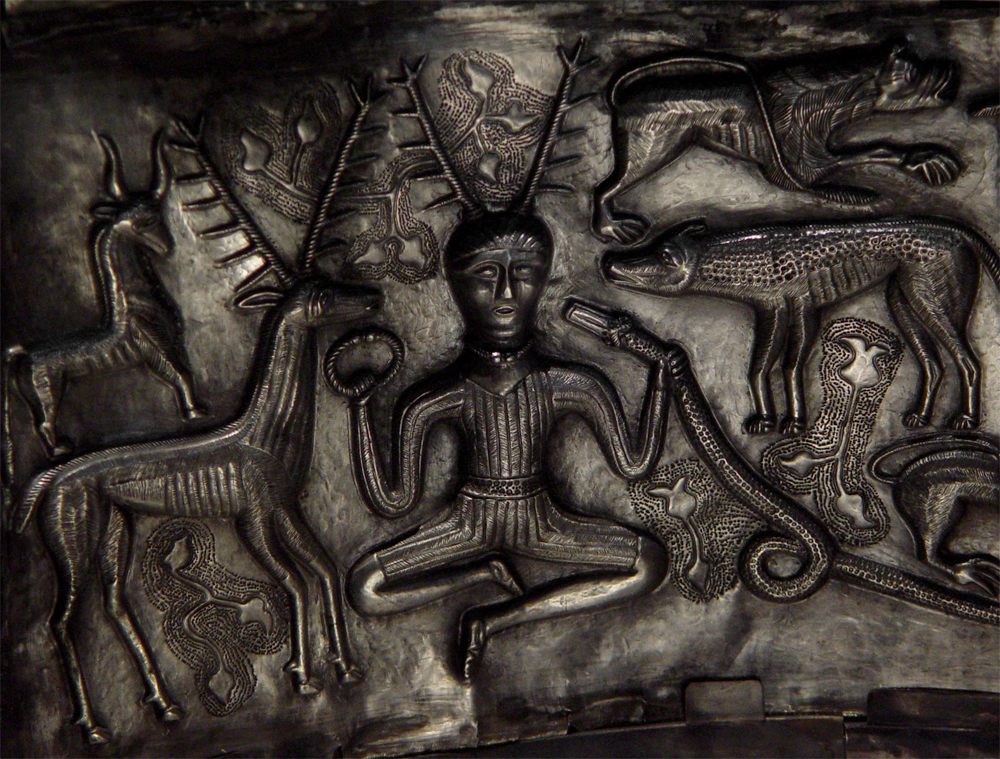
Here is where the main claims stand, stated as flatly as the evidence allows:
| Claim | Evidence offered | Current status |
|---|---|---|
| Yoga is 5,000 years old, shown by the Indus seal | Mohenjo-daro seal 420, Marshall 1931 | Rejected by specialists; posture and identification both contested[9][10] |
| The Rigveda describes yoga practice | RV 10.136, RV 5.81.1 | Not supported; no technique is described anywhere in the text[7] |
| The Rigveda supplies yoga’s central metaphor and vocabulary | yuj, yoga, dhī, tapas, the chariot | Well supported; the words and the image are demonstrably Rigvedic |
| Systematic yoga emerges in the śramaṇa and Upaniṣadic milieu | Kaṭha, Śvetāśvatara, Maitrī; early Buddhist and Jain sources | Mainstream position, roughly fifth century BCE onward[10][11] |
| Modern postural yoga descends directly from ancient āsana practice | Twentieth-century lineage claims | Substantially revised; the postural repertoire is largely modern[12] |
Where the Chariot Went Inside
The interesting question is not whether the Rigveda has yoga. It is how the yoking image made the jump from horses to minds and then to a system. The answer is visible in the texts, and it happens through a single sustained metaphor.
The Kaṭha Upaniṣad, composed some centuries after the Rigveda, takes the Vedic chariot and puts the human being in it:
“Know the self as a rider in a chariot, and the body as simply the chariot. Know the intellect as the charioteer, and the mind as simply the reins. The senses, they say, are the horses, and the sense objects are the paths around them.”
Kaṭha Upaniṣad 3.3 to 3.4, after Patrick Olivelle (Oxford 1996).
Every element of that image is Rigvedic hardware. The chariot, the reins, the horses, the driver: this is the vehicle that Indra rides, that the Aśvins race, that Uṣas drives out at dawn across a thousand verses. What the Upaniṣad does is reassign the parts. And once the parts are reassigned, the old verb comes back with a new object. A few pages later, the same text gives us the first definition of yoga as a practice in Sanskrit literature:
“When senses are firmly reined in, that is Yoga, so people think. From distractions a man is then free, for Yoga is the coming into being, as well as the ceasing to be.”
Kaṭha Upaniṣad 6.11, translated by Patrick Olivelle (Oxford 1996).
Sthirām indriyadhāraṇām: the steady holding of the senses. The horses are still there. They have simply become the eyes, the ears, the tongue, the skin. Whoever wrote that verse was not inventing a metaphor; they were cashing one in, and they expected their audience to hear the chariot behind it.
graph TD
    A["PIE *yeug-, to join"] --> B["Vedic yuj: harness animals"]
    B --> C["RV 1.5.3, 1.30.7: yoga as enterprise"]
    B --> D["RV 5.81.1: yoking mind and dhi"]
    B --> E["RV 10.114.9: yoking of metres"]
    F["RV tapas: generative heat"] --> G["Renunciate milieu, c. 500 BCE"]
    H["RV 10.136: the kesin"] --> G
    D --> I["Katha Up.: chariot of the self"]
    I --> J["Katha 6.11: yoga defined"]
    G --> J
    J --> K["Svetasvatara 2: posture, breath"]
    K --> L["Maitri 6.18: six limbs"]
    L --> M["Patanjalayogasastra, c. 400 CE"]
The rest follows quickly. The Śvetāśvatara Upaniṣad quotes the Savitṛ verses and then gives what appears to be the earliest posture and breath instruction in Sanskrit: hold the body erect in its three upper parts, draw the senses inward, breathe gently through the nose, and choose a level, clean, quiet place free of gravel and fire.[5] The Maitrī Upaniṣad enumerates six limbs of yoga: breath control, withdrawal of the senses, meditation, concentration, contemplative reasoning, and absorption.[11] Patañjali, whose Pātañjalayogaśāstra is dated on critical-edition grounds to roughly 400 CE, expands the list to eight and opens with a definition that is still, structurally, a restraint metaphor: yogaś citta-vṛtti-nirodhaḥ, the stilling of the turnings of thought.[13]
$$ \textit{yuj-} \;\longmapsto\; \begin{cases} \text{harness the team to the pole} & \text{Rigveda, literal} \ \text{harness mind and vision} & \text{RV 5.81.1} \ \text{hold the senses steady} & \text{Kaṭha Upaniṣad 6.11} \ \text{still the turnings of thought} & \text{Yogasūtra 1.2} \end{cases} $$
One detail is worth holding onto, because it demolishes a great deal of marketing. Patañjali’s text names no postures at all. It devotes a single aphorism to posture, sthira-sukham āsanam, “the seat should be steady and comfortable,” and moves on.[14] The elaborate standing sequences that fill a modern studio are a much later development, and the specifically modern repertoire owes a great deal to twentieth-century physical culture, as Mark Singleton documented in detail.[12] This is not a debunking. It is a clarification of what is old and what is new, and both turn out to be more interesting once separated.
What the Rigveda Actually Offers a Modern Reader
Here is the thing I did not expect when I started reading these hymns against the history of yoga. The Rigveda is a worse source than the marketing claims and a better one than the debunkers imply, and the reason is that it preserves something the later systems assume without explaining: the original problem.
Patañjali tells you to still the turnings of thought. He does not tell you what that felt like to somebody encountering it for the first time. RV 5.81.1 does, by accident, because the poet reached for the only image available to him. Attention is a pair of animals. They are strong, they are useful, they are not yours by default, and getting them under one pole before the light comes is work that has to be done fresh every morning. That is a more honest description of what happens when a person sits down to concentrate than most things written since.
Three observations to close.
First, the continuity is real but it runs through vocabulary and metaphor, not through practice. Nobody in the Rigveda is doing yoga. Everybody in the Rigveda is doing something that yoga would later name: harnessing a faculty that does not want to be harnessed, at a specific hour, for the sake of an act that has to be performed exactly right.
Second, the discontinuity is where the interesting history lives. The move from yoga as a raid to yoga as restraint of the senses took the better part of a thousand years, and it happened in a period of enormous religious argument involving Buddhists, Jains, and Upaniṣadic teachers who were not always friendly to the Vedic sacrifice. The word survived that argument by changing sides. Johannes Bronkhorst has argued at length that the ascetic practices classical yoga inherited come substantially from non-Vedic sources in the eastern Gangetic plain.[15] Whether or not one accepts the strong form of that thesis, the fact that it can be seriously argued tells you how much happened between RV 5.81 and Patañjali.
Third, and this is the part worth taking off the page: the Vedic version of the practice is verbal, not postural. The discipline it describes is the discipline of speaking well after having seen clearly, at dawn, with the mind gathered. If you want to try the oldest form of this that survives anywhere, you do not need a mat. You need to get up before the sun, not speak for a while, and then say something difficult and true. The Rigveda thought that was the hardest thing a person could do. Having tried it, I am not sure it was wrong.
Open RV 5.81 at first light, before you have spoken to anyone, and read the five verses through once. Then read RV 10.129, the creation hymn, where cosmic order comes out of heat and the poem ends by admitting it does not know. Those two texts, twenty lines between them, contain more of yoga’s actual intellectual inheritance than any number of claims about five thousand years. For the wider frame, see The Nāsadīya Sūkta and A Hundred Autumns, which follows the Vedic idea of a long life to its limits.
A Short Glossary
| Term | Devanagari | Sense in the Rigveda | Later sense |
|---|---|---|---|
| yuj | युज् | to harness, to yoke animals | to concentrate, to unite |
| yoga | योग | the yoking; an expedition or enterprise | disciplined practice; union |
| yuga | युग | the yoke, the crossbar | a world-age |
| dhī | धी | visionary insight; inspired thought | intellect, meditation (dhyāna) |
| tapas | तपस् | generative heat; ascetic intensity | austerity, penance |
| manas | मनस् | mind as the wandering faculty | mind as the internal organ |
| ṛta | ऋत | the order things run in | superseded by dharma |
References
Grassmann, Hermann. Wörterbuch zum Rig-Veda. Leipzig: F. A. Brockhaus, 1873. archive.org. The standard word-by-word index of the Rigveda; occurrence lists for yoga and yuj are drawn from it.
Rau, Wilhelm. Staat und Gesellschaft im alten Indien nach den Brāhmaṇa-Texten dargestellt. Wiesbaden: Otto Harrassowitz, 1957.
Witzel, Michael. ‘On the Origin of the Literary Device of the “Frame Story” in Old Indian Literature.’ In Hinduismus und Buddhismus: Festschrift für Ulrich Schneider, ed. H. Falk. Freiburg, 1987, pp. 380-414.
Gonda, Jan. The Vision of the Vedic Poets. The Hague: Mouton, 1963. archive.org.
Olivelle, Patrick, trans. Upaniṣads. Oxford World’s Classics. Oxford University Press, 1996. Śvetāśvatara Upaniṣad 2.1 to 2.15, including the Rigvedic borrowings at 2.4 and 2.5.
Jamison, Stephanie W., and Joel P. Brereton. The Rigveda: The Earliest Religious Poetry of India. 3 vols. Oxford University Press, 2014. OUP.
Werner, Karel. ‘Yoga and the Ṛg Veda: An Interpretation of the Keśin Hymn (RV 10, 136).’ Religious Studies 13, no. 3 (1977): 289-302. Cambridge Core.
Whitney, William Dwight, trans. Atharva-Veda Saṃhitā. Harvard Oriental Series 7-8. Cambridge, MA: Harvard University Press, 1905. Book 15, the Vrātya book. archive.org.
Srinivasan, Doris. ‘The So-Called Proto-Śiva Seal from Mohenjo-Daro: An Iconological Assessment.’ Archives of Asian Art 29 (1975-76): 47-58.
Samuel, Geoffrey. The Origins of Yoga and Tantra: Indic Religions to the Thirteenth Century. Cambridge University Press, 2008. CUP.
Olivelle, Patrick, trans. Upaniṣads. Oxford University Press, 1996. Kaṭha Upaniṣad 3.3 to 3.9 and 6.10 to 6.11; for the Maitrī six-limbed yoga see the Maitrāyaṇīya Upaniṣad 6.18 onward.
Singleton, Mark. Yoga Body: The Origins of Modern Posture Practice. Oxford University Press, 2010. OUP.
Maas, Philipp A. Samādhipāda: Das erste Kapitel des Pātañjalayogaśāstra zum ersten Mal kritisch ediert. Aachen: Shaker Verlag, 2006.
Mallinson, James, and Mark Singleton, trans. Roots of Yoga. Penguin Classics, 2017.
Bronkhorst, Johannes. The Two Sources of Indian Asceticism. Bern: Peter Lang, 1993. See also Greater Magadha: Studies in the Culture of Early India. Leiden: Brill, 2007.
Griffith, Ralph T. H., trans. The Hymns of the Rigveda. Benares: E. J. Lazarus, 1896. wikisource.
Wilson, H. H., trans. Ṛig-Veda Sanhitā. London: W. H. Allen, 1850-88. archive.org.
Macdonell, Arthur A. Vedic Mythology. Strassburg: Karl J. Trübner, 1897. archive.org. On Savitṛ, see sections 12 and 13.
van Nooten, Barend A., and Gary B. Holland, eds. Rig Veda: A Metrically Restored Text. Harvard Oriental Series 50. Cambridge, MA: Harvard University Press, 1994. text.
White, David Gordon. The Yoga Sutra of Patanjali: A Biography. Princeton University Press, 2014. PUP.
Eliade, Mircea. Yoga: Immortality and Freedom. Trans. Willard R. Trask. Bollingen Series 56. Princeton University Press, 1958. Cited as a historically influential reading whose Indus-Valley arguments are no longer accepted.
Marshall, John. Mohenjo-Daro and the Indus Civilization. 3 vols. London: Arthur Probsthain, 1931. archive.org.
Comments (0)
No comments yet. Sign in to start the discussion.