The God Who Fell Silent: Dyaus Pita and the Faded Sky Father
The name that outlived the god
There is exactly one Rigvedic deity whose name a linguist can reconstruct backward through five thousand years and pronounce with something close to certainty. It is not Indra, who dominates the hymns. It is not Agni, who opens the collection. It is a god so faint in the Rigveda that a casual reader can finish the whole Samhita and barely notice him: Dyaus, the Sky.
Say his full title aloud, Dyauṣ Pitṛ (Sanskrit: द्यौष्पितृ, “Sky Father”), and you are speaking a phrase older than Sanskrit, older than the Rigveda, older than any text on earth. Shift it into Greek and it becomes Zeus Patēr. Into Latin it collapses into a single word, Iuppiter, from the older Diespiter. The Illyrians of the Balkans said Deipaturos. These are not similar names. They are the same name, inherited from a common ancestor and worn down along four separate roads for four thousand years. Comparative philology has few results as clean as this one. The Sky Father is the most secure single fact we possess about the religion of the Proto-Indo-Europeans.
Here is the paradox that this article is about. In Greece that Sky Father became the king of the gods, the thunder-wielding sovereign of Olympus. In Rome he became the state itself, Iuppiter Optimus Maximus, in whose temple the Republic kept its treaties. And in India, where his name survived most transparently of all, he became almost nothing. Not a single hymn in the Rigveda is addressed to Dyaus alone. He appears mostly as half of a compound, yoked to the Earth, a grammatical dual with no independent voice. The god whose name we can still say turns out to be the god who had almost nothing left to say.
This is the story of that silence: what Dyaus was, what the Rigveda actually gives him, why he faded while his cousins rose, and where he went when he went quiet.
The article ahead moves from the reconstructed name to the thin Rigvedic evidence, through a genuine textual puzzle (did Indra kill his own father?), and out into the larger question comparative mythology has argued over for a century: why does the same inherited god end up supreme in one culture and vestigial in another?
The one name we can still pronounce
Start with the linguistics, because that is where the certainty lives. The reconstructed Proto-Indo-European form is *Dyēus ph₂tḗr, built from the root *dyeu-, “to shine,” specifically the shining of the daytime sky. The same root generates the ordinary Vedic word dyaus (“sky, day, heaven”), the Latin dies (“day”), and, through a derived adjective *deiwós (“celestial, of the bright sky”), the entire Indo-European vocabulary for divinity: Sanskrit deva, Latin deus and divus, Lithuanian Dievas, Old Norse tívar (“gods”).[1] Hold that last point. It matters for the ending.
The god himself surfaces across the family with unusual consistency. The table below lays out the correspondence. What to watch is not just the name but the epithet father, because the survival of a two-word ritual formula across separated languages is far stronger evidence than a shared name alone.
| Branch | Reflex of the god | “Father” formula preserved? |
|---|---|---|
| Vedic | Dyauṣ Pitṛ | Yes: Dyauṣ Pitṛ |
| Greek | Zeus Patēr (Ζεῦ πάτερ) | Yes: Zeus Patēr |
| Latin | Iuppiter (from Diēspiter) | Yes: Diēs-piter |
| Illyrian | Deipaturos | Yes |
| Germanic | Týr (from *Tīwaz) | Name only, formula lost |
| Baltic | Latvian Dievs, Lith. Diēvas | Name only |
| Anatolian | Hittite šiuš (“god”), Palaic Tiyaz | Name/appellative |
Aside. Why the fuss over one word? Because father here is not sentiment. When Vedic priests, Greek poets, and Roman magistrates independently address their sky god with the reflex of the same inherited word for “father,” and do so in fixed liturgical phrases, the odds of coincidence collapse. Linguists call this an inherited formula, and Calvert Watkins built a whole method on tracing them.[2] The Sky Father formula is one of the oldest recoverable pieces of human religious language.
Two things follow. First, *Dyēus was not primarily a storm god or a war god. His name means the bright sky, the vault of daylight, and by extension the luminous dwelling of the gods. He was, as Mallory and Adams put it, less a personality than “the gateway to the deities,” the father of the Dawn goddess and of the Divine Twins.[3] Second, his consort is almost as reconstructible as he is: the Earth, *Dʰéǵʰōm, the wide dark ground against which the bright sky stands. Sky and Earth, father and mother, the oldest married couple in the Indo-European imagination. In the Rigveda they are Dyava-Prithivi, and, tellingly, they are almost always mentioned together. Which is exactly the problem.
A god with no hymns of his own
Arthur Macdonell, whose Vedic Mythology (1897) remains the standard reference catalogue of the Rigvedic pantheon, states the situation plainly: Dyaus is invoked, but not one hymn is addressed to him by himself.[4] He lives almost entirely in the dual. Six whole hymns are dedicated to the conjoined pair Heaven-and-Earth, Dyava-Prithivi: RV 1.159, 1.160, 1.185, 4.56, 6.70, and 7.53. Beyond these, the dual compound recurs throughout the collection, and the individual name Dyauṣ Pitṛ pierces the surface at a handful of famous verses: 1.89.4, 1.90.7, 1.164.33, 1.191.6, 4.1.10, 4.17.4.[5]
To feel the asymmetry, set it against the numbers you meet everywhere else in this corpus. Indra carries roughly a quarter of the Rigveda, on the order of 250 hymns (see Indra and the arithmetic of the Rigveda). Agni takes some 200. Even the Earth, Dyaus’s own wife, does slightly better than her husband: she gets one short hymn to herself, the three-verse RV 5.84. The Sky Father gets zero. The reconstructed head of the Indo-European pantheon is, in the oldest Indian text, outscored by a three-stanza afterthought to the ground.
| Deity | Approx. hymns dedicated | Share of Rigveda |
|---|---|---|
| Indra | ~250 | ~25% |
| Agni | ~200 | ~20% |
| Soma (esp. Mandala 9) | ~120 | ~12% |
| Dyava-Prithivi (the pair) | 6 | under 1% |
| Prithivi alone | 1 | negligible |
| Dyaus alone | 0 | none |
So what does the text actually say about him, in the scattered lines where he appears? The imagery is old and physical, not theological. Dyaus is a bull, vṛṣabha, who bellows: the thunder is his roar, and the rain that falls to fertilize the Earth is read, without much euphemism, as his seed.[6] Heaven and Earth are twinned as two vast bowls or two world-halves (rodasi) turned toward each other, holding the cosmos between them. In the riddle hymn of Dirghatamas, the sky is the father who begets and the great Earth is the mother and kin (see The riddle hymn of RV 1.164). The verse is worth quoting because it is the clearest self-statement Dyaus ever gets, and even here he is one term in a family, not a sovereign:
Dyaus is my father, the begetter; the navel is here. This great Earth is my kin and my mother.
(RV 1.164.33, after Jamison and Brereton)
Notice what is absent. There is no throne, no court of gods over which Dyaus presides, no myth in which he decrees or judges or wins. He is paternity and weather. He is the fact of the sky, personified just enough to be called Father and then left standing in the background while the active gods do the work.
Heaven and Earth, the two world-halves
If Dyaus has a genuine role in Rigvedic cosmology, it is structural rather than dramatic, and it belongs to the pair rather than to him. Heaven and Earth are the frame of the world. They are addressed as the universal parents, the two who hold all creatures, the pair that never fails. RV 1.160 gives the register:
These two, Heaven and Earth, wide and far-extending, the two great world-halves, the poet reveres, the two well-endowed, whose children are the gods, who by their law uphold the tribes of the living.
(RV 1.160.1-2, after Jamison and Brereton, condensed)
There is a cosmogonic puzzle folded into this imagery, and it is one of the most important in the Veda. If Heaven and Earth are the parents of the gods, then at some point they must have been separated, pried apart to open the space in which everything exists. A married couple locked together leaves no room for a world. And the Rigveda does describe this separation, this propping-apart of the two halves, as a creative act of the highest importance. But here is the strange part: the god who performs it is never Dyaus. It is Indra, or Varuna, or Vishnu, who is credited with holding the two worlds apart and fixing the sky in place.[7] The Sky Father is acted upon. He is the raw material of creation, not its author. Even in his own foundational myth he is passive, the thing that gets separated rather than the one who separates.
graph TD
    PIE["PIE *Dyeus Pter (Sky Father)"]
    PIE --> V["Vedic: Dyaus Pita"]
    PIE --> G["Greek: Zeus Pater"]
    PIE --> L["Latin: Diespiter / Jupiter"]
    PIE --> I["Illyrian: Deipaturos"]
    PIE --> T["Germanic: Tiwaz / Tyr"]
    V --> F["Faded: 0 solo hymns"]
    G --> K["King of the gods"]
    L --> S["God of the Roman state"]
    T --> W["Reduced to war/justice"]
The diagram makes the comparative scandal visible. From one ancestor, five very different fates. In Greece and Rome the Sky Father climbs to the summit. In the Germanic north Tyr, whose name is the same root, is demoted to a one-handed god of war and legal oaths, eclipsed by Odin. And in India, where the name survives most faithfully, the god survives least. The persistence of the name and the disappearance of the god move in opposite directions.
Methods note. Beware the temptation to read the reconstructed *Dyēus back into the Rigveda as if the fuller “original” god had merely been forgotten. We do not have the Proto-Indo-European religion; we have a reconstruction assembled precisely by comparing the descendants, including Dyaus. Using the reconstruction to explain the descendant risks circularity. What we can say with confidence is narrower and more interesting: the same inherited figure took radically different paths, and the Vedic path led downhill.
Did Indra kill his father?
The most provocative evidence for Dyaus’s fall is not his silence but a possible act of violence buried in Mandala 4. The Vamadeva hymns include a dark, elliptical passage about Indra’s birth and its aftermath, and one verse has been read for over a century as an accusation of patricide. In RV 4.18, a voice asks Indra:
Who made your mother a widow? Who sought to slay you, the still one and the moving? What god was at hand for you in the fight, when you slew your father, seizing him by the foot?
(RV 4.18.12, after Jamison and Brereton)
Read literally, Indra kills his own father and makes his mother a widow. And if the father is the Sky, the verse is a myth of generational overthrow of exactly the kind familiar from Greece, where Zeus dethrones Kronos, who had dethroned Ouranos, the Sky. The Vedic version would be more compressed and more shocking: the storm-god son does not merely displace the Sky Father, he drags him down by the foot and kills him.
Here scholarship divides, and honestly. Some read the “father” of the verse as Dyaus and take the passage as a genuine, if fragmentary, succession myth, a Vedic echo of the widespread Indo-European pattern in which a younger, more dynamic god supplants the old Sky.[8] Others are cautious: the hymn is notoriously obscure, the “father” is not named as Dyaus in the line itself, and the killing may refer to Tvashtr (Indra’s adversary and, in some tellings, his father) or to another figure entirely. Jamison and Brereton treat the birth-of-Indra material in this hymn as deliberately riddling, resistant to a single clean narrative.[9] The verse does not prove that Indra slew the Sky.
But consider what even the uncertainty tells us. In no other Indo-European tradition would it be an open question whether the storm-god had murdered the Sky Father, because in the others the Sky Father is too central, too vividly characterized, to be dispatched in a single ambiguous line and forgotten. That the question can even be asked of the Rigveda, that Dyaus is faint enough for his own death to pass almost unremarked, is itself the strongest measure of how far he had already fallen by the time these hymns were composed. A god you can kill in a subordinate clause is a god already most of the way gone.
Why the Sky Father faded
So why did it happen here? Why did the transparently inherited head of the pantheon end up a vestige in India while flourishing on the Mediterranean? There is no single proven answer, but the shape of the explanation is well understood, and it is about the redistribution of jobs.
A high god is a bundle of functions: sovereignty, law, weather, war, light, fatherhood. When we watch what became of those functions in the Rigveda, we find them not abolished but reassigned, parceled out to more vivid specialists. The sovereignty and the guardianship of cosmic law (ṛta) migrated to Varuna, the watchful binding god who oversees oaths and order (see Varuna and the weight of cosmic guilt). The storm, the thunder, the war-making, and the sheer noise that a sky god ought to command went wholesale to Indra, who took the bull imagery, the roar, and the rain along with them. The pure luminosity of the daytime sky was claimed by the solar gods, Surya and Savitr. What was left for Dyaus, once the interesting work had been given away, was the bare physical fact of the sky and the role of father. Personified weather. A background.
| Function of the Sky Father | Where it went in the Rigveda | Where it stayed in Greece/Rome |
|---|---|---|
| Sovereignty, cosmic law | Varuna (with Mitra) | Zeus / Jupiter |
| Storm, thunder, war | Indra | Zeus the thunderer |
| Solar light | Surya, Savitr | Apollo / Helios (partly Zeus) |
| Rain, fertilizing sky | Parjanya, Indra | Zeus / Jupiter Pluvius |
| Fatherhood, cosmic frame | Dyaus (residual) | Zeus / Jupiter as king-father |
Read across the rows, and the Vedic column is a diaspora. The single sky god of the reconstructed religion has been broken into a committee, and Dyaus kept only the least active portfolio. In Greece and Rome the reverse happened: one god annexed the neighboring functions and consolidated them into a sovereign personality. Georges Dumezil, whose comparative work framed Indo-European religion as a system of three social functions (sovereignty, force, fertility), read the Vedic sovereignty itself as split, shared between the two faces of Mitra and Varuna, the god of contract and the god of the binding oath.[10] If even sovereignty is a partnership in the Vedic imagination rather than a throne, there was never a vacancy for a single sky-king to fill. The structure that produced Zeus was simply not the structure the Vedic poets were working in.
Aside. There is a tidy irony in the fact that the two gods who absorbed most of Dyaus’s substance, Indra and Varuna, are the two whose own etymologies are least secure and least clearly Indo-European. The god with the impeccable pedigree faded; the gods with the murky origins thrived. Antiquity of name and prominence in worship, it turns out, have almost nothing to do with each other. Cult follows usefulness, not lineage.
Two cautions before we push this too far. First, faded is not the same as absent. Dyaus is still there, still called Father, still one of the two parents invoked to protect and to prosper. He is diminished, not deleted. Second, the fading is not evidence that the Rigveda is somehow degenerate or that its poets had lost the “true” religion. It is evidence of the opposite: a living tradition reorganizing an inherited pantheon around the gods that actually mattered to the people singing, the war-leader Indra and the fire-priest Agni, and letting the abstract inheritance recede. Religions keep what they use.
Dissolved into the word for god
There is a last turn, and it is the most elegant thing about the whole story. Recall that the name Dyaus comes from *dyeu-, “to shine,” and that from the same root the Indo-European languages built their common adjective for “celestial, shining,” *deiwós, which became the ordinary word for a god: Sanskrit deva, Latin deus, Old Norse tívar, Lithuanian Dievas. The Sky Father did not simply shrink. He dispersed into the vocabulary. Every time a Vedic poet says deva, “god,” every time the priests invoke the devas as a class, they are using a word that means, at its root, “the bright celestial ones,” the children and kindred of the shining sky. Dyaus lost his hymns and became the adjective under which all the other gods are grouped. He stopped being a god and became the word for divinity.
The Rigveda even stages his replacement. In a famous verse the goddess Aditi, “boundlessness,” is declared to be everything, the sky included:
Aditi is the sky; Aditi is the air; Aditi is the mother, the father, the son. Aditi is all the gods; Aditi is what has been born and what will be born.
(RV 1.89.10, after Jamison and Brereton)
Aditir dyaur, “Aditi is the sky.” The very heaven that had a personal name and a father’s title is here folded into an abstraction, absorbed into a formula of totality. This is the Vedic mind at its most characteristic, restless with fixed personalities, always reaching past the named god toward the impersonal principle behind him, the same reaching that will produce the brahman of the Upanishads. Dyaus was too concrete a thing, the sky, to survive that pull intact. He evaporated upward into philosophy.
What matters here is the double disappearance. Dyaus fell out of cult, his functions redistributed to livelier gods, and he fell out of personhood, dissolved into the generic word deva and folded into abstractions like Aditi. The one Indo-European god we can name with the most confidence is the one who most thoroughly stopped being a character. Somewhere in that fact is a lesson about the difference between what a religion inherits and what it worships. The pedigree survives in the grammar; the devotion goes elsewhere.
To read Dyaus properly, then, is to read for absence. Open the six Dyava-Prithivi hymns and notice how rarely the Sky acts on his own, how completely he lives in the dual, how the poets reach past him to Indra when something needs doing and to Aditi when something needs to be everything. Then say his name once more, Dyauṣ Pitṛ, and remember that you are pronouncing Zeus and Jupiter at the same time, in a tradition that kept the sound and let the god go quiet. The name that outlived the god is not a failure of memory. It is a record of what the Vedic poets chose to carry forward and what they were content to leave behind, luminous and nearly nameless, holding up the far edge of the sky.
References
Mallory, J. P. & Adams, D. Q. The Oxford Introduction to Proto-Indo-European and the Proto-Indo-European World. Oxford University Press, 2006. OUP.
Watkins, Calvert. How to Kill a Dragon: Aspects of Indo-European Poetics. Oxford University Press, 1995. OUP.
Mallory, J. P. & Adams, D. Q. Encyclopedia of Indo-European Culture. Fitzroy Dearborn, 1997.
Macdonell, Arthur A. Vedic Mythology. Karl J. Trubner, 1897. archive.org.
Jamison, Stephanie W. & Brereton, Joel P. The Rigveda: The Earliest Religious Poetry of India. 3 vols. Oxford University Press, 2014. OUP.
Macdonell, Arthur A. & Keith, Arthur B. Vedic Index of Names and Subjects. 2 vols. John Murray, 1912. archive.org.
West, M. L. Indo-European Poetry and Myth. Oxford University Press, 2007. OUP.
Oberlies, Thomas. Die Religion des Rgveda. Sammlung De Nobili, 1998.
Jamison, Stephanie W. & Brereton, Joel P. The Rigveda: A Guide. Oxford University Press, 2020. OUP.
Dumezil, Georges. Mitra-Varuna: An Essay on Two Indo-European Representations of Sovereignty. Trans. Derek Coltman. Zone Books, 1988 (French orig. 1948).
Griffith, Ralph T. H. The Hymns of the Rigveda. E. J. Lazarus, 1896. archive.org.
Keith, Arthur B. The Religion and Philosophy of the Veda and Upanishads. Harvard Oriental Series, 1925. archive.org.
Puhvel, Jaan. Comparative Mythology. Johns Hopkins University Press, 1987.
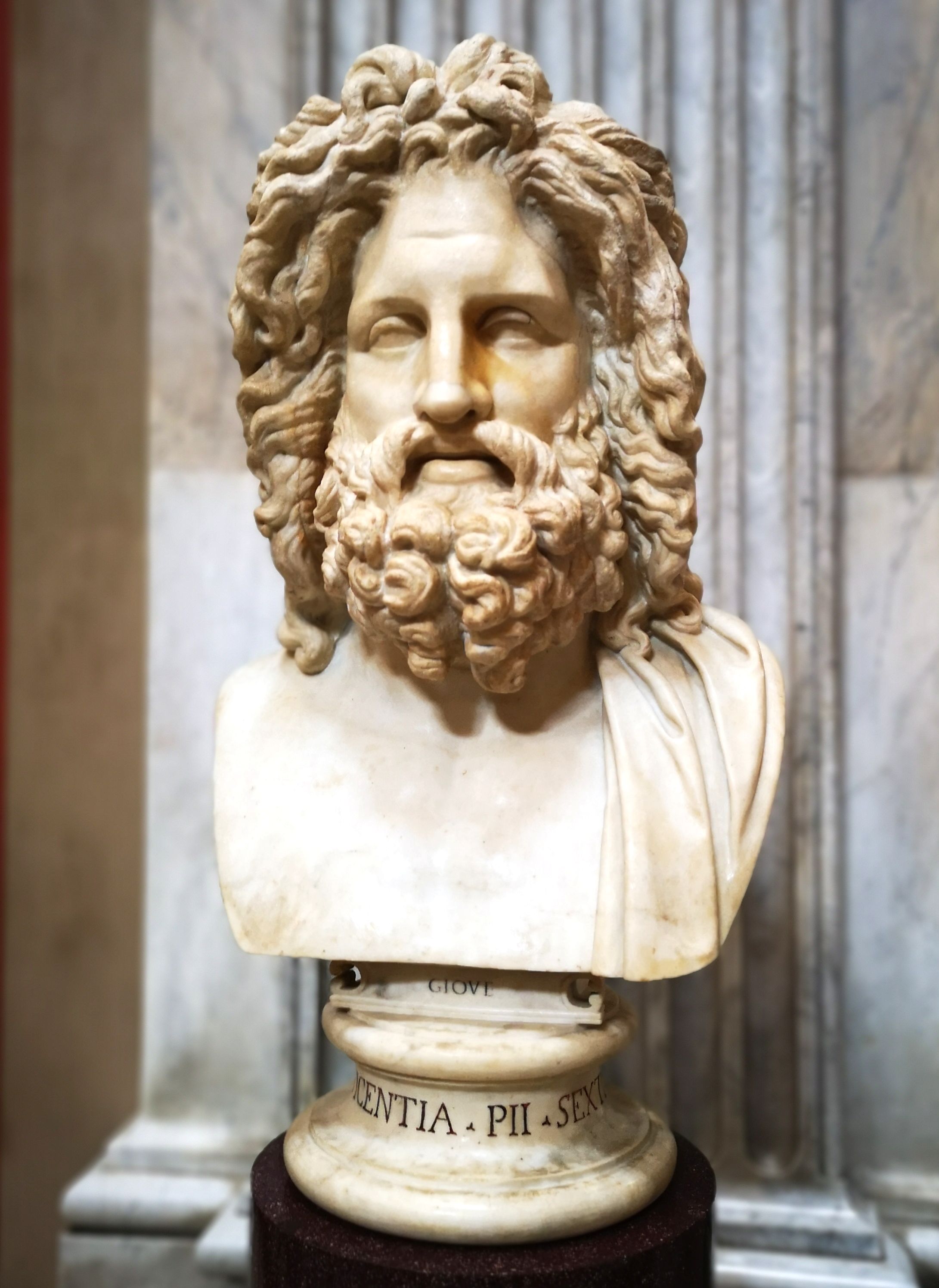
Figure 1. The Roman Jupiter, here the colossal "Zeus of Otricoli" in the Vatican. Latin Iūpiter preserves the vocative of the Proto-Indo-European sky father *Dyēus ph₂tḗr almost intact, the very compound that survives in Vedic as Dyáuṣ Pitṛ́; the god who ruled the sky for Greece and Rome had already faded to a near-silent presence in the Rigveda. Photograph by Biser Todorov, from Wikimedia Commons, File:Jupiter statue, Vaticana.jpg, CC BY 4.0.
Comments (0)
No comments yet. Sign in to start the discussion.