The Beast With a Hand: The Rig Veda's Missing Tiger and the Animals Its Poets Could Not Name
Nothing Comes Back
Load a machine-readable Rig Veda, one with both the Devanagari and a romanised transcription, and run a search for vyāghra, the ordinary Sanskrit word for tiger. In roughly 10,500 verses, across ten books composed over several centuries, nothing comes back. Not once. Search the Devanagari separately, in case the transliteration is hiding something, and you get the same result: व्याघ्र, zero hits.
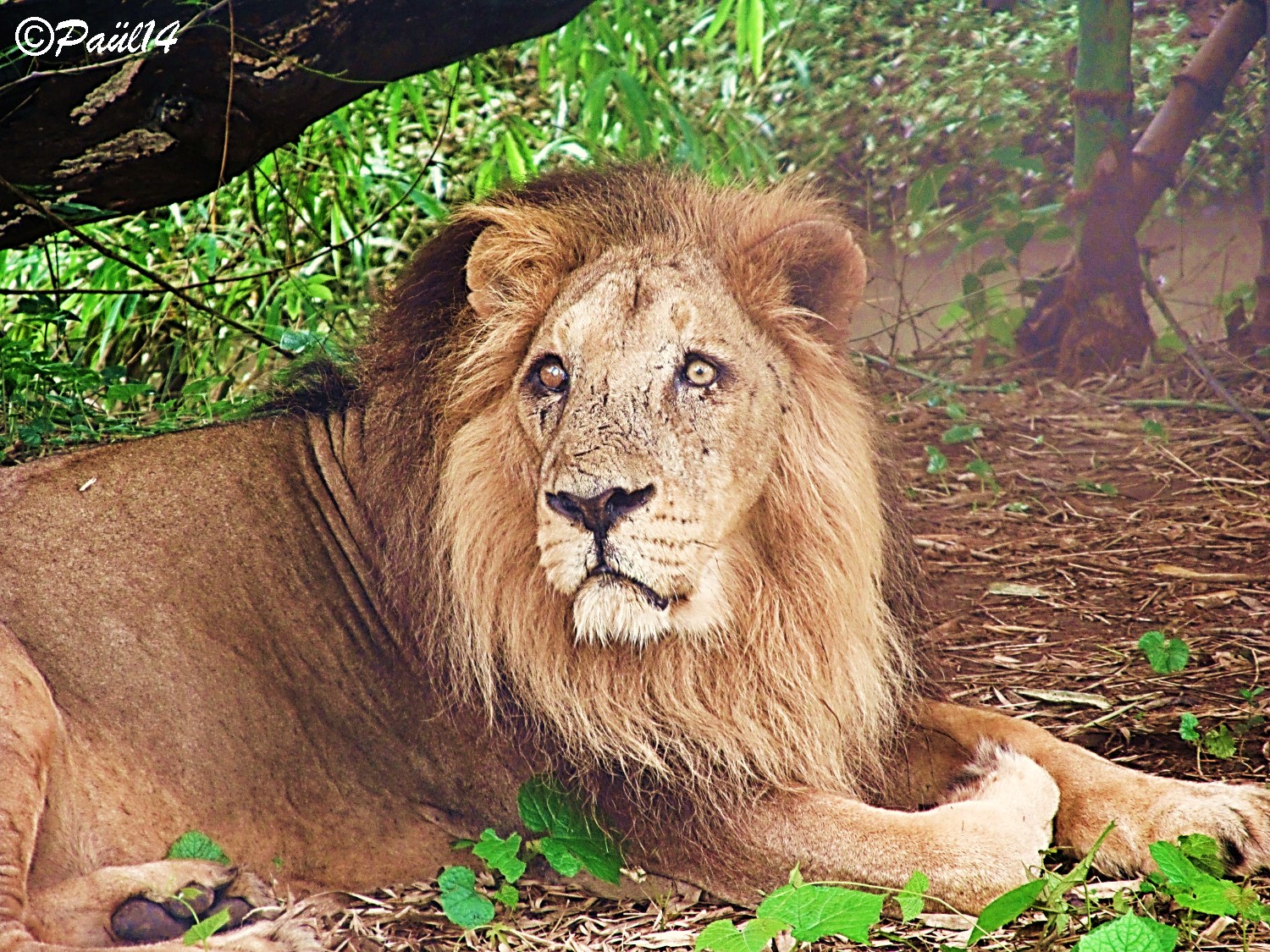
Now search for siṃha, lion. Fifteen verses, spread across seven of the ten books, from the oldest family collections to the latest additions. Indra roars like one. The Maruts roar like a troop of them. Soma, filtered through wool, is called a lion. Somebody’s fox creeps up on one in a riddle.
That asymmetry is strange enough on its own. It becomes much stranger when you look at what the people who lived in the same river basin a few centuries earlier were carving on stone. The Harappan seal-cutters of the Indus cities produced thousands of small inscribed objects, and their wild-animal repertoire is well known: rhinoceros, elephant, water buffalo, and tiger. The tiger is everywhere in that imagery, including on the famous seated-figure seal from Mohenjo-daro. The lion is absent from it.[1][2]
So we have two bodies of evidence from overlapping ground, and their big cats are mirror images. The seals show tigers and no lions. The hymns name lions and never once a tiger.
Something is being recorded here, but it is not a wildlife survey. This piece is about learning to read the Rig Veda’s animals correctly: not as a census of what lived in the Punjab, but as a record of what a particular group of ritual poets had looked at closely enough to name, and how the shape of the naming gives away how new the animal was to them. The best single example is not the tiger at all. It is the elephant, which the Rig Veda mentions exactly twice, and never quite manages to call by a name.
Methods note. The counts above come from string searches over a complete romanised and Devanagari text of the Saṃhitā, checked in both scripts so that a transliteration quirk cannot manufacture a result. The edition searched carries 10,528 verse records; printed editions differ by a few dozen depending on how certain long hymns are divided, so treat the totals as close approximations rather than canonical figures. Where a stem produces obvious false positives, I have filtered them by hand. Vṛka is a good example: the raw string appears in twenty-seven verses, but several of those are the formulaic adjective avṛka, “free of wolves,” meaning safe. The wolf proper is left in eighteen.
How to Name a Creature You Have Just Met
The two elephant passages are worth reading slowly.
The first belongs to a hymn to the Maruts, the storm troop, whose favourite mode is arriving loudly and wrecking things:
“Mighty, with wondrous power and marvellously bright, self-strong like mountains, ye glide swiftly on your way. Like the wild elephants ye eat the forests up when ye assume your strength among the bright red flames.”
(RV 1.64.7, trans. Ralph T. H. Griffith, 1896)
The second is from a hymn to Indra:
“What time thou settest near the Sun thy body, thy form, Immortal One, is seen expanding: thou a wild elephant with might invested, like a dread lion as thou wieldest weapons.”
(RV 4.16.14, trans. Griffith)
Griffith gives you “wild elephants” and “wild elephant,” which is accurate as to sense and completely hides the thing that matters. The Sanskrit in the first is mṛgā́ iva hastínaḥ, and in the second mṛgó ná hastī́. Literally: “like wild beasts that have hands,” and “like a wild beast that has a hand.”
Mṛga is the general Vedic word for a wild animal, a creature of the uncultivated country, later narrowing to deer. Hastin is a possessive adjective built on hasta, hand, and hasta is an unremarkable inherited body-part noun that the Rig Veda uses constantly for the hands of poets, priests, and gods. Indra is mahāhastī, “great-handed,” in RV 8.81.1. The ten fingers that squeeze the soma stalks are hastinaḥ, “the handed ones,” in RV 3.36.7 and RV 9.80.5. None of those are elephants. The elephant is simply the wild animal that turns out, improbably, to have one of these.
Notice what happens inside the second verse. In a single line the poet needs two words and a grammatical construction to point at the elephant, and then reaches for the lion in the very next breath and gets it in one: siṃho ná bhīmá, “terrifying like a lion.” One animal has a name. The other has a description.
The same construction covers the Rig Veda’s other elephant word. Vāraṇa means something like “the one to be warded off, the one that resists,” and it too travels with mṛga rather than standing alone:
“As a wild elephant rushes on this way and that way, mad with heat, none may compel thee, yet come hither to the draught: thou movest mighty in thy power.”
(RV 8.33.8, trans. Griffith)
The Sanskrit is dānā mṛgó ná vāraṇaḥ, “like a wild beast that resists, in rut.” At RV 10.40.4 the Aśvins are called down “as hunters follow two wild elephants,” mṛgéva vāraṇā. Again a mṛga with a qualifier attached.
| Word | Literal sense | Rig Vedic occurrences in the elephant sense | Later Sanskrit |
|---|---|---|---|
| hastin | “having a hand” | 2 (RV 1.64.7, RV 4.16.14), both with mṛga | The standard word for elephant |
| vāraṇa | “resisting, to be warded off” | 2 (RV 8.33.8, RV 10.40.4), both with mṛga | A common poetic word for elephant |
| ibha | disputed; possibly “elephant,” possibly “household, retinue” | Contested in every proposed instance | Elephant, in classical usage |
Arthur Macdonell put the observation into print in 1900 and it has not needed much revision since. The elephant, he wrote, “is explicitly referred to in only two passages of the Rigveda,” and the form of the name, “the beast (mṛga) with a hand (hastin),” shows that the poets “still regarded it as a strange creature.” By the time of the Atharva Veda and the Yajur Veda, the animal is familiar and the descriptive scaffolding falls away.[3]
That is the mechanism worth carrying forward. Languages do not usually invent a fresh root for something they have known forever; they inherit one. Horse, cow, wolf, dog, mouse, and goose all sit on solid Indo-European roots with cognates from Ireland to Xinjiang. When a language instead builds a compound description, or borrows a word wholesale, it is telling you the referent arrived recently, or at the edge of experience. The beast with a hand is what a poetic tradition sounds like when it is still improvising.

The Cat That Is Not There
Macdonell drew a second conclusion from the same kind of evidence, and this one has had a much rougher afterlife. The tiger, he noted, is not mentioned at all in the Rig Veda but appears in later Vedic texts, and he read that as evidence of eastward movement: the poets of the Rig Veda were living where lions were, and their descendants moved into country where tigers were.[3] Romila Thapar makes a related point about the lion, whose familiarity in the hymns fits a homeland in the drier northwest and the Indo-Iranian borderlands.[4]
The argument is clean and it has a real problem.
Asiatic lions were not confined to a narrow western strip. In the early nineteenth century, before hunting collapsed the population into a single forest in Gujarat, lions occurred in Sind, Bahawalpur, the Punjab, Rajasthan, Haryana, and eastward through the Gangetic plain as far as Bihar.[5] Lion habitat covers essentially the whole Rig Vedic world and a good deal beyond it, so knowing the lion places the poets almost nowhere in particular.
And the tiger was demonstrably present in the Indus basin. We know this not from a text but from the seal-cutters, who carved tigers by the hundred in the same river system the Rig Vedic poets would later occupy.[1][2] Whatever the hymns’ silence means, it does not mean the animal was over the horizon.
Three explanations are on the table, and they are not equally strong.
The first is the ecological one: the specific niches the poets moved through, dry scrub and riverine grassland along the northwestern rivers, favoured lions over tigers, and the hymns record local frequency. This is plausible but weak on its own, since the ranges overlapped heavily.
The second is lexical: siṃha covered both large cats, and the distinction we take for granted was not being drawn. This has been suggested, and it cannot be disproved from a corpus this size, but it asks us to believe that a tradition capable of naming three kinds of soma filter did not distinguish a striped cat from a maned one.
The third is that the silence is about genre rather than geography, and this is the one I find hardest to argue with. Which brings us to the real methodological point.
Aside. Arguments from silence in a corpus this specialised are load-bearing only when the corpus had a reason to speak. The Rig Veda is liturgy: praise, invocation, and ritual instruction addressed to gods, composed by hereditary poets competing for patronage. It is not natural history, and it never tries to be. An animal earns a mention when it can carry a simile for divine power, threaten the herds, pull a chariot, or be counted out as payment. A tiger that did none of those things for a given poetic lineage simply never had an occasion to appear.
| Evidence | Tiger | Lion | Elephant | Rhinoceros |
|---|---|---|---|---|
| Harappan seal iconography | Frequent | Absent | Frequent | Frequent |
| Rig Veda | Absent | 15 verses, plain noun | 2 passages, descriptive phrase | Absent |
| Atharva Veda and later Vedic | Present and frequent | Present | Present, name simplified | Later |
Read that table honestly and you get a conclusion that is more interesting than either of the strong versions. Neither corpus is a record of what walked past. The seals record what the Indus cities chose to make emblematic. The hymns record what a lineage of ritual poets found good to think with. The overlap between the two is the animals that were, so to speak, publicly useful in both worlds, and it is small.
What the Herders Were Actually Watching
If the animal list is a record of attention rather than of ecology, then it should be skewed in ways a herding and chariot-driving society would skew it. It is, precisely.
The wolf beats the lion. Eighteen verses to fifteen, and the wolf’s appearances are almost all about danger to something you own or someone you love. The Aśvins pull a quail from a wolf’s jaws in RV 1.116.14 and again in RV 1.117.16. Poets ask the gods to keep the wolf off the path in RV 2.29.6. The adjective avṛka, “wolfless,” becomes a general-purpose word for safety, which is what happens to a threat when it is common enough to lend its name to its own absence.
Horses and cattle dominate everything. The stem aśva opens a word in over three hundred verses, before you count the compounds buried mid-word, and cattle vocabulary is denser still, spread across gau, dhenu, vaśā, and a small technical vocabulary for age and condition that has no English equivalent. The Rig Veda’s animal lexicon is, in bulk, an inventory of property and traction. This is the same world described in the gift-economy hymns to poet-patrons, where the animal is simultaneously a creature, a unit of wealth, and a form of speech.
Set against that bulk, the wild animals are thin, occasional, and often startling. Which is what makes them useful.
| Animal | Sanskrit | Verses | How it enters the text |
|---|---|---|---|
| Horse | aśva | 300+ | Traction, sacrifice, wealth, divine vehicle |
| Wolf | vṛka | 18 | Threat to herds and to travellers |
| Lion | siṃha | 15 | Simile for Indra, Agni, Soma, the Maruts |
| Goose or swan | haṃsa | ~25 | Simile for flight, migration, the Aśvins |
| Buffalo | mahiṣa | ~50 | Overwhelmingly metaphorical; the god as “buffalo bull” |
| Camel | uṣṭra | 5 | Counted out in gift lists, once as a simile |
| Elephant | mṛga hastin, mṛga vāraṇa | 4 | Simile for uncontainable force |
| Peacock | mayūra | 2 | Only as the colour of Indra’s horses |
| Monkey | kapi | 2 | Only in one late, bizarre hymn |
| River dolphin | śiṃśumāra | 1 | Yoked to a bull in a miracle |
| Fox and jackal | lopāśa, kroṣṭṛ | 1 (same verse) | A riddle about the world inverted |
| Tiger | vyāghra | 0 | Absent |
A Hundred Camels
The camel is the cleanest case of an animal entering the text as an accounting entry rather than as a creature.
Uṣṭra appears in five verses. Four of them are in Maṇḍala 8, and all four are gift lists, the dānastuti verses in which a poet publishes the size of his fee:
“As such, O Aśvins, find for me my share of new-presented gifts, as Kasu, Cedi’s son, gave me a hundred head of buffaloes, and ten thousand kine.”
(RV 8.5.37, trans. Griffith)
Griffith’s “buffaloes” is a substitution. The word in the text is śatám uṣṭrā́nāṃ, a hundred camels. Kaśu the Caidya gave the poet a hundred camels and ten thousand cows. Camels turn up again at RV 8.6.48, where a patron gives four-yoked teams of them, and twice in the enormous gift catalogue of RV 8.46, which counts sixty thousand horses, twenty hundred camels, and ten thousand cows in a single breath. The fifth occurrence, at RV 1.138.2, is the only one where a camel does something: Pūṣan is asked to drive off enemies uṣṭró ná, “like a camel.”
Two things follow. First, the camel is wealth before it is an animal, and it is concentrated in the collection whose patrons and personal names have the strongest western and Iranian flavour. Second, the word itself is a border marker. Vedic uṣṭra is the exact cognate of Avestan uštra, and Avestan uštra is the second half of the name Zaraθuštra, the prophet whose name means something like “he who handles old camels.”[6] The animal sits on the shared Indo-Iranian side of the vocabulary, in a corpus where a great many other animals do not.
Notice also what Griffith did. A Victorian translator working through a hymn about lavish gifts reached a word meaning camel and wrote buffalo, because camels did not fit his picture of the Vedic world. The Rig Veda’s fauna has always been read through somebody’s expectations, and the corrective is simply to check the word.
The Peacock, the Dolphin, and the Fox
The one-off animals are where the text stops sounding like liturgy for a moment and starts sounding like somebody who has been outdoors.
The peacock appears twice, and in both cases it is not a bird but a colour. Indra’s two horses are mayūra-romabhiḥ, “with peacock hair,” in RV 3.45.1, and mayūra-śepyā, “with peacock tails,” in RV 8.1.25. Whether this describes iridescent coats or actual peacock feathers braided into manes and tails, the poet has clearly looked hard at a peacock and then looked hard at a horse.
The river dolphin appears exactly once, and in a hymn about the Aśvins performing impossible rescues it is the impossibility itself:
“When to his house ye came, to Divodāsa, hasting to Bharadvāja, O ye Aśvins, the car that came with you brought splendid riches: a porpoise and a bull were yoked together.”
(RV 1.116.18, trans. Griffith)
The animal is śiṃśumāra, the Gangetic river dolphin, Platanista gangetica, a blind, side-swimming, freshwater cetacean of the Indus and Ganges systems. Griffith’s “porpoise” is a reasonable Victorian gloss. The point of the image is the yoke: the Aśvins’ chariot is drawn by a bull and a river dolphin harnessed together, one animal that cannot swim beside one that cannot walk. It is a joke about impossibility that only works if the poet’s audience knew what a river dolphin was. A single word, and a whole river ecology is standing behind it.

The fox and the jackal share a single verse, and it is one of the strangest in the collection. RV 10.28 is a riddle dialogue, and the poet sets out a series of inversions:
“Resolve for me, O singer, this my riddle: the rivers send their swelling water backward: the fox steals up to the approaching lion: the jackal drives the wild boar from the brushwood.”
(RV 10.28.4, trans. Griffith)
Lopāśa and kroṣṭṛ, fox and jackal, occur nowhere else in the Rig Veda. They exist in the text solely so that the world can be described upside down: rivers running uphill, small scavengers bullying large predators. The riddle only functions if the ordinary hierarchy of the scrub jungle is common knowledge, which tells you a good deal about the audience. Readers who enjoy this mode should go on to the great riddle hymn of Dīrghatamas, where the same technique is turned on cosmology.
The monkey gets two verses, both in RV 10.86, the Vṛṣākapi hymn, a late, coarse, and much-argued domestic comedy in which Indra, his wife Indrāṇī, and a creature called the “bull-monkey” trade insults. Whatever else it is, it is the only place in the Rig Veda where a monkey exists, and the animal arrives fully domesticated into a joke.
Words Without Ancestors
There is a second signal running underneath the fauna, and it points the same way as mṛga hastin.
A significant slice of Rig Vedic vocabulary has no Indo-European pedigree. F. B. J. Kuiper’s Aryans in the Rigveda (1991) assembled the list, arriving at roughly 380 words of non-Indo-Aryan origin, a figure usually described as a few per cent of the text’s lexicon. Thomas Oberlies, reviewing the work, tightened the criteria and came out with 344 to 358 secure loans, dropping to somewhere between 211 and 250 once personal names and uncertain etymologies are excluded.[7][8] The numbers are contested; the pattern is not seriously disputed. What is striking is where the loans cluster: agriculture, plants, local animals, and material culture. Not the words for sky, fire, horse, cow, or god, which are inherited and ancient, but the words for the specific things a newcomer has to learn.
This is what makes the Rig Veda’s absences legible. The text has no word for rice, vrīhi, which is a loan when it does appear in later Vedic. It has no godhūma, wheat, and no tila, sesame. Its one cereal is yava, barley, an inherited Indo-European word.[9] A corpus whose grain vocabulary is entirely inherited and whose later successors are full of borrowed crop names is a corpus composed before its speakers took up the local agricultural package.
Aside. Two cautions before this evidence is pushed too hard. First, loanword identification is inference, not observation: it rests on phonology that looks irregular and on the failure to find a good Indo-European etymology, and failure to find one is not proof that none exists. Kuiper’s list has been trimmed by every scholar who has worked on it since. Second, absence of a word is not absence of a thing. The Rig Veda never mentions rice, but rice was under cultivation in the Ganges basin long before the hymns were composed. What the silence establishes is the poets’ vocabulary, and therefore their world of practice, not the contents of the subcontinent.
graph TD
    A[An animal in the Rig Veda] --> B[Plain inherited noun]
    A --> C[Descriptive phrase]
    A --> D[Counted as wealth]
    A --> E[Not named at all]
    B --> B1["aśva, vṛka, siṃha, haṃsa"]
    C --> C1["mṛga hastin, mṛga vāraṇa"]
    D --> D1["uṣṭra in gift lists"]
    E --> E1["vyāghra, vrīhi"]
    B1 --> F[Long familiar, deep vocabulary]
    C1 --> G[Recent, peripheral, still improvised]
    D1 --> G
    E1 --> H[Outside the poets' working world]
The elephant fits this frame exactly. It is not absent, so the poets had seen one. It has no simple name, so they had not lived with one. It is used for exactly one thing, uncontainable force wrecking a forest, so what they had seen was probably a bull elephant at a distance and not a working animal. Within a few centuries the descriptive scaffolding is gone, hastin stands alone as the ordinary word, and by the time of the later ritual literature the elephant is a familiar presence. You can watch the animal move from the edge of experience into the centre of it, in the vocabulary, across the length of the Vedic corpus.
Reading the Archive
The Rig Veda is not a bestiary and it makes no attempt to be one. It is a body of praise poetry whose composers were interested in gods, patrons, and the technical craft of getting a hymn right, and the poets thought of themselves as carpenters and weavers rather than as observers of nature. The animals get in sideways, as similes, as threats, as property, as riddles.
Which is exactly why they are good evidence. Nobody was curating the list. When a poet reaches for a comparison and produces “like a wild beast that has a hand,” he is not making a statement about elephants; he is revealing, without intending to, how his tradition had catalogued the world. Deliberate testimony can be shaped. This kind cannot.
Three things fall out of the survey that are worth holding on to.
The form of a name carries more information than its presence. A plain inherited noun, a descriptive compound, and a borrowed word are three different depths of acquaintance, and the Rig Veda contains all three at once. Siṃha and mṛga hastin sitting in the same line of RV 4.16.14 is a small stratigraphy of familiarity.
Silence is real evidence but weak evidence, and it is weakest exactly where people most want to use it. The missing tiger has been recruited into arguments about migration and origins for over a century, in both directions. The Harappan seals show that the animal was there. The hymns show that the poets had no occasion to say so. Both statements are true, and together they establish much less than either side would like.
And the corpus is smaller than the country. The Rig Vedic world is the Punjab and the upper Indo-Gangetic plain, seen by a specific priestly class, on ritual occasions, in a formal register. It does not describe the Deccan or the coast, and it does not describe the ordinary daytime life of the people who herded the cattle it counts. The animal list is a keyhole, and what makes it valuable is precisely that nobody arranged the view.
If you want to see this for yourself, do it in the order the evidence comes. Open RV 4.16 and read verse 14 twice, once in translation and once with the Sanskrit alongside, until the difference between siṃho ná and mṛgó ná hastī́ stops being invisible. Then read the riddle at RV 10.28.4 beside a field guide to Indian mammals and work out which animals the poet expects you to already know. Then look at a photograph of the Mohenjo-daro seals and count the tigers. The three sources will not agree, and their disagreement is the most informative thing about them.
Further reading on the material world behind the hymns: the metallurgy and material culture of the Rig Veda, the river atlas and its ecology, the frog hymn of RV 7.103, which is the closest the collection comes to sustained nature writing, and Araṇyānī, the forest goddess, who is the only figure in the Rig Veda who lives where the wild animals do.
References
Kenoyer, Jonathan Mark. ‘Master of Animals and Animal Masters in the Iconography of the Indus Tradition.’ In The Master of Animals in Old World Iconography, ed. Derek B. Counts and Bettina Arnold. Archaeolingua 24. Budapest: Archaeolingua, 2010, pp. 37-58. harappa.com.
Parpola, Asko. Deciphering the Indus Script. Cambridge University Press, 1994.
Macdonell, Arthur A. A History of Sanskrit Literature. William Heinemann, 1900, pp. 143-145. wikisource.
Thapar, Romila. Early India: From the Origins to AD 1300. University of California Press, 2004. ucpress.edu.
Divyabhanusinh. The Story of Asia’s Lions. Marg Publications, 2005. cambridge.org review.
Boyce, Mary. Zoroastrians: Their Religious Beliefs and Practices. Routledge, 1979. routledge.com.
Kuiper, F. B. J. Aryans in the Rigveda. Rodopi, 1991. google books.
Oberlies, Thomas. ‘Review of F. B. J. Kuiper, Aryans in the Rigveda.’ Indo-Iranian Journal 37, no. 4, 1994, pp. 333-349. brill.
Witzel, Michael. ‘Substrate Languages in Old Indo-Aryan (Ṛgvedic, Middle and Late Vedic).’ Electronic Journal of Vedic Studies 5-1, 1999. ejvs.
Witzel, Michael. ‘Autochthonous Aryans? The Evidence from Old Indian and Iranian Texts.’ Electronic Journal of Vedic Studies 7-3, 2001. ejvs.
Macdonell, Arthur A., and Arthur B. Keith. Vedic Index of Names and Subjects. 2 vols. John Murray, 1912. archive.org.
Griffith, Ralph T. H. The Hymns of the Rigveda. E. J. Lazarus, 1896. sacred-texts.
Jamison, Stephanie W., and Joel P. Brereton. The Rigveda: The Earliest Religious Poetry of India. 3 vols. Oxford University Press, 2014. oup.
Geldner, Karl Friedrich. Der Rig-Veda aus dem Sanskrit ins Deutsche übersetzt. Harvard Oriental Series 33-36. Harvard University Press, 1951.
Macdonell, Arthur A. Vedic Mythology. Karl J. Trübner, 1897. archive.org.
Zimmer, Heinrich. Altindisches Leben: Die Cultur der vedischen Arier. Weidmannsche Buchhandlung, 1879. archive.org.
Kenoyer, Jonathan Mark. Ancient Cities of the Indus Valley Civilization. Oxford University Press, 1998.
Sharma, A. K. ‘Faunal Remains from Harappan Sites.’ In Indian Archaeology in Retrospect, ed. S. Settar and Ravi Korisettar. Manohar, 2002.
Doniger O’Flaherty, Wendy. The Rig Veda: An Anthology. Penguin Classics, 1981. penguin.
Renou, Louis. Études védiques et pāṇinéennes. 17 vols. Institut de Civilisation Indienne, 1955-69.
Comments (0)
No comments yet. Sign in to start the discussion.