A Verb With No When
Four Verbs, Three Pasts, and One That Refuses
The single most quoted line in the Rigveda is the opening of the Vṛtra hymn, RV 1.32, where Indra kills the serpent and the rivers are released. In Sanskrit it runs:
índrasya nú vīryā̀ṇi prá vocaṃ yā́ni cakā́ra prathamā́ni vajrī́ / áhann áhim ánv apás tatarda prá vakṣáṇā abhinat párvatānām
“I will declare the manly deeds of Indra, the first that he achieved, the Thunder-wielder. He slew the Dragon, then disclosed the waters, and cleft the channels of the mountain torrents.”
RV 1.32.1, after Griffith (1896).
Four finite verbs in two lines, and a Vedic grammarian would label them three different ways. cakā́ra is a perfect. áhan and abhinat are imperfects, carrying the little prefixed á- that marks a Sanskrit verb as past. tatarda is another perfect. Griffith rendered the lot as English past tense and nobody has complained.
Then there is the first one. prá vocam does not have the á-. Strip the augment from the aorist ávocam, “I said”, and you get vocam, which is what the poet actually used, and which both Griffith and every later translator render as a future: I will declare. A form that looks like a past tense with a syllable filed off, sitting at the head of a sentence, meaning something closer to let me now say.
This is not a scribal slip or a metrical convenience. It is a grammatical category, it appears thousands of times across the Saṃhitā, and it has no tense. It has no mood either. Sanskrit grammarians never gave it a name. European philologists eventually did, calling it the injunctive, and then spent a century arguing about what it means. Karl Hoffmann wrote 298 pages on it in 1967 and concluded that it was a mood for mentioning things. [1] Paul Kiparsky replied that it is not a mood at all, that it simply has nothing in it, and that everything you think it means is coming from the sentence around it. [2] [3]
The category died. Classical Sanskrit kept the augment and made it compulsory, and the injunctive drops out of the language. It survived in exactly one construction, and that construction is the reason every speaker of Hindi, Gujarati and Punjabi still carries a fragment of Rigvedic morphology around in their mouth. This piece follows that thread: what the form is, what it does in the hymns, what two generations of linguists have made of it, and what the Rigveda’s own distribution of it reveals about what these poets were afraid of.
The Missing Syllable
Vedic verbs come in two families of endings. Primary endings (-mi, -si, -ti) mark the present and the future. Secondary endings (-am, -s, -t) mark the past tenses, the optative, and the injunctive. On top of that, past indicatives take a prefixed á-, the augment, which is stressed and which is the only thing in the word that says this happened before now.
Remove it and the form does not become ungrammatical. It becomes something else.
| Root | Augmented (indicative) | Augmentless (injunctive) | Usual gloss of the injunctive |
|---|---|---|---|
| vac “speak” | ávocam “I said” | vocam | “let me say”, “I will say” |
| han “smash” | áhan “he smashed” | han | “he smashes”, “may he smash” |
| gam “go” | ágamam “I went” | gamam | “let me go”, “that I go” |
| vadh “slay” | ávadhīḥ “you slew” | vadhīḥ | “do not slay” (with mā́) |
| bhṛ “carry” | ábharat “he carried” | bhárat | “he carries”, “he would carry” |
Two things follow from this table and both are strange. First, the difference between a statement about the past and a wish about the future is one unstressed syllable. Second, the injunctive column has no single gloss. Any honest dictionary entry would have to say: depends.
In Classical Sanskrit this ambiguity is simply not allowed to arise. The augment becomes obligatory; an aorist without it is a mistake. But the Rigveda is older than that settlement, and in the Rigveda the augment behaves like an option that poets exercise. The same root, the same stem, the same person and number can show up augmented in one verse and bare in the next, and the difference is not decorative.
graph TD
    A[Finite verb in a hymn] --> B{Secondary endings?}
    B -->|No| C[Present, perfect, future]
    B -->|Yes| D{Augment present?}
    D -->|Yes| E[Imperfect or aorist: past]
    D -->|No| F[Injunctive]
    F --> G{Preceded by the particle ma?}
    G -->|Yes| H[Prohibition]
    G -->|No| I[Context decides]
    I --> J[Timeless or mythic]
    I --> K[Wish or intention]
    I --> L[Backgrounded event]
Methods note. The augment is visible in the transmitted Saṃhitā text and in the padapāṭha, the word-by-word analysis that Vedic schools built on top of it and preserved alongside the continuous text for close to three thousand years. Nothing here depends on emendation. The relevant discussion of how that apparatus works is in the companion piece on how the Rigveda was transmitted.
A Category With No Indian Name
Here is the part that should be more famous than it is. Pāṇini, working somewhere around the fourth century BCE and producing what is still the most admired grammar ever written of any language, does not have a term for the injunctive.
He has terms for everything else. The imperfect is laṅ, the aorist is luṅ, the perfect is liṭ, the optative is liṅ, the imperative is loṭ, and the Vedic subjunctive, which had also died out of the spoken language, gets a slot of its own as leṭ. The injunctive is handled differently. It appears in the Aṣṭādhyāyī only as the output of two rules working together:
- 3.3.175, māṅi luṅ: after the particle mā́, use the aorist.
- 6.4.74, na māṅyoge: when mā́ is in play, the augment is not added.
Take an aorist, attach it to mā́, delete the augment, and what you have produced is a Rigvedic injunctive. Pāṇini describes the form perfectly and treats it as a morphological exception rather than a category. This is exactly what you would expect from a grammarian describing a language in which the category had already collapsed into a single surviving construction. He is not documenting a mood; he is documenting a fossil.
The label injunctive is a nineteenth-century European coinage, applied once comparative philology had enough Greek, Avestan and Vedic on the table to notice that augmentless preterites were doing systematic work across the family. Berthold Delbrück’s Altindische Syntax of 1888 gathers the Vedic evidence. [4] The naming is a small but real illustration of something worth holding onto: the Indian tradition preserved the text with a fidelity no European philology could match, and European philology asked a question about it that the Indian tradition had not needed to ask.

What Hoffmann Heard
Karl Hoffmann’s Der Injunktiv im Veda (1967) is the book everyone in this field still starts from, and its central proposal is easier to feel than to define. [1] Hoffmann called the injunctive a memorative, from German Erwähnung, “mention”. His claim: the injunctive does not report an event, it mentions one. It refers without asserting. It says that thing, you know the one, and leaves the temporal placement entirely alone.
Think about what a Vedic poet is actually doing. He is standing at a fire with an audience that knows the Vṛtra story as well as he does. He is not breaking news. When he says Indra smashed the serpent with an augmented verb, he is narrating: this happened, here is the sequence. When he uses the bare form, Hoffmann argued, he is invoking: this is the deed, the one that defines him, the one being re-enacted at this fire right now. Myth is not journalism. Ritual is not a report.
That reading has obvious appeal for anyone who has spent time in the hymns. It also explains why the form clusters where it does: in the compressed, allusive stretches where a myth is gestured at rather than told out, and in the ritual present where the boundary between what Indra once did and what Indra is doing while the fire burns is not a boundary the poet wants to draw.
“Who really knows, who here can proclaim it? Whence was it born, whence this creation?”
RV 10.129.6, after Griffith (1896). The verb prá vocat is another bare aorist, and translators split between “can proclaim”, “will proclaim” and “would proclaim”, which is a fair summary of the problem.
The Nāsadīya hymn is a useful test because its whole subject is a time before time, and it reaches repeatedly for forms that decline to place events on a timeline. If you have read the creation hymn and wondered why it feels temporally unmoored in a way translations struggle to reproduce, part of the answer is morphological rather than mystical.
The objection to Hoffmann is typological and it is serious. No one has produced a convincing parallel: a language elsewhere in the world with a dedicated verbal mood whose job is to mention rather than assert. Categories that exist in exactly one dead language and nowhere else should make a linguist uneasy. They usually mean the analysis has absorbed the interpreter’s sense of the texts rather than the grammar of the language.
Kiparsky’s Subtraction
Paul Kiparsky’s answer, first sketched in 1968 and set out in full in 2005, is to solve the problem by removing something rather than adding it. [2] [3] The injunctive, on his account, is not a mood at all. It is a verb form that carries aspect, voice and person-number and nothing else. It is not unmarked for tense and mood, which would imply a default reading; it is unspecified, meaning those features are simply absent from the representation.
$$\mathrm{INJ} = [\,\text{aspect},\ \text{voice},\ \text{person/number}\,],\qquad [\text{tense}] = \varnothing,\quad [\text{mood}] = \varnothing$$
Everything a reader perceives as meaning is therefore contributed by context: by the surrounding tenses, by particles, by whether the reference time has already been established, by the discourse. The apparent polysemy of the form is not polysemy. It is what an empty slot looks like when the sentence around it fills it in.
Notice what this does to the translator’s problem. If Kiparsky is right, there is no single correct English rendering of prá vocam, not because English is poor but because the Sanskrit form does not encode the distinction English is forced to make. Every translation of a Rigvedic injunctive is an addition to the text.
Eystein Dahl’s book-length treatment of the Early Vedic verb (2010) approaches the same data through aspect, arguing that aspectual contrasts do systematic work in the Rigveda alongside tense and that much of what looks like tense variation is aspectual. [5] Ian Hollenbaugh has more recently applied neo-Gricean pragmatics to the question, treating the injunctive’s range of readings as the product of competition: the injunctive means what it means because of what the speaker did not choose, blocked in some contexts by the augmented indicative, in others by the subjunctive or the imperative. [6] It is the grammatical equivalent of noticing that “some” implies “not all”.
| Position | Scholar | Core claim | Trouble with it |
|---|---|---|---|
| Descriptive | Delbrück (1888) | Augmentless preterites form a coherent set in Vedic | Stops short of a function |
| Memorative | Hoffmann (1967) | A mood for mentioning rather than asserting | No typological parallel anywhere |
| Underspecification | Kiparsky (1968, 2005) | No tense, no mood; context supplies both | Must explain why context resolves it so consistently |
| Aspectual | Dahl (2010) | Aspect carries much of the load attributed to tense | Does not dissolve the modal uses |
| Pragmatic | Hollenbaugh (2023) | Readings arise from blocking by competing forms | Requires a full inventory of the competition |
timeline
    title Naming and explaining the injunctive
    1888 : Delbrueck gathers the Vedic evidence
    1967 : Hoffmann proposes a memorative mood
    1968 : Kiparsky replies that it is no mood at all
    2005 : Kiparsky sets out underspecification
    2010 : Dahl reframes the system around aspect
    2023 : Hollenbaugh models it as pragmatic blocking
Aside. The argument is not settled and there is no reason to expect it to be soon. What has changed since Hoffmann is the availability of the whole corpus in searchable form, which means claims about distribution can now be tested rather than asserted. That is what the next section does, on one narrow question, with numbers anyone can reproduce from the Saṃhitā text.
Don’t
Of all the injunctive’s uses, one is unmistakable, because it comes with a flag attached. Put the particle mā́ (Sanskrit: मा) in front of an injunctive and you get a prohibition. Do not do this. Do not let this happen.
Two structural facts about this construction are worth pausing on. The first is that in Vedic, mā́ is effectively never used with the imperative proper. Positive commands take the imperative; negative ones take mā́ plus the injunctive. These are two different machines, not one machine with a switch. The implication, drawn by Delbrück and repeated since, is that the Indo-European imperative was originally a form for telling people to do things and had no negative counterpart at all. [4]
The second is that this construction is where the category goes to die and where it survives. Everything else the injunctive could do, later Sanskrit reassigned. This one job it kept.
So: how often does the Rigveda say don’t, and about what?
Methods note. Counting is less straightforward than it looks, because mā́ the prohibitive particle and mā the enclitic accusative of “I” are spelled identically once you drop the accents, and the widely circulated romanised texts drop them. The difference is audible in a properly accented recitation and invisible in a plain transliteration. RV 8.48.5 is the trap in miniature: ime mā pītā yaśasa uruṣyávo, “these glorious drops that give me freedom have I drunk” (Griffith), where every mā in the verse is “me” and none is a prohibition. A raw token count over the Saṃhitā finds 370 instances of bare mā. Restricting to instances that are pāda-initial, where an enclitic cannot stand, or that are immediately followed by a clitic an enclitic cannot precede, gives 183. The true figure for prohibitions sits between those bounds and nearer the lower one. All counts below use the conservative 183.
| Maṇḍala | Verses | Prohibitive mā́ (conservative) | Per 1,000 verses |
|---|---|---|---|
| 1 | 1,983 | 45 | 22.7 |
| 2 | 430 | 18 | 41.9 |
| 3 | 619 | 5 | 8.1 |
| 4 | 588 | 6 | 10.2 |
| 5 | 722 | 11 | 15.2 |
| 6 | 766 | 9 | 11.7 |
| 7 | 843 | 32 | 38.0 |
| 8 | 1,715 | 37 | 21.6 |
| 9 | 1,108 | 3 | 2.7 |
| 10 | 1,754 | 17 | 9.7 |
The spread is not noise. Maṇḍala 2 and Maṇḍala 7 say don’t roughly fifteen times as often, per verse, as Maṇḍala 9. Books 2 and 7 are the Gṛtsamada and Vasiṣṭha collections, and they are the books where Varuṇa is most present, the god who watches, keeps count and punishes. Maṇḍala 9 is the Soma Pavamāna book: a thousand verses of liquid being pressed, filtered and poured, addressed to a substance rather than to a judge. You do not beg a filter not to hurt you. The grammar tracks the theology, which is the kind of correlation that is easy to assert and pleasant to be able to check.
Now the content. Sort the hymns by how many prohibitions they contain and the top of the list reads like an inventory of Rigvedic fear.
| Hymn | Deity | Prohibitions | What is being warded off |
|---|---|---|---|
| RV 1.114 | Rudra | 8 | Harm to the old, the young, the parents, the body |
| RV 7.1 | Agni | 8 | Childlessness, rags, destitution, hunger, demons |
| RV 1.104 | Indra | 6 | Being killed, being abandoned, losing the unborn |
| RV 1.162 | The Horse | 5 | Botched butchery of the sacrificial animal |
| RV 2.42 | Bird omen | 4 | The bird calling from the wrong direction |
| RV 8.45 | Indra | 4 | Being overlooked, going unrewarded |
| RV 2.28 | Varuṇa | 3 | Death, exile from the light |
| RV 2.33 | Rudra | 3 | The archer’s arrow turning on the singer |
The single densest verse in the collection is this one, seven prohibitions deep, from the opening hymn of Vasiṣṭha’s book:
mā́ no agne ‘vīrate párā dā durvā́sase ‘matáye mā́ no asyaí / mā́ naḥ kṣudhé mā́ rákṣasa ṛtāvo mā́ no dáme mā́ vána ā́ juhūrthāḥ
“Give us not up, Agni, to want of heroes, to wretched clothes, to need, to destitution. Yield us not, Holy One, to fiend or hunger; injure us not at home or in the forest.”
RV 7.1.19, after Griffith (1896).
Read that as a list rather than as a prayer. Sonlessness. Bad clothing. Poverty. Hunger. Something in the dark. Danger in the house and danger outside it. This is a household inventory of what could go wrong, arranged by a poet who expected his audience to recognise every item, and it is held together entirely by a particle and a set of verbs with their augments removed. The vocabulary of Vedic anxiety gets a fuller treatment in the piece on áṃhas, the narrow place; what the grammar adds here is the shape of the fear, which is always the shape of a negation.
The Rudra hymn is the one that stays with you:
“O Rudra, harm not either great or small of us, harm not the growing boy, harm not the full-grown man. Slay not a sire among us, slay no mother here, and to our own dear bodies, Rudra, do not harm.”
RV 1.114.7, after Griffith (1896).
And the shortest and most exposed of them all, Vasiṣṭha to Varuṇa, four verses long, the first of which asks not to die:
mó ṣú varuṇa mṛnmáyaṃ gṛháṃ rājann aháṃ gamam / mṛḷā́ sukṣatra mṛḷáya
“Not yet, King Varuṇa, let me go into the house of clay. Be gracious, mighty lord, be gracious.”
RV 7.89.1, translation mine, keeping the Sanskrit order.
Gamam: the aorist of gam, “go”, with the augment absent. The house of clay is the grave. Everything about the sentence except that one syllable is ordinary. The companion essay on Varuṇa treats the theology; here the point is narrower and stranger. The Rigveda’s most naked line about the fear of death is grammatically a negated timeless verb, and it has to be, because mā́ accepted nothing else.
What Greek Had to Do
Now step outside Sanskrit, because the comparative picture is what turns this from a curiosity into evidence.
The augment is not an Indo-European universal. It shows up in Indo-Iranian, Greek, Armenian and Phrygian, a contiguous block, and is absent from Latin, Germanic, Celtic, Balto-Slavic, Anatolian and Tocharian. Wherever it exists, augmentless preterites exist alongside it in the oldest texts, which is why Homeric Greek is full of aorists without the e- that Attic prose would require. The injunctive is not a Vedic eccentricity. It is the state of affairs before the augment became obligatory, preserved in the Rigveda more completely than anywhere else.
The prohibitive particle travels with it. Vedic mā́, Greek μή, Old Persian mā, Old Armenian mi and Albanian mos all descend from Proto-Indo-European *méh₁. And the reconstructed construction is precisely the Vedic one: *méh₁ plus an augmentless preterite, never a modal form.
| Language | Prohibition | Verb form used | Status |
|---|---|---|---|
| Vedic | mā́ no vadhīḥ | Aorist injunctive | Inherited, intact |
| Old Avestan | mā + injunctive | Injunctive | Inherited, intact |
| Young Avestan | mā + injunctive | Injunctive, also the ordinary past narrative | Injunctive expanded |
| Homeric Greek | μή + aorist subjunctive | Subjunctive (replacing injunctive) | Repaired |
| Classical Sanskrit | mā́ gamaḥ | Augmentless aorist only after mā́ | Fossilised |
| Hindi | mat jāo | Imperative | Particle survives, form does not |
Greek is the instructive case. Once augmentless preterites in Greek merged functionally with the indicative past, the inherited prohibition became unusable: μή plus what was now an indicative past would have meant something like “don’t you did it”. Greek repaired the construction by substituting the subjunctive, which is where the familiar μή plus aorist subjunctive of classical prose comes from, and the repair is visible because it is incomplete in Homer, where metre sometimes protects the older form. [6] [7]
The upshot is worth stating flatly. Every Greek sentence that says don’t is a patch over a construction the Rigveda still uses undamaged. Avestan, the Rigveda’s nearest relative, kept the form so thoroughly that in its later stage the injunctive took over ordinary past narration outright. [8] The Vedic material is not an odd corner of Indo-European. It is the control case against which the others are measured, which is one concrete reason the Rigveda matters to people with no interest whatever in Indian religion.
The Fossil in the First Verse of Sanskrit Poetry
There is a story every student of Sanskrit literature learns. The sage Vālmīki is walking by a river when a hunter shoots one of a mating pair of krauñca birds. The surviving bird cries. Vālmīki, overcome, opens his mouth and a curse comes out, and the curse is metrical, and that accident is the invention of the śloka and with it of Sanskrit poetry. The verse, in the Bālakāṇḍa of the Rāmāyaṇa, runs:
mā niṣāda pratiṣṭhāṃ tvam agamaḥ śāśvatīḥ samāḥ / yat krauñcamithunād ekam avadhīḥ kāmamohitam
“Hunter, may you not attain stability for all the long years, since you slew one of a pair of krauñcas while it was lost in desire.”
Rāmāyaṇa 1.2.15 (verse numbering varies by recension), translation mine.
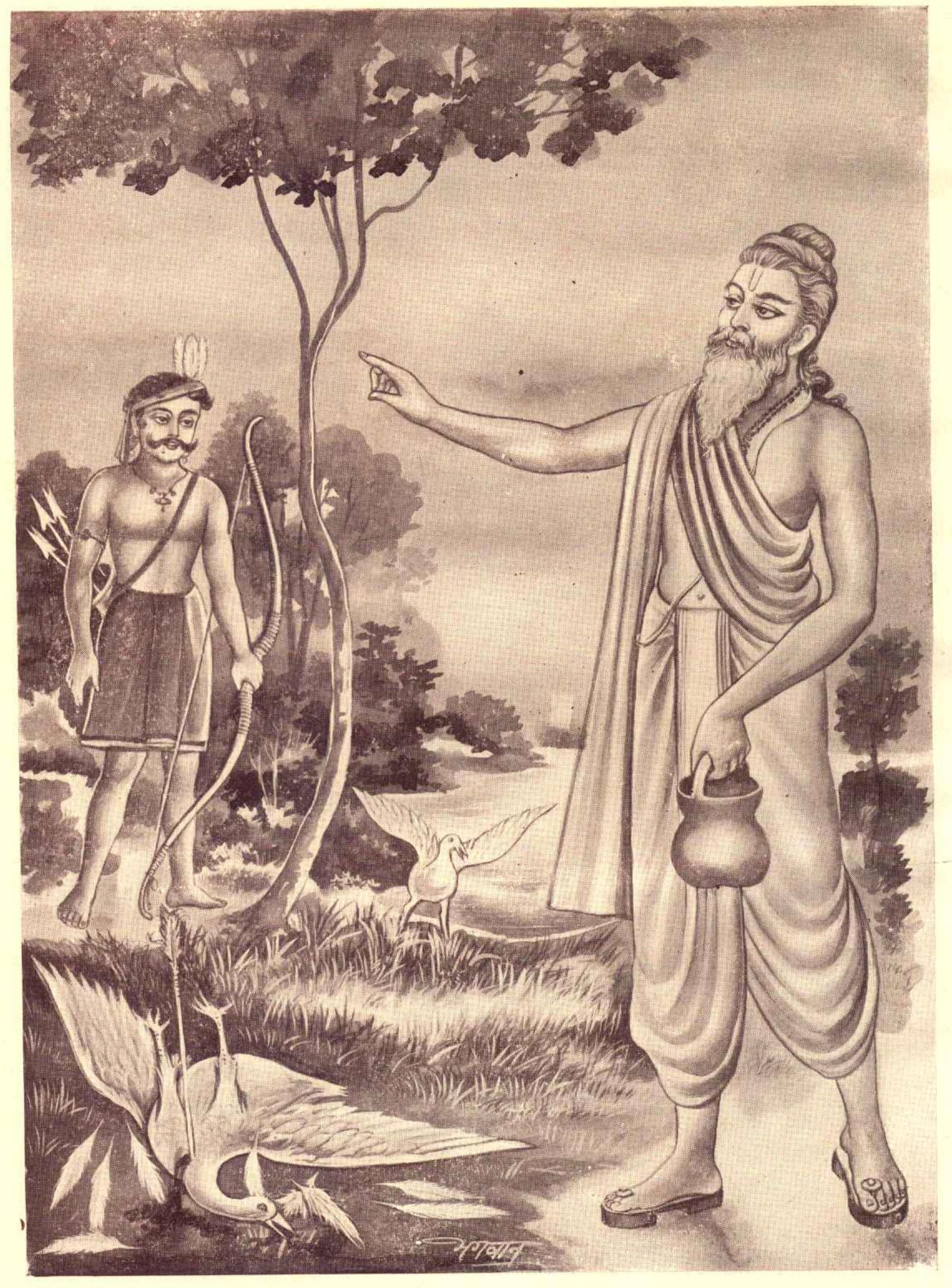
The first word is mā. The verb governed by it is agamaḥ, the aorist of gam, exactly the form Vasiṣṭha used to beg Varuṇa not to send him to the house of clay. The verb in the second line is avadhīḥ, the aorist of vadh, exactly the form the poet of RV 1.104 used when he wrote mā́ no vadhīr indra, “do not slay us, Indra”. A thousand years and an entire literature separate those texts, and the founding verse of Sanskrit poetry is built out of the Rigveda’s grammar of fear.
With one wrinkle that Sanskritists have been picking at for a very long time. Pāṇini’s rule 6.4.74 says the augment is deleted after mā́. The transmitted Rāmāyaṇa verse has agamaḥ and avadhīḥ, both carrying their augments, where the rule gives gamaḥ and vadhīḥ. The epic language is not Pāṇinian Sanskrit and licences of this kind are common in it, but the coincidence is a pleasing one: the most famous prohibition in Sanskrit literature does not quite obey the rule that preserves the Rigvedic form, and the metre would have scanned either way.
Aside. I would not build an argument on the mā niṣāda reading, and neither should anyone else; epic transmission is not Vedic transmission, and the text has been handled by many hands. What is not in doubt is the construction. Prohibition in Sanskrit, from the Rigveda to the epics, goes through mā́ and an augmentless aorist, and that pairing is inherited rather than invented.
Follow the particle forward and it does not stop. Sanskrit mā́ passes into Middle Indo-Aryan and emerges in modern Hindi as मत mat, still meaning don’t, still the first word of the sentence, cognate with Gujarati mat and Punjabi mat, and descended in an unbroken line from Proto-Indo-European *méh₁. [9]
But look at what it now governs. Hindi mat jāo, “don’t go”, puts mat in front of an imperative. The particle survived and the verb form under it did not, so the language quietly reassigned the job to the one form Vedic never allowed there. The whole history of the construction is legible in that small substitution: a particle three and a half thousand years old, sitting in front of exactly the kind of verb its Rigvedic ancestor refused to touch.
Reading Without a When
The reason to care about a dead verbal category is not completeness. It is that grammar encodes assumptions its speakers never had to state, and this one encodes an assumption about time.
A language in which every finite past verb must be marked as past is a language that has made a decision: events are located, the timeline is real, and you will commit to a position on it every time you open your mouth. Vedic had not made that decision yet. It had the machinery for it, used it constantly, and also had a form that opted out. A Rigvedic poet could say he smashed the serpent and mean a historical event, and could also say smash serpent in a form that declines to specify whether this is history, liturgy, hope, or the thing happening at the fire in front of him, and his audience did not experience that as vagueness.
Whether you follow Hoffmann in calling that a mood of mention or Kiparsky in calling it an empty slot, the effect on a reader is the same, and it is the reason translated Rigveda feels flattened. English cannot say a verb without saying when. The hymns can, and do, at the exact moments where the distinction between then and now is the thing the poet is trying not to draw. The same instinct is at work in the Nāsadīya, where the subject is a state before time, and in the poet’s account of his own craft, where making a hymn and repeating one are not cleanly separable activities.
Try this. Open RV 7.89, four verses, a minute’s reading, and notice that the whole hymn is a man asking not to die and that the request is grammatically a verb with the tense taken out. Then read RV 7.1.19 and count the mā́s. Then say mat jāo out loud, or mā niṣāda, or whichever of the descendants is nearest to hand. The category is gone. The reflex is not.
References
Hoffmann, Karl. Der Injunktiv im Veda: Eine synchronische Funktionsuntersuchung. Heidelberg: Carl Winter Universitätsverlag, 1967.
Kiparsky, Paul. ‘Tense and Mood in Indo-European Syntax.’ Foundations of Language 4 (1968): 30-57.
Kiparsky, Paul. ‘The Vedic Injunctive: Historical and Synchronic Implications.’ In The Yearbook of South Asian Languages and Linguistics 2005, ed. Rajendra Singh. Berlin: Mouton de Gruyter, 2005, pp. 219-235. De Gruyter.
Delbrück, Berthold. Altindische Syntax. Halle: Verlag der Buchhandlung des Waisenhauses, 1888.
Dahl, Eystein. Time, Tense and Aspect in Early Vedic Grammar: Exploring Inflectional Semantics in the Rigveda. Brill’s Studies in Indo-European Languages and Linguistics 5. Leiden: Brill, 2010. Brill.
Hollenbaugh, Ian. ‘Specification of the Underspecified: A Pragmatic Analysis of the Injunctive in the Ṛgveda.’ Proceedings of (Formal) Approaches to South Asian Languages 12 (2023): 124-143. FASAL 12.
Hollenbaugh, Ian. Tense and Aspect in Indo-European. PhD dissertation, University of California, Los Angeles, 2021. eScholarship.
Kellens, Jean. Le verbe avestique. Wiesbaden: Ludwig Reichert, 1984.
Turner, Ralph Lilley. A Comparative Dictionary of the Indo-Aryan Languages. London: Oxford University Press, 1966.
Jamison, Stephanie W. and Joel P. Brereton, trans. The Rigveda: The Earliest Religious Poetry of India. 3 vols. New York: Oxford University Press, 2014. OUP.
Jamison, Stephanie W. and Joel P. Brereton. The Rigveda: A Guide. New York: Oxford University Press, 2020. OUP.
Griffith, Ralph T. H. The Hymns of the Rigveda. 2nd ed. Benares: E. J. Lazarus, 1896.
Geldner, Karl Friedrich. Der Rig-Veda aus dem Sanskrit ins Deutsche übersetzt. Harvard Oriental Series 33-36. Cambridge, MA: Harvard University Press, 1951.
Macdonell, Arthur A. Vedic Grammar. Grundriss der Indo-Arischen Philologie I.4. Strassburg: Karl J. Trübner, 1910.
Macdonell, Arthur A. A Vedic Grammar for Students. Oxford: Clarendon Press, 1916.
Whitney, William Dwight. Sanskrit Grammar. 2nd ed. Leipzig: Breitkopf and Härtel, 1889.
Renou, Louis. Grammaire de la langue védique. Lyon: IAC, 1952.
Oldenberg, Hermann. Prolegomena zur Metrik und Textgeschichte der Ṛgveda. Berlin: Wilhelm Hertz, 1888.
Cardona, George. Pāṇini: A Survey of Research. The Hague: Mouton, 1976.
West, Martin L. Old Avestan Syntax and Stylistics. Berlin: De Gruyter, 2011.
Willi, Andreas. Origins of the Greek Verb. Cambridge: Cambridge University Press, 2018.
Aufrecht, Theodor, ed. Die Hymnen des Rigveda. 2nd ed. Bonn: Adolph Marcus, 1877.
Comments (0)
No comments yet. Sign in to start the discussion.