A Bull, a Log, and the Woman Holding the Reins
The Wind Takes Her Dress
Halfway through the tenth book of the Rigveda, between a hymn that tells farmers to lay on the yokes and sow the furrow and a hymn for the eve of a battle, someone describes a race.
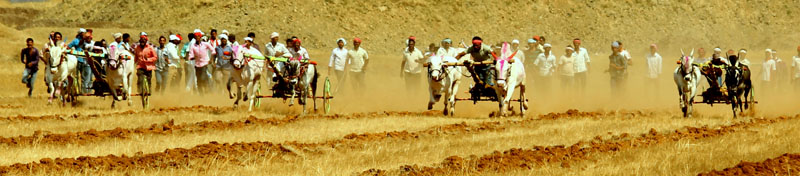
A bull is running. He is yoked to a cart, he has just drunk an entire pool of water, and the people who set him going have made him bellow and empty his bladder in the middle of the course. Clods of earth fly up from his hooves and keep hitting the person holding the reins, who is a woman. Her clothes are streaming behind her in the wind. On the other side of the yoke-pole, where the second draught animal ought to be, there is a block of wood.
She wins. The prize is a thousand cattle.
The poem is RV 10.102, twelve verses, traditionally ascribed to a poet called Mudgala Bhārmyaśva, and it is the only sustained account of a race anywhere in the Rigveda. It is also one of the few places in the collection where a named woman does something physical, in public, and is credited with the result. Everything else about it is contested: whether the event is a sporting contest or a cattle raid, what the block of wood was doing there, why a poet thought any of this was worth a hymn, and whether the whole thing is about something else entirely.
What is not contested is the texture. The Rigveda is a corpus of liturgical poetry, enormously formal, obsessed with fire and pressed juice and the correct way to address a god. Then this: dust, dung, an improvised vehicle, a crowd, and a win that everyone involved seems to find slightly disreputable. The hymn opens by admitting that the chariot has been assembled wrong.
This piece follows the twelve verses closely, then follows the argument about them, which runs from Yāska in perhaps the fifth century BCE to a paper in the Journal of the American Oriental Society in 2002 that proposed the race is not really a race at all.
Twelve Verses, In Order
Read straight through, the hymn behaves like a commentary on a scene the audience can already see. It does not narrate from the beginning. It points.
| Verse | What happens | The word that matters |
|---|---|---|
| 1 | A prayer that Indra help “your chariot, which has been made wrong” | mithūkṛta, mismatched |
| 2 | The wind lifts her dress; Mudgalānī becomes the driver and wins a thousand | rathī́, driver; kṛtá, the winning throw |
| 3 | A conventional plea: keep the weapon of Dāsa and Ārya away | vadha, weapon |
| 4 | The bull drinks a pool dry, charges, “heavy in the testicles”, seeking fame | muṣkabhāra |
| 5 | They make him bellow and urinate mid-race; Mudgala wins the stakes | amehayan, they made him piss |
| 6 | The bull is yoked, the long-haired driver shouts, thrown-up clods hit Mudgalānī | niṣpád, what the hooves throw up |
| 7 | Someone lifts the wheel-rim, yokes the ox; Indra helps “the lord of cows” | pradhí, wheel-rim |
| 8 | Goaded, the shaggy one runs well, “tied to the strap with wood” | dāru, wood |
| 9 | Look: the bull’s yoke-mate, a wooden club, lying in the middle of the track | drughaṇá, wooden club |
| 10 | Nobody feeds it grass or water, yet it pulls and points the way | dhúr, yoke-pole |
| 11 | “Like a rejected wife who has found a husband”, swelling with milk | parivṛktā́, the avoided one |
| 12 | Indra too wins races driving a gelding as yoke-mate | vadhrí, gelding |
The first verse is the tell. Before anything else happens, the poet asks Indra to look after a vehicle he describes as mithūkṛtam, put together in a mismatched way, wrongly paired.
pra te rathaṃ mithūkṛtam indro ‘vatu dhṛṣṇuyā
“Let Indra boldly protect that chariot of yours, the one that has been put together wrong. In this race worth fame, much-invoked one, help us when the stakes are shared out.”
Rigveda 10.102, verse 1. My rendering from the Sanskrit; compare Jamison and Brereton (Oxford, 2014). [1]
A hymn that opens by conceding the equipment is defective is not a hymn doing propaganda. Whatever else RV 10.102 is, it knows the situation is funny.
What Griffith Did to Verse 5
Ralph Griffith finished his complete English Rigveda in 1896, and for a century it was the version most English readers met. [2] Here is his verse 5:
“They came anear the bull; they made him thunder, made him pour rain down ere the fight was ended. And Mudgala thereby won in the contest well-pastured kine in hundreds and in thousands.”
(RV 10.102.5, Griffith 1896)
Thunder and rain. It reads like a storm simile, the sort of thing the Rigveda does constantly with the Maruts. The Sanskrit is ny àkrandayann úpayanta enam ámehayan vṛṣabhám mádhya ā́jeḥ. The first verb is from krand, to bellow or roar, which is fine. The second is a causative of mih.
Mih means to urinate. It is one of the most securely reconstructed verbs in the family: Greek omeikhein, Latin mingere, Old English mīgan, all from an Indo-European root meaning exactly that, and the noun megha, “cloud”, is the same root doing metaphorical work. [3] The line says that the handlers came up to the bull and made him piss in the middle of the race. Griffith knew this. He also knew his readership.
| Sanskrit | Plain sense | Griffith 1896 |
|---|---|---|
| ámehayan (5) | they made him urinate | “made him pour rain down” |
| muṣkabhārá (4) | bearing testicles, heavy-scrotumed | omitted; “in vigorous strength” |
| mádhya ā́jeḥ (5) | in the middle of the race | “ere the fight was ended” |
| kā́ṣṭhāyā mádhye (9) | in the middle of the racecourse | “midway on the field of battle” |
| niṣpádaḥ (6) | what the hooves throw up | “his lifted heels” |
The last two rows are the consequential ones. Griffith turns the racing vocabulary into battle vocabulary, which makes the event a skirmish and Mudgalānī a woman driving through a war. He had some support for that, since the hymn does use raiding words, as we will see. But the choice compounds, and by verse 9 his “field of battle” has quietly replaced a racetrack: the Sanskrit there says only that the club is lying in the middle of the kā́ṣṭhā, the course.
That muṣka means what it means is not a guess. The Rigveda twice calls Indra sahasramuṣka, thousand-testicled (RV 6.46.3, RV 8.19.32), which no translator has ever managed to make decorous. The bull in verse 4 is described the same way, in a poem about winning. The two facts are related.
Aside. I am not interested in scoring points off Victorian translators, and the same pattern of softening shows up in the translation history of ṛṇá, debt, which I traced in The Gods Who Came to Collect. The point is practical. If you read this hymn in a nineteenth-century translation you will not find the race, the genitals, or the urine, and those three things are most of the evidence for deciding what the poem is about.

The Vocabulary of Going Fast
The word at the centre of the hymn is ājí (Sanskrit: आजि), race or contest. It comes from the root aj, to drive, the same root as Latin agere and Greek agein. [3] A Vedic race is, etymologically, a driving, and the noun covers both the event and the course it is run on.
Ājí is not common. Scanning the romanised Saṃhitā for its inflected forms turns up roughly two dozen verses in the whole collection, clustered where you would expect: Indra hymns, Soma hymns, and this one. Three of them are in RV 10.102 itself, which is the only place in the Rigveda where we watch a particular race rather than being told that somebody is good at racing.
| Term | Sense | Verses in the Rigveda (approx.) |
|---|---|---|
| ā́ji | race, contest, course | ~23 |
| kā́ṣṭhā | racecourse, goal, finishing line | 11 |
| prádhana | stake, what is put up to be won | 8 |
| vā́ja | prize, and the speed that wins it | several hundred, with derivatives |
| dhána | stake, winnings, wealth at risk | ~112 |
| rathī́ | chariot-driver, the one in the car | 34 |
| sārathi | charioteer, the one at the reins | 6 |
| ánas | ox-cart, wagon | rare; one of them is 10.102.6 |
Methods note. These counts come from my own scan of the romanised text of all ten maṇḍalas, matched on stems. Vedic sandhi fuses words across boundaries, so asmin ājau surfaces as asminnājau and any count of this kind is approximate at the edges. Ā́ji is a particular trap: the letter sequence also sits inside vājin, rājan and bhrājate, which I have excluded by hand. Read every number here as “roughly this many verses”, not as a concordance entry.
Two details in the hymn’s own vocabulary do real work. Verse 2 says Mudgalānī won gáviṣṭau, in the cattle-quest, and gaviṣṭi is standard raiding language, the word for going out after somebody else’s herds. Verse 9 places the win pṛtanā́jyeṣu, in the pṛtanā-ājya, the driving-forth of armies. The Rigvedic poets did not keep sport and war in separate boxes, because the prize was the same in both cases and so was the skill. Griffith’s “battle” was not perverse. It was one legitimate side of a word that genuinely faces both ways.
And verse 2 hides a third game inside the second. Mudgalānī, the verse says, kṛtáṃ vy aced: she gathered in the kṛtá, which is the name of the winning throw in the Vedic dice game. [4] The poet has stacked three kinds of winning into a single line, a raid, a race and a cast of dice, which tells you something about how this culture filed the concept of luck. For the dice themselves, see the Gambler’s Hymn.
The Thing in the Middle of the Track
Now the problem.
“Look at this one here, the bull’s yoke-mate, the wooden club lying in the middle of the track, with which Mudgala won cattle in the contests, a hundred times a thousand.”
Rigveda 10.102, verse 9. My rendering; compare Griffith’s “this mace, this bull’s companion”. [2]
Drughaṇá is transparent as a compound: dru, wood or tree, plus the root han, to strike. A wood-striker, a mallet, the kind of heavy club you split timber with. It occurs exactly once in the Rigveda, here, and the next verse makes its function unmistakable by joking about it.
“Who has ever actually seen such a thing? The one they yoke, they merely prop into place. They bring it no grass and no water. Out past the pole it pulls, and it points the way.”
Rigveda 10.102, verse 10. My rendering. The syntax is rough and every translator patches it differently.
A draught animal that eats nothing and drinks nothing. Mudgala had one bull and needed two, so he lashed a log into the empty half of the yoke and drove anyway. Verse 8 confirms the method from the other side: the bull is dārv ānahyamānaḥ, being bound with wood to the leather strap.
This is where the hymn stops being merely strange and becomes interesting, because a Vedic yoke is a paired thing. The vocabulary of Vedic ritual and Vedic grammar runs on pairs, as the collection’s dual deities show at length in the grammar of pairs. A team with one animal and one absence is a small structural scandal, and verse 1 flagged it in advance: mithūkṛta, wrongly paired. Mudgala did not just improvise. He entered a contest with a yoke that was, in the terms his own culture used, incomplete.
graph TD
    A["RV 10.102: a race won<br/>by bull plus wooden club"] --> B["Yaska, Sarvanukramani<br/>deity is the club, or Indra"]
    A --> C["Brhaddevata<br/>Indra's mallet, a contest won"]
    A --> D["Sayana and Wilson<br/>cattle raid, robbers routed"]
    A --> E["19th century Europe<br/>a comic ballad"]
    A --> F["Brereton 2002<br/>a niyoga rite for offspring"]
    B --> G["The club is a divinity"]
    C --> G
    D --> H["The club is a weapon"]
    E --> I["The club is a joke"]
    F --> J["The club is a substitute husband"]
Three Thousand Years of Guessing
The oldest surviving readers of this hymn were already puzzled, and their confusion is itself evidence: whatever institution the poem assumes, it had stopped being obvious well before the first commentaries.
The traditional index of poets, deities and metres assigns the hymn to Mudgala Bhārmyaśva and gives its deity as drughaṇo indro vā, “the club, or Indra”. The Bṛhaddevatā reports the same split: Yāska, the earliest Vedic etymologist whose work survives, took the hymn to address the mallet or Indra, while Śaunaka preferred to call it a hymn to the All-gods. [5][18] Consider what the first option means. A canonical index of divinities was prepared to entertain the possibility that the addressee of a Rigvedic hymn is a piece of firewood.
The Bṛhaddevatā, the versified catalogue of the legends behind the hymns, supplies a story: Mudgala yoked a bull and a mallet belonging to Indra, entered a contest, and beat Indra and Soma themselves. [5] Later tellings, and Sāyaṇa’s fourteenth-century commentary behind H. H. Wilson’s English version, move the scene decisively to a cattle raid: thieves took Mudgala’s herd, the old man gave chase with his one remaining ox and a club, his wife drove, and he got the cows back by knocking the robbers down. [6] That reading explains the drughaṇa by demoting it from yoke-mate to weapon, at the cost of ignoring verses 8 and 10, which have it tied into the harness and pulling.
European readers largely gave up on the ritual question and enjoyed the poem as a ballad. The Journal of the Royal Asiatic Society printed a note in 1910 with the tired title “Suggestions regarding Rig-Veda, X, 102”. [7] Geldner’s German translation and Oldenberg’s exegetical notes handled the crux word by word without settling the scene. [8][9] The hymn joined a small file of Rigvedic oddities, the dice lament and the frogs and the forest goddess, that got labelled secular or popular and set aside.
Then, in 2002, Joel Brereton published “The Race of Mudgala and Mudgalānī” in the Journal of the American Oriental Society and argued that the race is a figure for a rite of niyoga: the appointment of a substitute to father a child on the wife of a man who cannot. [10]
| Reader | Roughly when | What the contest is | What the club is |
|---|---|---|---|
| Sarvānukramaṇī, Yāska | mid first millennium BCE | unspecified | a deity in its own right |
| Bṛhaddevatā | c. 400 BCE | a contest against Indra and Soma | Indra’s own mallet |
| Sāyaṇa, followed by Wilson | 14th c. CE, 19th c. CE | a cattle raid | a weapon |
| Griffith, Geldner, most 20th c. readers | 1896 onward | a comic race, or a battle | improvised junk |
| Brereton 2002 | modern | a rite of niyoga in the language of racing | the stand-in for a husband |
The Gelding at the End
Brereton’s case rests on where the poem puts its emphasis, and the last verse is the hinge.
“You, Indra, are the eye of everything that moves, the eye of the eye itself. Bull that you are, you have won the race with your bull; you go for the win urging on a gelding as your yoke-mate.”
Rigveda 10.102, verse 12. My rendering; compare Jamison and Brereton (Oxford, 2014). [1]
Vadhrí means castrated: a gelded animal, and by extension an impotent man. A hymn about a race ends by telling Indra that he too wins while driving something that cannot reproduce. Verse 11, immediately before it, compares the situation to a parivṛktā́, the avoided or rejected wife, who has now “found a husband”, and describes her pīpyānā, swelling, running with milk. That word belongs to lactation and to abundance, not to athletics. Parivṛktā́ occurs nowhere else in the Rigveda; in the later royal consecration it is the title of one of the king’s four wives, the one who is passed over. [11]
Once you are looking for it, the corpus supplies a whole pattern. Five verses across four maṇḍalas tell a story about a vadhrimatī́, a woman whose husband is impotent, who called on the Aśvins and was given a son named Hiraṇyahasta, Golden-hand.
| Verse | What it says |
|---|---|
| RV 1.116.13 | The Aśvins hear “the weakling’s wife” and give her a son, Hiraṇyahasta |
| RV 1.117.24 | The same gift, named again |
| RV 6.62.7 | “They heard the call of the eunuch’s consort” |
| RV 10.39.7 | They came at the call of the vadhrimatī and granted noble offspring |
| RV 10.65.12 | Śyāva, son of Vadhrimatī, revived |
Translations after Griffith (1896). [2]
The Rigveda, in other words, already had a recognised problem and a recognised divine solution for it: a household with no heir, a husband who cannot supply one, and gods who arrange a substitute. Read RV 10.102 against that file and the hymn’s peculiar furniture lines up disconcertingly well. A yoke with one live partner and one lifeless stand-in. A woman doing the driving. A win counted in offspring-bearing cattle. A closing image of a god who succeeds with a gelding in harness. The word for the rejected wife, and the word for milk coming in.
I find the reading persuasive without finding it proved, and two cautions are worth stating plainly.
First, niyoga as an institution is documented in the Dharmasūtras and the epics, centuries later than these hymns, and reading a late legal category back into Rigvedic poetry is exactly the move that Vedic scholarship spends most of its time policing. The Rigveda’s own funeral liturgy gestures at something levirate-shaped when it raises the widow from beside the corpse at RV 10.18.8, which I discuss in the funeral hymns, but gesture is not attestation.
Second, nobody in the Indian tradition read it this way. Yāska did not, the Bṛhaddevatā did not, Sāyaṇa did not. If the hymn accompanied a fertility rite, that context was lost early and completely.
Aside. Both things can be true. A poem composed for one occasion can be preserved because a later community found it funny, and the mismatch between an obscene subtext and a slapstick surface is not a scholarly embarrassment but a normal fact about how bawdy ritual language survives. The Vedic ritual corpus keeps a place for exactly this register: the Mahāvrata day includes ritually mandated obscene exchange, and Vedic literature is not squeamish in the way that Vedic translation has been.
Rigged Races Are Normal
One reason a poem about a fixed contest raises no eyebrows in its own tradition is that Vedic ritual institutionalised the fixed contest.
The vājapeya, the “drink of the prize”, is a soma rite whose centrepiece is a chariot race. Seventeen chariots run, the patron of the sacrifice is one of the drivers, and he is required to win; the victory is then celebrated on seventeen drums. [12][13] The number seventeen recurs throughout the rite with the persistence the Brāhmaṇas reserve for things they consider structurally important. Nobody pretends the outcome is open. The race is a machine for producing a specific result, and the result is the point.
Marcus Sparreboom’s study of Vedic chariots makes the general case: the ratha was never merely transport, and races were never merely sport. [12] They were how a community converted speed, animals and nerve into status that everyone had watched being earned.
Which reframes what looks like cheating. A ritual race is supposed to be won by the right person, and the equipment is a formality. A man who enters with one bull and a log and takes a thousand cattle off the field has not broken the logic of the institution. He has exposed it.
The Rigveda even has a second improper-animal race, easy to miss. In an Aśvin hymn the poets recall that the twins’ rā́sabha, their donkey, won the thousand at Yama’s contest (RV 1.116.2). A donkey. Beating horses. For a text that is besotted with fast horses, and spends whole hymns on the anatomy of a racer, the Rigveda has a striking fondness for stories in which the wrong animal wins.
The Woman at the Reins
Verse 2 is worth holding up on its own, because of what it does not say.
“The wind lifts her dress as she wins the thousand that comes with the chariot. Mudgalānī became the driver in the cattle-quest; in the contest, Indrasenā raked in the winning cast.”
Rigveda 10.102, verse 2. My rendering; compare Jamison and Brereton (Oxford, 2014). [1]
The word for driver is rathī́, which is the ordinary noun for the man in the car, used across the Rigveda of Indra, of the Aśvins, of human warriors. The poet does not coin a feminine form and does not apologise. He writes rathī́r abhūn mudgalā́nī, Mudgalānī became the driver, and moves on.
Her name is a husband-derived formation, Mudgala’s wife, which is how Rigvedic women’s names usually work, a pattern visible across the collection’s accidental census of personal names. But the verse also gives her a second name of her own: indrasenā́, Indra’s Missile, which occurs nowhere else in the Rigveda. In a corpus where few women are named at all, this one gets an epithet suitable for artillery.
The detail I keep returning to is the dress in the wind, because it is the kind of thing a poem includes only if someone actually saw it. There is no theological work for it to do. Somebody watched a cart go past with a woman standing in it, noticed the cloth streaming, and put the image in a hymn that has been recited for three thousand years. The Rigveda contains a great deal about women as ritual participants, as poets, as goddesses, and I have written about that elsewhere in the hidden women of the Rigveda and the rishikās. This is something else. This is reportage.
A caution against romanticising it, though. If Brereton is right, Mudgalānī is at the reins because her husband cannot do what the rite requires, and the poem’s admiration is entangled with her being in a difficult position. And even on the plainest reading, one named woman driving one cart on one afternoon is not evidence of a class of women charioteers. It is evidence that it could happen and be celebrated rather than concealed.
Nestor’s Son, and What the Comparison Is Worth
Book 23 of the Iliad gives us the other great early chariot race of the Indo-European world, run at Patroclus’s funeral games, roughly six or seven centuries after the likeliest date for the Rigveda’s tenth book. The overlaps are real: a turning post, prizes announced in advance, a divine patron interfering for a favourite, an irregularity in the running, and a dispute afterwards about who deserves what. The Vedic word for the goal or course, kā́ṣṭhā, occupies the same conceptual slot as Homer’s nyssa.

What the comparison licenses is modest and worth stating precisely: societies that inherited the horse-drawn spoked-wheel chariot, a technology whose earliest secure archaeological attestation is the Sintashta burials of the southern Urals around 2000 BCE, also inherited or independently developed the habit of racing it for prizes in front of an audience, with gods involved. [14] What it does not license is treating Mudgala’s cart as a version of anything Greek. His vehicle is an anas, an ox-cart. His animal is a bull. The Rigveda knows perfectly well what a racing chariot is and uses a different word for it, ratha, the light spoked vehicle whose fittings I looked at in Metallurgy and Mantras. The joke of the hymn depends on the gap between the two.
Why the Canon Kept It
Rigvedic transmission is the most conservative textual operation in the ancient world. The hymns were preserved syllable by syllable, accent by accent, through a system of recitation designed to make drift impossible, described in the oral engine. Nothing was edited for taste. That is why the collection still contains a gambler’s confession, a hymn of frogs that sounds suspiciously like a parody of priests, and this: a poem whose traditional deity may be a log, whose best modern reading makes it a fertility rite in athletic disguise, and whose most quoted line is about a bull relieving himself at speed. Every generation has found it embarrassing in a different way and passed it on intact.
That is worth more than any particular solution to the puzzle. The people who assembled the Rigveda were not curating scripture in the later sense. They kept what had been well made, including the parts that did not flatter them, on the assumption that a poem good enough to survive is worth keeping whether or not you can explain it.
Open RV 10.102 in two translations at once, Griffith’s from 1896 beside Jamison and Brereton’s from 2014, and read the twelve verses down both columns. The first will give you a battle. The second will give you a race, a joke and an obscenity. The hymn has not changed a syllable in between. Everything that moved was on our side of the page.
References
Jamison, Stephanie W., and Joel P. Brereton. The Rigveda: The Earliest Religious Poetry of India. 3 vols. Oxford University Press, 2014. The standard modern English translation; a fuller technical commentary is maintained online by the translators.
Griffith, Ralph T. H. The Hymns of the Rigveda. 2 vols. Benares, 1896. archive.org.
Mayrhofer, Manfred. Etymologisches Wörterbuch des Altindoarischen. 3 vols. Carl Winter, 1992-2001, s.v. míh, ā́ji, drughaṇá.
Falk, Harry. Bruderschaft und Würfelspiel: Untersuchungen zur Entwicklungsgeschichte des vedischen Opfers. Freiburg: Hedwig Falk, 1986. On dicing, the kṛta throw, and the sabhā.
Macdonell, Arthur A., ed. and trans. The Bṛhad-devatā, Attributed to Śaunaka. Harvard Oriental Series 5-6. Harvard University Press, 1904. archive.org.
Wilson, Horace Hayman, trans. Ṛig-Veda Sanhitā: A Collection of Ancient Hindu Hymns. London, 1850-1888. Translated from the text with Sāyaṇa’s commentary. archive.org.
“Suggestions regarding Rig-Veda, X, 102.” Journal of the Royal Asiatic Society 42, no. 4 (1910): 1328-1334. Cambridge Core.
Geldner, Karl Friedrich. Der Rig-Veda aus dem Sanskrit ins Deutsche übersetzt. Harvard Oriental Series 33-36. Harvard University Press, 1951.
Oldenberg, Hermann. Ṛgveda: Textkritische und exegetische Noten. 2 vols. Berlin, 1909-1912. archive.org.
Brereton, Joel P. “The Race of Mudgala and Mudgalānī.” Journal of the American Oriental Society 122, no. 2 (2002): 224-234.
Jamison, Stephanie W. Sacrificed Wife / Sacrificer’s Wife: Women, Ritual, and Hospitality in Ancient India. Oxford University Press, 1996. On the king’s four wives, including the parivṛktī, and on women’s ritual agency.
Sparreboom, Marcus. Chariots in the Veda. Memoirs of the Kern Institute 3. Leiden: E. J. Brill, 1985.
Keith, Arthur Berriedale. The Religion and Philosophy of the Veda and Upanishads. Harvard Oriental Series 31-32. Harvard University Press, 1925. On the vājapeya and its chariot race. archive.org.
Anthony, David W. The Horse, the Wheel, and Language: How Bronze-Age Riders from the Eurasian Steppes Shaped the Modern World. Princeton University Press, 2007. On the Sintashta chariot burials.
Macdonell, Arthur A., and Arthur B. Keith. Vedic Index of Names and Subjects. 2 vols. London: John Murray, 1912. s.v. Mudgala, ratha, ājí. archive.org.
Whitaker, Jarrod L. Strong Arms and Drinking Strength: Masculinity, Violence, and the Body in Ancient India. Oxford University Press, 2011. On competitive masculinity and the language of prizes in the Rigveda.
Kuiper, F. B. J. “The Ancient Aryan Verbal Contest.” Indo-Iranian Journal 4, no. 4 (1960): 217-281. archive.org. On contest as an organising institution of Vedic culture.
Sarup, Lakshman, ed. and trans. The Nighaṇṭu and the Nirukta of Śrī Yāskācārya. Oxford University Press, 1921. archive.org.
Comments (0)
No comments yet. Sign in to start the discussion.