The Secret Name of Butter: Inside the Rigveda's Hymn to Ghee
The Last Hymn of the Fourth Book
A bull with four horns, three feet, two heads and seven hands stands somewhere in the Rigveda, bound in three places, bellowing. It is one of the most quoted images in Sanskrit literature. India’s greatest grammarian used it to describe the structure of language itself; commentators have read it as the syllable om, as the sacrifice, as the sun, as the year. What almost nobody mentions when they quote it is the subject of the hymn it comes from.
The subject is clarified butter.
RV 4.58 is the final hymn of the Rigveda’s fourth book, eleven verses long, and its addressee is ghṛtá (घृत), the fat that is left when butter is simmered until its water has boiled off and its milk solids have browned and settled. The word survives, barely changed, as Hindi ghī and English ghee. The hymn names it in nine of its eleven verses. It calls ghee the tongue of the gods and the navel of the immortal. It says that ghee has a hidden name. It describes streams of ghee pouring out of an ocean inside the human heart, running in a hundred channels that an enemy cannot see, moving like deer bolting from an archer, inclining toward the fire like women at a gathering who have caught someone’s eye.
This is not a minor curiosity tucked into a corner of the collection. Ghee is everywhere in the Rigveda. By my own count of the romanised text of all ten maṇḍalas, the stem ghṛta and its compounds occur in about 238 of the 10,524 verses, spread across 179 of the 1,028 hymns: roughly one verse in forty four, and something close to one hymn in six. Counted the same way, that is more hymns than contain the name of the Aśvins (123) or of the Maruts (170). Ghee is the second most pervasive substance in the text after soma, and unlike soma, nobody has ever had to argue about what plant it came from.
What follows is an attempt to take the hymn seriously as a hymn, and then to ask the question it forces: why would a society put its cooking fat at the centre of its cosmology, and what did it actually cost to pour a ladle of it into a fire?
Methods note. The counts here come from my own scan of the romanised Saṃhitā text held in this project’s corpus, matched on the stem ghṛt and tokenised on word boundaries. Two traps needed clearing by hand. The rishi name Gṛtsamada and the adjective gṛtsa, “clever”, appear in that corpus with an intrusive h and look like ghee words; they are not, and I have excluded them. Vedic sandhi also fuses words together, so ghṛtam anvavindan surfaces as a single token and a strict word-initial match loses it, which is why a stem search returns about 238 verses where a word-initial one returns 212. Read every number here as “roughly this many verses”, and treat the Griffith tallies further down as counts over the 199 of those verses for which the English text in the same corpus is complete.
Eleven Verses and the Thing They Describe
The hymn opens on water, not on a kitchen.
samudrā́d ūrmír mádhumāṁ úd ārad úpāṁśunā sám amṛtatvám ānaṭ
ghṛtásya nā́ma gúhyaṁ yád ásti jihvā́ devā́nām amṛ́tasya nā́bhiḥ
“From the ocean the honeyed wave rose up; by way of the stalk it reached immortality. That which is the hidden name of ghee: the tongue of the gods, the navel of the immortal.”
Rigveda 4.58, verse 1, translated from the Sanskrit.
Four moves in two lines. A wave of sweetness rises out of an ocean; it passes through aṁśu, the pressing stalk, which in the Rigveda is almost always soma’s word; it arrives at deathlessness; and then the poet gestures at a name that is gúhya, hidden, which he declines to say and instead describes in apposition. The Rigveda does this with things it considers dangerous or load bearing, a habit worth its own study and one I have written about in What the Rigveda Hides. To call ghee the tongue of the gods is not decoration either. The gods eat by means of fire; fire’s tongue is its flame; and the thing that makes a flame leap and brighten on a wood fire, instantly and visibly, is fat.
Verse two announces the project in the flattest possible terms, and then drops the bull in.
Let us declare aloud the name of Ghṛta, and at this sacrifice hold it up with homage. So let the Brahman hear the praise we utter. This hath the four-horned Buffalo emitted.
(RV 4.58.2, trans. Griffith 1896) [1]
Four are his horns, three are the feet that bear him; his heads are two, his hands are seven in number. Bound with a triple bond the Steer roars loudly: the mighty God hath entered in to mortals.
(RV 4.58.3, trans. Griffith 1896) [1]
Then the hymn does something that reads, on a first pass, like a myth fragment and, on a second, like a description of a process. The gods find ghee tridhā́ hitam, “set down in three portions”, hidden in the cow by the Paṇis, the hoarders who in the Vala myth keep the cattle shut in a rock. Indra generates one portion, Sūrya another, and a third is fashioned from Vena, a figure the hymn does not bother to explain and about whom the commentarial tradition is guessing as openly as we are. After that the hymn turns inward and stays there.
| Verse | What the verse does | The image it leaves |
|---|---|---|
| 1 | Names the hidden name | Honeyed wave out of the ocean; tongue of the gods |
| 2 | States the intention to praise | The four-horned gaura who emitted this |
| 3 | The riddle | Bull with four horns, three feet, two heads, seven hands |
| 4 | The finding of ghee | Three portions hidden in the cow by the Paṇis |
| 5 | The source | A hundred channels from the ocean in the heart; a golden reed among them |
| 6 | Purification | Streams cleansed by heart and mind; deer fleeing the bowman |
| 7 | Speed | Currents faster than wind, like a red stallion breaking fences |
| 8 | Arrival at the fire | Streams like smiling women inclining toward Agni |
| 9 | Arrival at the rite | Streams like brides adorned for a wedding |
| 10 | The request | Cattle, goods, and the offering carried to the gods |
| 11 | The closing claim | The world rests on it: in the ocean, the heart, the lifespan |
Verse five is the one that stops a careful reader.
From inmost reservoir in countless channels flow down these rivers which the foe beholds not. I look upon the streams of oil descending, and lo! the Golden Reed is there among them.
(RV 4.58.5, trans. Griffith 1896) [1]
Griffith’s “inmost reservoir” is doing a lot of hiding. The Sanskrit is hṛdyā́t samudrā́t, “from the ocean that is in the heart”. That collocation is almost unique. Searching the whole Saṃhitā for verses that contain both samudra, ocean, and a form of hṛd, heart, returns six verses in ten thousand, and two of the six are in this hymn: verse 5 and verse 11. The Rigveda, which is usually taken to be a text about external powers, here locates an ocean inside a person and runs a hundred irrigation channels out of it.
The last verse makes the claim as large as it can be made.
dhā́man te víśvam bhúvanam ádhi śritam antáḥ samudré hṛdy ántar ā́yuṣi
“On your ordinance the whole world is set: within the ocean, within the heart, within the lifespan. May we attain that honeyed wave of yours, gathered where the waters meet.”
Rigveda 4.58, verse 11, translated from the Sanskrit. The sense of the final line is disputed.
The whole world is set on the ordinance of clarified butter. Whatever else this hymn is, it is not a recipe.
Aside. The hiraṇyáyo vétaso, “golden reed”, of verse 5 is a genuine crux. Translators have made it a reed, a rush, a water plant, a stalk, a pipe, or a shaft of sunlight in the pouring stream; Geldner marks the difficulty in his notes and later interpreters have not settled it [4]. The honest position is that the Rigveda contains an object here whose referent we cannot recover, standing in the middle of a flow of melted fat, looking golden. The text is older than its own interpreters, and this is one of the places where you can feel the gap.
graph LR
    A["Ocean, samudra"] --> B["Honeyed wave"]
    B --> C["Hidden name"]
    C --> D["Four-horned bull"]
    D --> E["Three portions in the cow"]
    E --> F["Ocean in the heart"]
    F --> G["A hundred channels"]
    G --> H["Rivers, purified"]
    H --> I["Deer fleeing the archer"]
    I --> J["Stallion through fences"]
    J --> K["Women, smiling"]
    K --> L["Brides at a wedding"]
    L --> M["The kindling, and Agni"]
Read as a sequence, the hymn is a single sustained act of attention to a liquid moving. It starts cosmic, narrows to a household fat, relocates the source inside the body, and then follows the pour all the way down to the point where the fat touches burning wood. The similes accelerate as the stream does. By verse 9 the ghee is a bride walking toward a fire, which in the Rigvedic wedding is exactly where a bride walks.
What a Ladle of Ghee Actually Cost
Here is the part that tends to be left out of discussions of Vedic ritual. Ghee is expensive. Not expensive in the vague way that offerings are said to be precious, but expensive in a way you can calculate.
Clarified butter is almost pure milk fat. Indian dairy-industry specifications put it at about 99 to 99.5 percent fat with under half a percent moisture, produced by heating butter or cream to roughly 110 to 120 degrees Celsius until the water has driven off [11][12]. Cow milk carries roughly four percent fat. So, ignoring processing losses, the milk behind a kilogram of ghee is
$$m_{\text{milk}} \;=\; \frac{m_{\text{ghee}} \cdot \phi_{\text{ghee}}}{\phi_{\text{milk}}} \;\approx\; \frac{1\ \text{kg} \times 0.99}{0.04} \;\approx\; 25\ \text{kg}$$
about twenty five litres, which for a traditionally managed zebu cow yielding a litre or two a day beyond what her calf takes is somewhere between two and four weeks of one animal’s surplus. A ladleful poured into a fire is not a gesture. It is a measurable subtraction from a herd’s output, performed in public, at a moment when everyone present can price it.
That is also why the substance is ghṛta and not butter. Fresh butter in the heat of the Punjab is a few days from rancid. Clarified, with its water and milk solids removed, it keeps for months at room temperature without any technology at all [11]. For a mobile pastoral society this is the only way to turn a perishable daily yield into a storable, divisible, transportable asset. Ghee is a battery for cattle wealth, and cattle wealth is the Rigvedic economy, a subject this blog has treated at length in Cattle as Currency.
Aside. The arithmetic above is an order-of-magnitude exercise, not a measurement. Milk fat content varies by breed, season and lactation stage; churning and clarification lose material; and we have no Rigvedic figures for anything. What the calculation establishes is a ratio, not a quantity: ghee concentrates dairy fat by roughly twenty five to one, which is the fact the ritual economics depends on. Anyone wanting the hard numbers on modern composition should start with the dairy-science literature rather than with me [11][12].

The archaeology has caught up with this in the last few years, and from an unexpected direction. In 2020 a team led by Kalyan Sekhar Chakraborty published compound-specific isotope analysis of absorbed lipid residues from pottery at Kotada Bhadli, a Harappan agro-pastoral settlement in Gujarat occupied between about 2300 and 1950 BCE. Twenty two of fifty nine sherds carried dairy lipids, with isotope values pointing to milk from animals grazing C4 vegetation, that is, cattle or water buffalo [10]. Dairy processing in northwestern South Asia is therefore attested in the ground, in cooking pots, centuries before the Rigveda’s hymns were composed. The poets inherited the technology. What they did with it was new.
Why the Fire Needed Fat
The Rigvedic sacrifice has a transport problem. An offering has to reach gods who are not present, and the only vehicle available is fire, which is why Agni is the messenger and not merely the hearth. Anything offered must therefore be convertible into flame.
Ghee converts better than anything else in the house. Fat carries roughly 37 megajoules per kilogram against dry wood’s 16 to 18, so a ladle of ghee is a sudden injection of fuel at about twice the energy density of the firewood under it, delivered in a form that vaporises and burns with a tall bright luminous flame. The fire visibly answers. You do not need a theology to notice this; you need one ladle and one evening.
The vocabulary records exactly that observation. Agni is ghṛtápratīka, “ghee-faced”, and ghṛtápṛṣṭha, “ghee-backed”. The ladle is ghṛtā́cī, “the ghee-dripping one”. Things are ghṛtaścút, ghee-dripping, and ghṛtasnú, ghee-flowing, and ghṛtanirṇíj, ghee-robed.
| Compound | Literal sense | Verses | Usually describes |
|---|---|---|---|
| ghṛtā́cī | ghee-dripping, ghee-bearing | 17 | The offering ladle, the sacrificial grass |
| ghṛtaścút | ghee-dripping | 13 | Streams, grass, offerings |
| ghṛtasnú | ghee-flowing | 11 | Waters, the strew, divine pairs |
| ghṛtápṛṣṭha | ghee-backed | 9 | Agni |
| ghṛtápratīka | ghee-faced | 6 | Agni |
| ghṛtanirṇíj | ghee-robed | 5 | Agni, the offering |
Counts are my own, over the stem forms; the “usually describes” column is a summary of the passages, not a complete concordance.
Ghee also does something to the poetry. Once the substance is in hand, the poets start thinking with it, exactly as they do with pressing stones and with grain. In RV 6.70, a hymn to Heaven and Earth, verse 4 piles four ghee words into a single line: the two world halves are ghṛténa abhī́vṛte, wrapped round with ghee, ghṛtaśríyā, ghee-adorned, ghṛtápṛcā, ghee-mingled, ghṛtā́vṛdhā, ghee-increased. In RV 1.125, a poem in praise of a patron’s generosity, the reward for giving is that “the streams of ghee come to him from all sides”. And in RV 10.69, a hymn to the fire of a man named Vadhryaśva, ghee is simply the fire’s diet:
Butter is that which makes Vadhryaśva’s fire grow strong: the butter is its food, the butter makes it fat. It spreads abroad when butter hath been offered it, and balmed with streams of butter shines forth like the Sun.
(RV 10.69.2, trans. Griffith 1896) [1]
Notice what the Rigveda does not have. There is no word in the collection for fresh unclarified butter: navanīta, the ordinary later Sanskrit term, does not occur once. Āmikṣā, the curds-and-whey preparation that matters in later ritual, is likewise absent. Kṣīra, milk, appears in six verses; sarpis, another word for melted fat, in eleven; pṛṣadājya, ghee mixed with curds, exactly once, and in a startling place: RV 10.90.8, where the dripping fat gathered from the dismembered cosmic Puruṣa becomes the animals of the world. The one appearance of the compound is in the one hymn that makes the universe out of a sacrifice, a text given a full reading in our critical account of the Puruṣa Sūkta.
| Term | Sense | Verses | Comment |
|---|---|---|---|
| ghṛta and compounds | clarified butter | ~238 | The second most pervasive substance after soma |
| páyas | milk, fluid, sap | ~82 | Often figurative, of rain, soma, poetic yield |
| sarpis | melted fat | 11 | Mostly in the phrase sarpirāsuti, “fat-libation” |
| kṣīra | milk | 6 | Including kṣīrapāka, “milk-cooked” |
| pṛṣadājya | ghee mixed with curds | 1 | RV 10.90.8 only |
| navanīta | fresh butter | 0 | Absent from the Rigveda; standard in later Sanskrit |
| āmikṣā | curds preparation | 0 | A later ritual food |
The pattern is consistent with a text whose dairy interest is overwhelmingly the processed, storable, burnable product, and whose interest in the intermediate stages is nil. The Rigveda is not a cookbook. It is a liturgy that happens to be built around a manufactured fat.
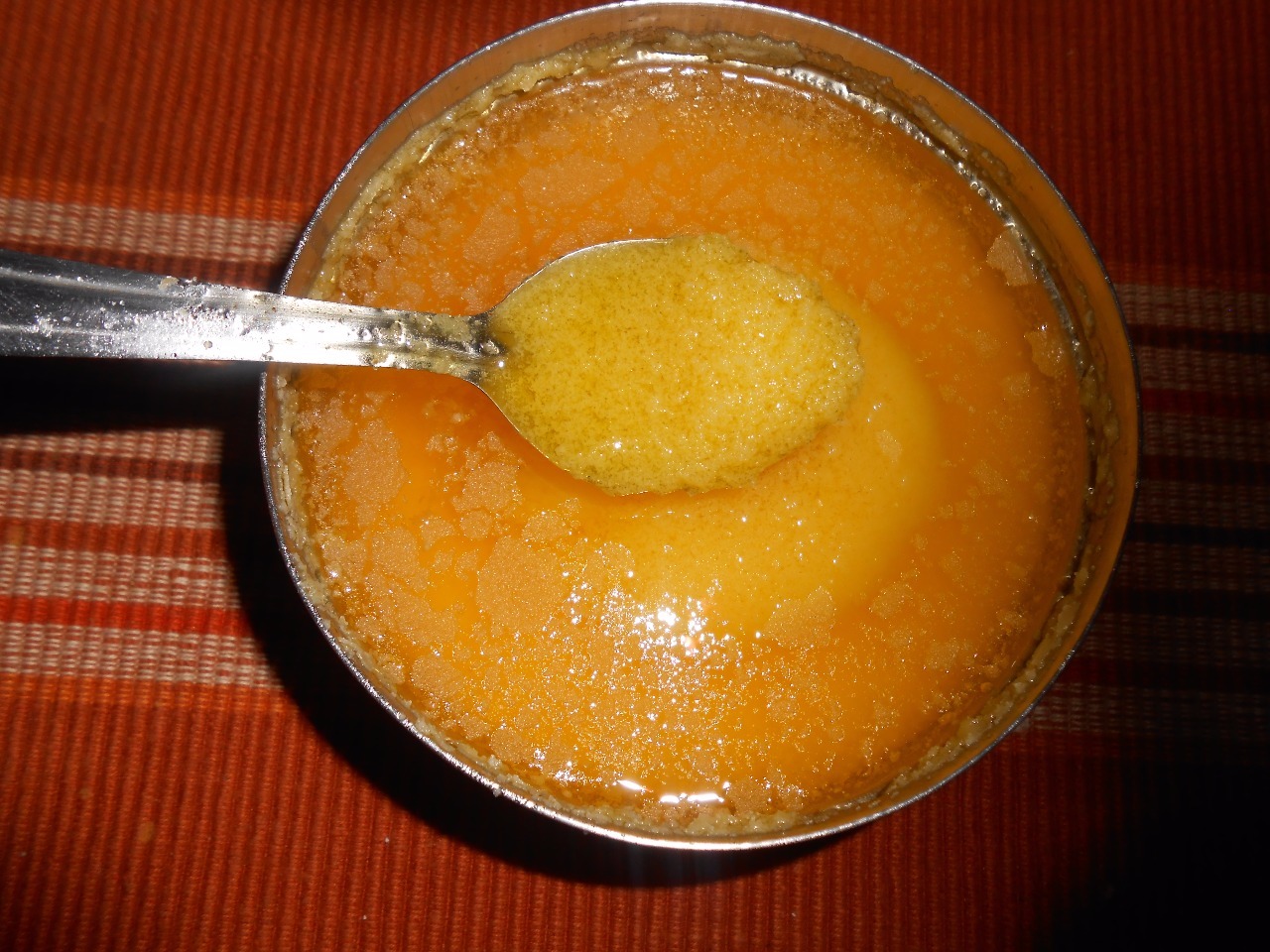
Hidden by Its Own Translators
Here is a fact about reading the Rigveda in English that deserves to be better known. If you read Ralph Griffith’s 1896 translation, which is the version most freely available online and the one most non-specialists have actually read, you will never once meet the word “ghee”.
I checked. Across the 199 ghee-bearing verses for which the corpus holds Griffith’s English, he renders the substance as “oil” in 117, “fatness” in 38, “butter” in 27, and “balm” in 11, with occasional overlaps where a verse uses several ghee words. The count of verses in which Griffith writes “ghee” in the body of the translation is zero.
| Griffith’s English | Verses | Effect on the reader |
|---|---|---|
| “oil”, “holy oil”, “sacred oil” | 117 | Suggests a lamp, or anointing; hides the dairy |
| “fatness” | 38 | Reads as abstract abundance, not a substance |
| “butter” | 27 | Accurate, but only in a minority of passages |
| “balm” | 11 | Suggests ointment or fragrance |
| “ghee” | 0 | The word a cook would use, never used |
The consequence is structural, not cosmetic. A single substance that runs through one hymn in six arrives in English under four different nouns, three of which point away from a kitchen. The reader of Griffith cannot see the pattern because the pattern has been dissolved into vocabulary, and a pattern you cannot see is a pattern you cannot think about. Anyone reading RV 4.58 for the first time should read it in a modern scholarly translation instead, where the substance is named for what it is and the hymn arrives as a poem about one identifiable thing [2][3]. The distortion belongs beside the others catalogued in our piece on the translation history. Victorian English had no comfortable register for sacred animal fat. Sanskrit did.
Where the Hymn Sits, and Who Decided What It Was About
RV 4.58 is the last hymn in its book, and that position is informative. Hermann Oldenberg’s Prolegomena of 1888 established the arrangement principles of the family books, Maṇḍalas 2 to 7: each opens with hymns to Agni, then Indra, then other deities in order of decreasing bulk, and hymns that break the pattern tend to be later additions sitting at the end, forming a kind of appendix [5]. Maṇḍala 4 obeys this and then trails off exactly as the model predicts. After its paired hymns to Dawn (51 and 52) and to Savitṛ (53 and 54) the book closes on All Gods, Heaven and Earth, the Lord of the Field, and Ghee: a run that ends with two subjects which are not gods at all.
The two closing hymns make an unexpectedly matched set. RV 4.57 praises the furrow, the plough, the ploughmen and Sītā, a text we have read closely in The Furrow and the Goddess. RV 4.58 praises clarified butter. Agriculture, then dairy. The book of Vāmadeva ends with its two means of production, which is not what a casual account of Vedic religion would lead you to expect. The Rigveda does this more often than its reputation suggests, raising wrath, faith, the priest’s fee and food itself into addressable powers, as catalogued in Hymns to Nouns and in A Hymn to Gruel.
The tradition itself could not decide what 4.58 was about. The Anukramaṇī, the ancient index that assigns each hymn its seer, metre and deity, attributes the hymn to Vāmadeva Gautama with the rest of the book, and then lists its deity not once but five ways: Agni, or Sūrya, or the Waters, or the Cows, or Ghee. That is a remarkable admission from a tradition whose job was to be definite, and it tells you the hymn was already a puzzle when the index was compiled. On the value and the limits of these attributions, see The Rigveda’s Impossible Authors.
graph TD
    A["RV 4.58, eleven verses"] --> B["Anukramani: five deities"]
    B --> C["Agni"]
    B --> D["Surya"]
    B --> E["The Waters"]
    B --> F["The Cows"]
    B --> G["Ghrta"]
    A --> H["Later readings of verse 3"]
    H --> I["Patanjali: grammar"]
    H --> J["Sayana: the syllable om"]
    H --> K["Ritualists: the sacrifice"]
Aside. On metre, the hymn is regular where it matters and slightly odd at the close. Counting syllables in the romanised text, verses 1 to 10 run to about forty four syllables, the signature of triṣṭubh, eleven syllables to the line in four lines. Verse 11 runs longer, close to forty eight, which is the jagatī count of twelve. A final verse in a longer metre is a common Rigvedic way of marking a seal, and it matches the content: verse 11 is where the hymn stops describing a liquid and starts making a claim about the world. My syllable counts are approximations drawn from a romanised text with sandhi already applied, so treat the numbers as supporting an impression, not as a metrical edition. The authoritative treatment of the arrangement and metre of hymns like this remains Oldenberg’s, discussed in The Sorted Collection.
The Verse That Became Grammar
Now back to the bull, because its afterlife is the strangest thing in this story.
Patañjali, writing the Mahābhāṣya, the great commentary on Pāṇini’s grammar, needed to establish at the outset why the study of words was a serious and even sacred undertaking. In the Paspaśāhnika, the introductory section, he quotes RV 4.58.3 and reads it as a description of Sanskrit [8][9]. The four horns are the four classes of word: noun, verb, preverb and particle. The three feet are the three tenses. The seven hands are the seven case endings. The two heads and the triple binding are glossed in more than one way in the commentarial literature, reportedly as the two aspects of the word, the eternal and the produced, and as the three places of articulation in chest, throat and head.
| Reading | Four horns | Three feet | Seven hands |
|---|---|---|---|
| Patañjali, Mahābhāṣya | Noun, verb, preverb, particle | Three tenses | Seven cases |
| Ritual and nirukta readings | The four Vedas, or the officiating priests | The three pressings of the day | The metres, or the priests |
| Later commentary, incl. Sāyaṇa | The bull as the sacrifice, or as om | ||
| Modern philology | An unresolved riddle, read against the hymn’s own triads |
Methods note. Only the first row of that table rests on a text I can cite directly: the Paspaśāhnika quotation is in every edition of the Mahābhāṣya and in Joshi and Roodbergen’s annotated translation [8][9]. The rows below it summarise readings that circulate in the commentarial and secondary literature, and I was unable to check them against printed editions of Sāyaṇa or the Nirukta while writing this piece, because the digitised texts I would normally consult were not reachable. Treat them as the shape of the tradition rather than as sourced attributions, and treat the fact that the glosses multiply as the real finding; the Anukramaṇī’s five deities make the same point independently.
The grammatical reading is not arbitrary. The hymn hands it the equipment. Verse 4 has already said ghee is tridhā́ hitam, set down in three portions, found hidden in the cow; verse 3 has a bull bound tridhā́, in three. A text this insistent on threes and sevens invites a reader to supply a system, and every tradition that came later supplied its own. For the grammarians the system was language; for the ritualists it was the sacrifice; for Sāyaṇa it was om. The Rigveda’s riddle hymns were built to be re-solved, which is the point argued at length in our reading of the great riddle hymn of Dīrghatamas and in the background to Sanskrit’s invention of linguistics.
Two cautions, though. First, Patañjali’s reading tells us about Patañjali, not about Vāmadeva. It is reception, and probably separated from the hymn by a thousand years or more. Second, the hymn in front of us is not obviously a riddle about anything except its own subject. Strip the later systems away and verse 3 is a creature with the parts of a bull multiplied, bound, and bellowing, offered as an identification of melted fat. One reading I find attractive, and flag clearly as my own inference rather than received scholarship, concerns only the threes: the bull bound tridhā́ and the ghee tridhā́ hitam, set down in three portions, may be tracking the three states the dairy actually passes through on its way to the fire, milk and then butter and then the clarified fat, each one a thing the previous one was hiding. The hymn is explicit that ghee was found in the cow, as something concealed there, which is a fair description of what making ghee feels like. The horns and the hands I have no account of, and neither, I suspect, did Patañjali.
An Ocean You Can Point To
The thing worth carrying away from RV 4.58 is not the riddle and not the cosmology. It is the move the hymn makes in verse 5, when it puts the source of the streams inside the chest.
Centuries later, Indian thought will be full of inner space: the cave of the heart in the Upaniṣads, the ātman seated in a lotus the size of a thumb, the whole apparatus of interiority that makes Indian philosophy recognisable. The Rigveda mostly does not work that way. Its energy is directed outward at powers that arrive from elsewhere, and its word for the self is still tanū́, the body, as we traced in The Word for Self Before Ātman. Then a poet describing clarified butter writes hṛdyā́t samudrā́t, from the ocean in the heart, and in the last verse puts the world’s foundation in three places at once: in the ocean, in the heart, in the span of a life. Six verses in ten thousand set the sea and the heart side by side, and this hymn holds two of them.
That is not mysticism grafted onto a kitchen. It is the opposite, and it is the reason the hymn still works on a modern reader. The poet is watching something real: a pan of butter over a low flame, water hissing off, solids darkening and settling, the clear gold rising and then pouring in a stream that catches the light. He follows it with complete attention, and partway through the pour he notices that the description he is building fits something else as well, something that also wells up from an unseen reservoir and runs in channels an enemy cannot see. So he lets the two be the same thing for eleven verses. That is what good poems do, and the Rigveda was doing it three thousand years before the word for inner life had been invented.
Read RV 4.58 next time you clarify butter, with the pan actually on the heat. The hymn turns out to be an accurate account of what is in front of you, in the order it happens, and then it is about something else, and the join is impossible to locate. Read RV 6.70 afterwards for the version where heaven and earth are soaked in the stuff, and RV 1.125 for the version where it is money.
References
Griffith, Ralph T. H. The Hymns of the Rigveda. 2 vols. Benares: E. J. Lazarus, 1896-1897. archive.org. Used here as the check translation and as the object of the rendering tally.
Jamison, Stephanie W. & Brereton, Joel P. The Rigveda: The Earliest Religious Poetry of India. 3 vols. Oxford University Press, 2014. global.oup.com.
Jamison, Stephanie W. & Brereton, Joel P. Rigveda Translation: Commentary. Online, University of California. rigvedacommentary.alc.ucla.edu. Hymn-by-hymn notes, including the appendix hymns of the family books.
Geldner, Karl Friedrich. Der Rig-Veda aus dem Sanskrit ins Deutsche übersetzt. Harvard Oriental Series 33 to 36. Cambridge, MA: Harvard University Press, 1951. Notes on the cruxes of RV 4.58, including hiraṇyáyo vétasaḥ.
Oldenberg, Hermann. Die Hymnen des Rigveda, Band I: Metrische und textgeschichtliche Prolegomena. Berlin: Wilhelm Hertz, 1888. archive.org. The arrangement principles of the family books and the appendix character of their closing hymns.
Macdonell, Arthur A. Vedic Mythology. Strassburg: Karl J. Trübner, 1897. archive.org.
Macdonell, Arthur A. & Keith, Arthur B. Vedic Index of Names and Subjects. 2 vols. London: John Murray, 1912. archive.org. See the entry Ghṛta.
Kielhorn, Franz, ed. The Vyākaraṇa-Mahābhāṣya of Patañjali. 3 vols. Bombay: Government Central Press, 1880-1885. The standard edition; the Paspaśāhnika quotation of RV 4.58.3 stands near the opening.
Joshi, S. D. & Roodbergen, J. A. F., eds. and trans. Patañjali’s Vyākaraṇa-Mahābhāṣya: Paspaśāhnika. Pune: University of Poona, 1986. Annotated translation of the introductory section, with the grammatical reading of the four horns.
Chakraborty, Kalyan Sekhar, Greg F. Slater, Heather M.-L. Miller, Prabodh Shirvalkar & Yadubirsingh Rawat. “Compound Specific Isotope Analysis of Lipid Residues Provides the Earliest Direct Evidence of Dairy Product Processing in South Asia.” Scientific Reports 10, 16095 (2020). nature.com.
National Dairy Development Board. Technews 99: Technology of Ghee Manufacturing. Anand: NDDB. dairyknowledge.in. Composition and clarification parameters used in the calculation above.
Kataria, Deepshikha & Singh, Gurmeet. “Effect of Processing Methods on Fatty Acid Composition and Flavour Profile of Clarified Butter (Ghee) Obtained from Deoni and Holstein Friesian Cow Breeds.” 2025. PMC.
Rau, Wilhelm. Staat und Gesellschaft im alten Indien nach den Brāhmaṇa-Texten dargestellt. Wiesbaden: Otto Harrassowitz, 1957. Heidelberg digital edition. The standard reconstruction of early Vedic material culture, dairy included.
Oberlies, Thomas. Die Religion des Ṛgveda. 2 vols. Vienna: Institut für Indologie, 1998-1999.
Gonda, Jan. Vedic Ritual: The Non-Solemn Rites. Leiden: Brill, 1980. On ghee as the default oblation substance across the ritual repertoire.
Staal, Frits. Agni: The Vedic Ritual of the Fire Altar. 2 vols. Berkeley: Asian Humanities Press, 1983. Documentation of ghee offerings in a performed Vedic ritual.
Witzel, Michael. “The Development of the Vedic Canon and its Schools: The Social and Political Milieu.” In Inside the Texts, Beyond the Texts, edited by Michael Witzel. Harvard Oriental Series, Opera Minora 2. Cambridge, MA, 1997, 257-345.
Wilson, Horace Hayman. Ṛg-Veda Saṃhitā, translated with Sāyaṇa’s commentary. London, 1850-1888. Text of RV 4.58 with the commentarial glosses, online at wisdomlib.org.
Comments (0)
No comments yet. Sign in to start the discussion.