Apām Napāt, the Child of the Waters: A God of Fire Born from the Flood
A Fire That Burns at the Bottom of the Flood
Somewhere in the Punjab, perhaps a thousand years before the Buddha, a poet of the Gṛtsamada family sat down to praise a god who made no sense. The god lived in water. He was, the poet insisted, made of light. He burned without firewood, clothed himself in melted butter, and stood upright in the current while young women, the rivers themselves, circled him and groomed him like attendants tending a prince. His name was a riddle in two words: apā́m nápāt, the Child of the Waters.
There is exactly one hymn in the entire Rigveda addressed to him alone, RV 2.35, and it is one of the most beautiful and least understood poems in the collection. Everywhere else the name appears as an epithet, attached most often to Agni, the fire, and now and then to Savitṛ, the sun-impeller, or left floating free as if it belonged to no one in particular. Scholars have argued for more than a century about who he really is. A water spirit absorbed into the fire god? A buried form of Varuṇa, lord of the cosmic waters? A solar deity sinking nightly into the western sea? Or the Indian survival of a god the Indo-Iranians worshipped before they ever reached either India or Iran?
The question matters because Apām Napāt is not a Vedic curiosity. The same god, under almost the same name, stands in the oldest layer of the Iranian Avesta as an exalted ahura, a partner of Mithra, a guardian of the royal glory of kings. And the deep structure of his name, “descendant of the waters,” reappears across the Indo-European world, in Celtic Nechtan, in Roman Neptune, in a fire that springs from the sea in Norse and Armenian verse. To read RV 2.35 carefully is to look down a well that reaches back past the Rigveda into a shared prehistoric imagination. What follows is a reading of that hymn, the scholarly fight over what it means, and the long comparative trail that makes the fight worth having.
Aside. The phrase apā́m nápāt is grammatically transparent and semantically opaque. Apā́m is the genitive plural of áp-, “water”; nápāt means “descendant, grandson, scion.” Word for word it is “grandson of the waters.” But a god of fire who is the grandson of water is a paradox the grammar cannot resolve. The interpretive history of Apām Napāt is, in large part, the history of trying to resolve it.
A Title Looking for a Bearer
Start with the textual facts, because they are stranger than any single theory built on them. The name apā́m nápāt is not used the way “Indra” or “Agni” is used. It behaves like a title that several gods can wear.
In the great majority of its Rigvedic appearances the epithet attaches to Agni. Fire, the Vedic poets noticed, hides in many places: in the kindling sticks, in the lightning, in plants, and, crucially, in water. Agni is repeatedly said to dwell within the waters, to be born from them, to be the embryo the rivers carry. When RV 3.1 describes Agni growing in the streams, or RV 7.49 hymns the waters that hold him, the identification of Agni with the Child of the Waters feels natural. Occasionally the title slides toward Savitṛ, the golden sun who, at evening, was imagined sinking into the western ocean. And then there is RV 2.35 itself, where the god called Apām Napāt is not securely identified with anyone. He is simply a luminous asura, a lord, glowing in the flood.
| Where the epithet appears | Bearer | What the text emphasizes |
|---|---|---|
| Majority of Rigvedic uses | Agni | Fire hidden in and born from the waters |
| Several passages (e.g. Savitṛ contexts) | Savitṛ / the sun | The sun sinking into the evening sea |
| RV 2.35 | An unnamed luminous asura | A self-shining god dwelling in the waters |
| RV 10.8.5 | Agni-as-Varuṇa | Agni “becomes” Varuṇa and Apām Napāt for ṛta |
| RV 1.143 | Agni | The fiery child set in the waters by Mātariśvan |
The table shows the single most important fact about Apām Napāt: he is less a person than a role, and at least three different gods step into it.
This is why the Encyclopaedia Iranica entry by Mary Boyce opens by stating flatly that “Apām Napāt is a title, not a proper name.”[7] The observation is old; it already troubled Hermann Oldenberg in the late nineteenth century, and it is the hinge on which every later argument turns. If the name is a title, the real question is not “what is Apām Napāt” but “what original being first deserved that title, before the Vedic poets parceled it out among Agni, Savitṛ, and an unnamed god in the waters?”
Methods note. Vedic deities are not bounded the way modern readers expect gods to be. Epithets migrate; one god is praised in the language of another; identities blur deliberately, because the poets prized the perception of hidden connections (bandhu) between gods, ritual acts, and cosmic processes. When we ask “is Apām Napāt really Agni,” we are partly imposing a precision the tradition did not want. The right question is which connections the poets were drawing and why.
Reading RV 2.35
The hymn is the work of Gṛtsamada Śaunahotra, the seer to whom the second maṇḍala, the second of the so-called family books, is traditionally ascribed. Its fifteen verses move through a single sustained image: a radiant masculine god standing in living water, fed and adorned by the rivers, shining without any fuel. Open it at the first verse.
Eager for spoil my flow of speech I utter: may the Floods’ Child accept my songs with favour. Will not the rapid Son of Waters make them lovely, for he it is who shall enjoy them?
(RV 2.35.1, trans. Griffith 1896)
The poet then makes the largest possible claim for this god. He is not a minor river-spirit; he is a creator.
The friendly Son of Waters, by the greatness of Godhead, hath produced all things existing.
(RV 2.35.2, trans. Griffith 1896)
That single line, apā́ṃ nápād… viśvāny aryó bhúvanā jajāna, is the verse Mary Boyce singled out as the Vedic echo of the Avestan creator hymn, the place where the Indian and Iranian figures most clearly rhyme.[7] Then comes the hymn’s signature image, the rivers as attendant maidens and the god burning unfed in the water.
The never-sullen waters, youthful Maidens, carefully decking, wait on him the youthful. He with bright rays shines forth in splendid beauty, unfed with wood, in waters, oil-enveloped.
(RV 2.35.4, trans. Griffith 1896)
“Unfed with wood”: ánidhmo, without kindling. This is the crux of the whole problem in four syllables. A fire normally requires fuel; this one shines in water, with no firewood, wrapped in ghṛta, clarified butter, the very substance poured on the sacrificial flame. The poet knows he is describing an impossibility and leans into it. By verse ten the god has become almost entirely golden, a figure of worked metal seated in his watery hall.
The grandson of the waters is of ancient form, of golden aspect, of golden hue; and seated on a seat of gold, the givers of gold present to him sacrificial food.
(RV 2.35.10, trans. H. H. Wilson, after Sāyaṇa)
Key Insight: RV 2.35 never resolves the paradox at its center. It does not explain how a luminous god lives in water; it stages the mystery as worship. The poem’s power lies in holding fire and flood together in one image and refusing to choose. Every later scholarly theory is an attempt to say in prose what the hymn deliberately leaves as a riddle.
Look closely at the name itself, because the comparative argument depends on its bones.
| Element | Form | Meaning | Cognates |
|---|---|---|---|
| apā́m | gen. pl. of áp- | “of the waters” | Avestan apąm, Hittite ḫapa- |
| nápāt | nom. sg. | “descendant, grandson, scion” | Latin nepōs, Old English nefa, English nephew |
| apā́ṃ nápāt | compound phrase | “Child of the Waters” | Avestan apąm napå, PIE h₂epom népōts |
The genitive-plus-kinship-term structure is identical in Vedic and Avestan, which is the first hard sign that the phrase, and probably the god, predates the split between the two communities.

The Fire-in-Water Paradox and How Scholars Have Read It
How do you put a fire in a flood? The Vedic poets had at least one ready answer from observation, and modern interpreters have proposed several more. It is worth laying them out, because each one reconstructs a different original god.
The oldest and most influential reading belongs to Hermann Oldenberg, who argued in Die Religion des Veda (1894) that the original Apām Napāt was an independent Indo-Iranian “water spirit,” a being native to the rivers, who only secondarily became associated with and partly absorbed into Agni.[6] The mechanism Oldenberg proposed is psychologically neat. To an early observer, fire seems to “enter into” water when it is quenched; the flame goes down into the liquid and disappears. If fire can sink into water, then water can be imagined as holding fire within itself, hidden, waiting. Apām Napāt, on this view, is the fire that water secretly contains. The link to Savitṛ followed the same logic in reverse: the setting sun, a great fire, descends each evening into the western sea.
Arthur Macdonell, in his standard Vedic Mythology (1897), kept the fire-in-water identification but emphasized a more concrete natural image: lightning. The flash that leaps from rain-bearing clouds is, literally, fire born from water. A god who is fiery and yet a child of the waters fits the storm exactly, and several of Apām Napāt’s epithets (his speed, his brilliance, his association with the swift horses he shares with the Avestan figure) sit comfortably with a lightning interpretation.[5]
A third reading looks at the geography of the Caspian. Where natural gas seeps from the ground and ignites, fire genuinely burns on water; the Absheron region near Baku, with its eternal flames, lies in exactly the zone the early Iranians knew. Some have tried to connect the word naptha, petroleum, which passed through Greek from an Iranian source, with napāt. That etymology is almost certainly an accident of sound, and serious linguists reject it; naptha most plausibly goes back to an Akkadian word for petroleum. But the underlying observation, that fire can be seen burning on water in the Iranian landscape, is real and may have nourished the image.[11]
graph TD
    A[Fire in the waters?] --> B[Quenched fire enters water]
    A --> C[Lightning from rain clouds]
    A --> D[Sun sinking into the sea]
    A --> E[Burning gas seepage]
    B --> F[Water hides fire: Oldenberg]
    C --> G[Storm fire: Macdonell]
    D --> H[Solar reading: Savitṛ link]
    E --> I[Naphtha image: rejected etymology]
Four natural observations, four different reconstructed gods. The diagram maps the main explanations for how a fire could be imagined living in water; none excludes the others, and the Vedic poets may have drawn on several at once.
Aside. Notice what none of these theories require: a literal belief that physical fire and physical water coexist. The Vedic mind worked by analogy and hidden correspondence, not by physics. The “fire in water” is first of all a perception of likeness, the kind of bold cross-category identification that the riddle hymns of the Rigveda (see the Asya Vāmasya riddle of RV 1.164) raise to an art form. Apām Napāt is a riddle wearing the mask of a god.
The Iranian Double
The strongest evidence that Apām Napāt is genuinely ancient comes from outside India entirely. In the Avesta, the scripture of Zoroastrianism, a figure named Apąm Napāt stands as one of the great ahuras, the lordly gods. He has no surviving hymn of his own, just as in the Veda he has only one; but he is invoked across several yašts and woven permanently into the daily liturgy.[7]
What he is in Iran is illuminating precisely because it differs from India. There is no Agni in the Zoroastrian pantheon, no fire god by that name, so the Iranian Apąm Napāt is never identified with a fire deity. He is a water lord, a partner of Mithra, and the guardian of xᵛarənah, the radiant “glory” or “fortune” that legitimizes Iranian kingship. In Yašt 19, the Zamyād Yašt, when the glory flees from the lying king Yima and takes refuge in the depths of the cosmic sea Vourukaša, it is Apąm Napāt who seizes and protects it “at the bottom of profound bays.” The same yašt then breaks into one of the most striking verses addressed to him anywhere.
We worship the High Lord, kingly, shining, Son of the Waters, who has swift horses, the hero who gives help when called upon. He who created men, he who shaped men, the god amid the waters, who being prayed to is swiftest of all to hear.
(Yašt 19.52, trans. Mary Boyce, Encyclopaedia Iranica)
Set that beside RV 2.35.2, “the Son of Waters has produced all things existing,” and the rhyme is unmistakable. Both traditions know a Child of the Waters who is a creator, a giver of help, a swift and shining lord of the flood. The comparison lets us reconstruct, with real confidence, an Indo-Iranian deity who already bore this name and this character before the two peoples parted.
| Feature | Vedic Apām Napāt | Avestan Apąm Napāt |
|---|---|---|
| Status | asura, luminous lord | ahura, exalted lord |
| Dedicated hymn | One (RV 2.35) | None surviving |
| Element | Water (and fire/light) | Water; no fire association |
| Creator role | “produced all beings” (RV 2.35.2) | “created men, shaped men” (Yt. 19.52) |
| Close partner | (absorbed toward Agni) | Mithra |
| Special charge | Guards the waters’ glory / treasure | Guards royal xᵛarənah |
| Mount | Swift horses | Swift horses |
The columns agree on everything except the fire connection, which appears only in India. That single asymmetry is the load-bearing fact in the long debate over whether fire was original to the god or a Vedic addition.
The Iranian evidence does something else, too. It connects Apām Napāt to a cluster of ideas, glory, kingship, the radiance that dwells in water, that links him to a wider Indo-Iranian theology of fortune. The Indologist Kristoffer af Edholm has argued that the Vedic concept of śrī-, splendor or majesty, and the Avestan xᵛarənah are two reflexes of a single inherited idea of a luminous power that resides in the waters and confers legitimate rule, and that Apām Napāt is its keeper on both sides.[16] The water that hides the fire also hides the kingship.

Boyce’s Wager: Is Apām Napāt a Hidden Varuṇa?
Here the scholarship turns genuinely contentious. Mary Boyce, working from the Iranian side, noticed a problem that had nagged Indo-Iranian studies for decades: Varuṇa, one of the two greatest gods of the Veda, the lord of cosmic order and the waters, seems to be missing from the Iranian pantheon. There is no Avestan Varuṇa. Where did he go?
Boyce’s answer was bold. Perhaps the Iranians did keep Varuṇa, but never under that name. Perhaps “Apąm Napāt” was an old cult title of Varuṇa, and in Iran the title survived while the proper name dropped away. Her case rests on several Vedic threads pulled together. Varuṇa is himself called apām śiśu, “child of the waters,” in the Vājasaneyi-Saṃhitā; the waters are called varuṇānī, “wives of Varuṇa,” in RV 2.32; Varuṇa is a god of the sea and of ṛta, the cosmic order that is the Avestan aša; and Agni, when kindled, is twice said to “become Varuṇa.” RV 10.8.5 makes the chain explicit: addressing Agni, the poet says “you become Varuṇa, since you enter on behalf of ṛta; you become Apām Napāt.”[7] If Agni can become both Varuṇa and Apām Napāt in the same breath, perhaps the two were always two faces of one watery, order-keeping lord.
It is an elegant solution to two puzzles at once: it explains the missing Iranian Varuṇa and gives the floating title a permanent owner. Boyce herself noted that the identification “remains controversial, but a reasoned refutation of the hypothesis has yet to be published,”[7] a careful scholar’s way of saying the jury is still out.
“The original Apām Napāt had been an independent divinity, an Indo-Iranian water-spirit, who had become associated with and partly absorbed in Agni because to ancient Indian thinkers water held fire within itself.” Hermann Oldenberg, Die Religion des Veda (1894), paraphrased in Boyce, Encyclopaedia Iranica
“Apām Napāt has been the subject of much debate among Vedic scholars, with a wide range of interpretations, and there was never a firm consensus on his significance.” Ellison Banks Findly, “The Child of the Waters” (1979)
“Apām Napāt is a title, not a proper name. In the Vedas this title is most often used of Agni.” Mary Boyce, Encyclopaedia Iranica (1986)
Not everyone follows Boyce. The cautious majority position, restated in the introduction to the Jamison and Brereton translation, is more conservative: Apām Napāt was probably a separate deity to begin with, a glowing fiery being concealed and nurtured in the waters, perhaps in part lightning, whom RV 2.35 gradually merges with Agni.[1] Ellison Banks Findly’s careful 1979 study, the most thorough English-language treatment, used the new comparative evidence not to crown him as Varuṇa but to show how a shared Indo-European inheritance was reshaped to fit specifically Indian ritual needs, including the obscure water rite called the aponaptrīya.[9] The state of play is best summarized as three live options that have not been reconciled.
| Position | Original identity of Apām Napāt | Lead proponents | Main strength | Main weakness |
|---|---|---|---|---|
| Water spirit absorbed into fire | Independent water deity, later merged with Agni | Oldenberg; Macdonell | Explains the Agni overlap and the fire imagery | Fire is absent in Iran |
| Hidden Varuṇa | A cult title of Varuṇa | Boyce | Solves the missing Iranian Varuṇa | Direct evidence is indirect, by association |
| Inherited luminous water god | A distinct Indo-Iranian deity of fiery glory in water | Findly; Jamison & Brereton; af Edholm | Fits both Veda and Avesta without forcing identity | Leaves the Agni and Varuṇa links unexplained |
The three positions are not all mutually exclusive, but they reconstruct different prehistories. Which one you favor depends largely on how much weight you give the Iranian silence about fire.
The Long Indo-European Trail
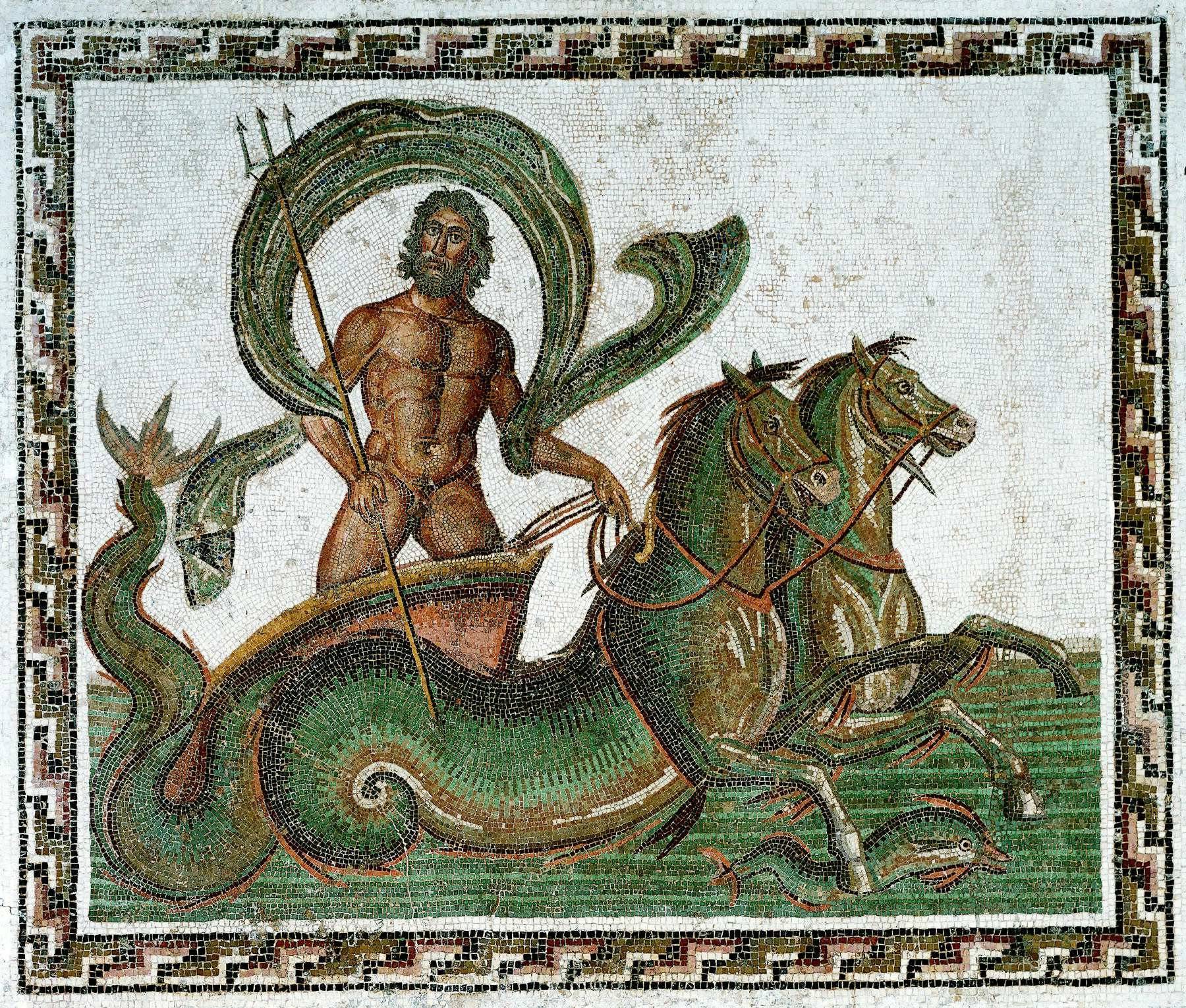
Step back from India and Iran and the figure stretches further still. The name apā́ṃ nápāt can be projected back to a Proto-Indo-European phrase, reconstructed by Mallory and Adams and others as h₂epom népōts, “descendant of the waters.”[14] The second element, népōts, is one of the best-attested kinship words in the family, the source of Latin nepōs, English nephew. And the comparative mythologist Georges Dumézil, followed by others, argued that the whole theonym survived in the Latin sea god Neptūnus, in the Old Irish water-spirit Nechtan, and in the Etruscan Nethuns. On this reading a single inherited divine figure, the watery nephew or grandson, fans out across the Indo-European world.[15]
The fire-in-water motif travels with him, or at least alongside him. Martin West, in his survey Indo-European Poetry and Myth, gathered the parallels.[13] A ninth-century Norse skaldic poem, the Ynglingatal, uses the kenning sævar niðr, “kinsman of the sea,” as a poetic word for fire, the same paradox of fire as the sea’s offspring. An old Armenian hymn describes a reed in the midst of the sea that spontaneously catches fire, and from the flame leaps the hero-god Vahagn, with hair of fire and eyes that blaze like the sun. Fire born from water, against all natural sense, recurs too widely to be coincidence.
graph LR
    PIE["PIE *h₂epom népōts"] --> IIr[Indo-Iranian]
    IIr --> Ved[Vedic Apām Napāt]
    IIr --> Av[Avestan Apąm Napāt]
    PIE --> Ita[Latin Neptunus]
    PIE --> Cel[Irish Nechtan]
    PIE --> Etr[Etruscan Nethuns]
    Ved -.fire in water.-> Nor[Norse kenning]
    Ved -.fire in water.-> Arm[Armenian Vahagn]
A network of reflexes from a single reconstructed phrase. Solid lines trace the name “descendant of the waters”; dotted lines mark the separate but related motif of fire born from water, which surfaces in Norse and Armenian verse.
A caution is in order. Not every link in this network is equally secure. The name equation Apām Napāt = Neptune = Nechtan is widely cited but not universally accepted; the Neptune etymology in particular remains debated among Latinists. The fire-in-water parallels are suggestive but scattered across very different genres and millennia. What is solid is the Indo-Iranian core: a god called “Child of the Waters” stood in the common religion of the ancestors of the Vedic and Avestan peoples, and he was a luminous, kingly, helpful lord of the flood. What is plausible but lighter is the wider Indo-European pedigree. Honest comparative work keeps the two apart.
A Timeline of the Argument
The modern study of Apām Napāt is itself a small drama, and it helps to see it laid out in order.
| Year | Milestone | Significance |
|---|---|---|
| 1894 | Oldenberg, Die Religion des Veda | Frames Apām Napāt as a water spirit absorbed into Agni |
| 1897 | Macdonell, Vedic Mythology | Standardizes the fire/lightning-in-water reading |
| 1898 | Magoun, “Apāṁ Napāt in the Rig-Veda” (JAOS) | First focused English study of the Vedic figure |
| 1900 | Gray, “The Indo-Iranian Deity Apām Napāt” (ARW) | Endorses and extends Oldenberg’s reconstruction |
| 1951–59 | Lüders, Varuṇa | Documents Varuṇa as a water god, fueling later identifications |
| 1975 | Boyce proposes the Varuṇa hypothesis | Reframes Apām Napāt as a hidden Varuṇa |
| 1979 | Findly, “The Child of the Waters” (Numen) | Most thorough revaluation; ties him to the aponaptrīya rite |
| 2007 | West, Indo-European Poetry and Myth | Maps the fire-in-water motif across the family |
| 2014 | Jamison & Brereton, The Rigveda | Restates the cautious “separate deity, later merged” consensus |
Notice the rhythm: a confident nineteenth-century reconstruction, a mid-twentieth-century reframing, and a late-twentieth-century return to caution. The arc is typical of how Indology revisits its founding hypotheses.
Did You Know? - Apām Napāt has exactly one dedicated hymn in the Rigveda and exactly zero in the Avesta, yet he is daily invoked in the Zoroastrian liturgy. - In Iran he is honored every afternoon: the daylight was once divided between Mithra (morning) and Apąm Napāt (afternoon). - His Middle Persian name became simply Borz, “the High One,” from Avestan bərəzant. - The waters are called “wives of Varuṇa” in the Veda and “the Ahura’s wives” in the Avesta, a parallel that helped inspire Boyce’s identification. - The “swift horses” of the Avestan god match the speed-epithets of the Vedic one, a small detail that survived the millennia intact.
What the Child of the Waters Was For
Strip away the comparative scaffolding and a coherent figure remains. Apām Napāt is the Vedic name for a perception: that the most active and dangerous of elements, fire, lies hidden inside the most yielding, water, and that this hidden fire is precious, generative, and bound up with order and rule. The poet of RV 2.35 was not confused. He was holding two opposed things in one image on purpose, because the holding-together is the religious point. Fire in water is the same kind of perception as order in chaos, speech in silence, the visible god in the invisible process. It belongs to the same imagination that produced ṛta, the cosmic order that Varuṇa guards and that the Avestan aša preserves (see Varuṇa, the watchful god of cosmic order).
That is also why he fades. A god who is a perception rather than a personality is vulnerable to absorption. In India the role migrated into Agni, the fire who was everywhere anyway, and into Savitṛ, the descending sun (compare Savitṛ, the impeller behind the Gāyatrī). In Iran the creator function passed to Ahura Mazdā and the water-glory to Anāhitā, leaving Apąm Napāt an honored shell, invoked but no longer adored. The same comparative logic that recovers a dragon-slaying formula behind Indra and Vṛtra (see Vṛtra and the Indo-European dragon-slaying formula) recovers, behind these faded names, a single luminous lord of the flood.
Open RV 2.35 and read it slowly, against a winter river if you can find one: the current dark and fast, light caught on its surface, the sense of something bright and alive moving beneath. The hymn does not argue. It points. The fire is in the water, the poet says, and the water is its mother, and the god who burns there made everything that is. You do not have to solve the riddle to feel its pull. The scholars have been trying for a hundred and thirty years, and the river is still flowing, and the fire is still in it.
Frequently Asked Questions
Who is Apām Napāt? Apām Napāt, literally “Child of the Waters,” is an Indo-Iranian deity associated with water and, in the Vedic tradition, with a fire that mysteriously burns within water. He has one dedicated hymn in the Rigveda, RV 2.35, and appears as an exalted lord in the Zoroastrian Avesta.
Is Apām Napāt the same as Agni? In most Rigvedic passages the title attaches to Agni, the fire god, because fire was imagined as hidden in the waters. But in RV 2.35 the figure is not clearly identified with Agni, and many scholars think Apām Napāt was originally a separate deity later merged with him. The Iranian version has no fire connection at all.
What does RV 2.35 actually say? It praises a golden, self-luminous god who stands in the waters, is tended by the rivers (imagined as young women), shines without firewood, is wrapped in clarified butter, and “produced all things existing.”
Why do scholars connect Apām Napāt with Varuṇa? Mary Boyce proposed that “Apąm Napāt” was an old title of Varuṇa, which would explain why Varuṇa seems absent from the Iranian pantheon. Varuṇa is himself called “child of the waters” elsewhere, and Agni is said to “become Varuṇa” and “become Apām Napāt” in the same verse, RV 10.8.5. The hypothesis is influential but unsettled.
Is Apām Napāt related to Neptune? Possibly. Dumézil and others derived Latin Neptūnus, Irish Nechtan, and Etruscan Nethuns from the same Proto-Indo-European phrase, h₂epom népōts. The equation is widely cited but debated, especially the Neptune part.
What is the fire-in-water myth? A recurring Indo-European image of fire born from or hidden within water. Besides Apām Napāt, it appears in a Norse kenning that calls fire “kinsman of the sea” and in an Armenian poem where the god Vahagn springs as fire from a reed in the sea.
Glossary
Apām Napāt (apā́ṃ nápāt): “Child / grandson of the waters,” an Indo-Iranian deity of water and hidden fire.
Agni: The Vedic fire god, with whom Apām Napāt is most often identified.
asura / ahura: A lordly class of gods; cognate terms in Vedic (asura) and Avestan (ahura).
ghṛta: Clarified butter (ghee), poured on the sacrificial fire; Apām Napāt is said to be “wrapped” in it.
ṛta / aša: Cosmic and ritual order, guarded by Varuṇa in India and central to Zoroastrian aša in Iran.
xᵛarənah: The radiant “glory” or fortune of Iranian kingship, guarded by Apąm Napāt in the Avesta.
triṣṭubh: The eleven-syllable, four-line meter of RV 2.35 and much of the Rigveda.
aponaptrīya: An obscure Vedic water rite connected with Apām Napāt.
References
Jamison, Stephanie W., and Joel P. Brereton. The Rigveda: The Earliest Religious Poetry of India. 3 vols. Oxford University Press, 2014. global.oup.com.
Jamison, Stephanie W., and Joel P. Brereton. The Rigveda: A Guide. Oxford University Press, 2020. global.oup.com.
Griffith, Ralph T. H. The Hymns of the Rgveda. 2nd ed. Benares: E. J. Lazarus, 1896. archive.org.
Wilson, Horace Hayman. Ṛig-Veda Sanhitá: A Collection of Ancient Hindu Hymns (with Sāyaṇa’s commentary). London: Trübner, 1850–1888.
Macdonell, Arthur A. Vedic Mythology. Strassburg: Karl J. Trübner, 1897. archive.org.
Oldenberg, Hermann. Die Religion des Veda. Berlin: Wilhelm Hertz, 1894. archive.org.
Boyce, Mary. “Apąm Napāt.” In Encyclopaedia Iranica, vol. II, fasc. 2, pp. 148–150. 1986. iranicaonline.org.
Boyce, Mary. A History of Zoroastrianism, Volume One: The Early Period. 2nd ed. Leiden: Brill, 1989.
Findly, Ellison Banks. “The ‘Child of the Waters’: A Revaluation of Vedic Apāṃ Napāt.” Numen 26, no. 2 (1979): 164–184. doi.org.
Magoun, Herbert W. “Apāṁ Napāt in the Rig-Veda.” Journal of the American Oriental Society 19 (1898): 137–144. doi.org.
Gray, Louis H. “The Indo-Iranian Deity Apām Napāt.” Archiv für Religionswissenschaft 3 (1900): 18–51.
Lüders, Heinrich. Varuṇa. 2 vols. Göttingen: Vandenhoeck & Ruprecht, 1951–1959.
West, Martin L. Indo-European Poetry and Myth. Oxford University Press, 2007.
Mallory, J. P., and D. Q. Adams. The Oxford Introduction to Proto-Indo-European and the Proto-Indo-European World. Oxford University Press, 2006.
Dumézil, Georges. Mythe et Épopée. Vol. III. Paris: Gallimard, 1973 (Quarto ed. 1995).
Af Edholm, Kristoffer. “Royal Splendour in the Waters: Vedic Śrī- and Avestan Xᵛarənah-.” Indo-Iranian Journal 60, no. 1 (2017): 17–73. doi.org.
Forizs, Laszlo. “Apāṁ Napāt, Dīrghatamas and the Construction of the Brick Altar: Analysis of RV 1.143.” In Vedic Investigations, ed. Asko Parpola, 97–126. Delhi: Motilal Banarsidass, 2016.
Gershevitch, Ilya. The Avestan Hymn to Mithra. Cambridge University Press, 1959.
Macdonell, Arthur A., and Arthur B. Keith. Vedic Index of Names and Subjects. 2 vols. London: John Murray, 1912. archive.org.
Geldner, Karl Friedrich. Der Rig-Veda aus dem Sanskrit ins Deutsche übersetzt. Harvard Oriental Series 33–36. Harvard University Press, 1951.
Comments (0)
No comments yet. Sign in to start the discussion.