The Impeller's Verse: How a Stanza to Savitṛ Became the Gāyatrī
The most repeated verse in the world started small
Somewhere this morning, before sunrise, a few hundred thousand people sat facing east and recited twenty-four syllables that ask a god to set their thoughts in motion. They were chanting the Gāyatrī, very probably the most-recited verse in human history, the stanza that the Manusmṛti later called the essence of the three Vedas and that the tradition came to personify as a goddess and “mother of the Vedas.” Most of them could not name the deity it addresses.
The deity is Savitṛ (Sanskrit: सवितृ), the Impeller. He is not Viṣṇu, not Śiva, not even a front-rank Vedic power like Indra or Agni. In the Rigveda he is celebrated in only about eleven entire hymns, with his name surfacing on the order of 170 times across the collection.[1] He never receives a share of the soma sacrifice, the central rite of Vedic religion, which is itself a strong hint that the ritualists of the time did not treat him as a major player.[2] And the verse that made him immortal, RV 3.62.10, is not even a standalone hymn. It sits buried as the tenth stanza of a composite hymn addressed to half a dozen different gods, no more typographically distinguished than its neighbors.
How does a single stanza to a minor solar deity become the load-bearing verse of an entire religion? The answer is not that the verse is uniquely beautiful, though it is fine. It is that three different things, a god, a meter, and eventually a goddess, slid into one another over a thousand years until the join was invisible. This is the story of that slippage, and of the strange, abstract little god at the center of it.
A god who is a grammatical function
Begin with the name, because the name is the whole argument. Savitṛ is an agent noun built from the verbal root sū (also written su), “to impel, to stimulate, to set in motion, to bring forth.” Add the agent suffix -tṛ and you get “the one who impels”: the Impeller, the Rouser, the Vivifier.[3] He is, quite literally, a verb wearing a face.
Notice what this means. Most Rigvedic gods are named for a thing or a phenomenon. Agni is fire, Uṣas is the dawn, Vāyu is the wind, Sūrya is the visible sun. Savitṛ is named for an action with no object attached. He impels; the poets then spend their hymns specifying what he impels, which turns out to be more or less everything: the sun across the sky, the waters in their channels, the day into night and night into day, and, crucially for what follows, the dhī, the visionary thought or insight, of the worshipper.
Arthur Macdonell, whose 1897 Vedic Mythology remains the standard reference catalogue of these deities, grouped Savitṛ with a small, telling class. Alongside Dhātṛ (“the Establisher”), Trātṛ (“the Protector”), and Tvaṣṭṛ (“the Fashioner”), Savitṛ belongs to the -tṛ gods, deities whose names are functions rather than objects.[4] Arthur Berriedale Keith, in his 1925 Religion and Philosophy of the Veda and Upanishads, called them “functional gods” and put the interpretive problem squarely: it will, he wrote, “always be open to question whether Savitṛ is really an aspect of the sun, or whether he is god of stimulation, who by reason of similarity of nature has been made ‘like to the sun.’”[5]
| Agent god | Root | Function | Survival after the Veda |
|---|---|---|---|
| Savitṛ | sū, “impel” | sets all things in motion | fades as a god; survives only as the Gāyatrī |
| Dhātṛ | dhā, “place” | establishes, arranges | absorbed into later “creator” concepts |
| Trātṛ | trā, “protect” | guards, rescues | epithet only |
| Tvaṣṭṛ | takṣ, “fashion” | the divine artisan | survives in myth as craftsman of Indra’s bolt |
That table contains a small irony worth pausing on. Of these four function-gods, Savitṛ was arguably the least concrete and the most expendable. Yet he is the only one whose words a billion people would eventually learn by heart. The others were absorbed or forgotten. Savitṛ was forgotten as a god and remembered as a verse, which is a different and stranger kind of survival.
Aside. The English habit of writing the name as “Savitar” or “Savitur” comes from the inflected forms. The bare stem is savitṛ; the nominative is savitā (“the impeller does X”); the genitive, which is what appears in the famous verse, is savitur (“of the impeller”). When you hear tat savitur vareṇyaṃ, the savitur is a genitive: “that desirable [splendor] of Savitṛ.”
Savitṛ or Sūrya? The oldest debate about him
If Savitṛ impels the sun, is he the sun? The tradition itself could not quite decide, and the indecision is old. The grammarian-etymologist Yāska, in the Nirukta (probably around the fifth century BCE), placed Savitṛ’s appearance at the moment “when darkness has been removed,” that is, at the cusp of dawn.[6] The fourteenth-century commentator Sāyaṇa drew the line more sharply: before the disk rises, the luminary is Savitṛ; from rising to setting, it is Sūrya.[7] On that reading Savitṛ is the sun precisely when you cannot yet see it, the impulse before the appearance.
It is a lovely distinction, and it is probably too neat. The Rigveda will not cooperate with it. Savitṛ is also invoked at evening, as the god who unyokes the horses, brings the wanderer home, tells the weaver to roll up her web and the worker to lay down the unfinished task. The hymn RV 2.38, by the poet Gṛtsamada, is the great evening hymn of Savitṛ, and it is one of the quietest, most domestic pieces in the whole collection.
God Savitar hath stretched out his arms to bless the world, bringing the wanderer home and lulling all to rest.
The waters and the wind are subject to his law; at night the weaver folds her web, the worker rests.
(after RV 2.38, paraphrasing Griffith 1896)
So Savitṛ frames the day at both ends, dawn and dusk, impulse and cessation. Sūrya only crosses the visible sky between. This is why most scholars now resist collapsing the two. Savitṛ is less the solar body than the principle of solar agency, the go-ahead that sets the sun moving and, by extension, sets everything moving.
The most thorough recent reexamination is Dominik Haas’s 2020 study, pointedly titled “A Nature Deity? The Ṛgvedic Savitṛ Revisited.”[8] Haas argues against the reflex, inherited from nineteenth-century nature-mythology, of reading Savitṛ as just a poetic dressing-up of the physical sun. The textual evidence, he shows, foregrounds Savitṛ’s activity, his impelling and sanctioning, far more consistently than it foregrounds any solar disk. The god is closer to a personified divine prompting than to a celestial object. That reading matters enormously for the famous verse, because the verse is not a sun-worship hymn at all. It is a request to have one’s mind set going.
Methods note. Distinguishing a “nature god” from a “functional abstraction” in the Rigveda is harder than it sounds, because the poets habitually pile solar imagery onto any luminous power. Golden hands, golden chariots, and radiant paths attach to Savitṛ, but they also attach to Agni and to the dawn-goddess. Shared imagery is weak evidence for shared identity. What individuates a deity is the verb the hymns give it, and Savitṛ’s verb is sū.
What the golden-handed god looks like
For a god so abstract, Savitṛ is rendered with surprising sensory richness, and almost all of it is gold. He is hiraṇya-hasta, golden-handed; hiraṇya-pāṇi, golden-palmed; broad-handed and beautiful-handed; golden-eyed and golden-tongued; tawny-haired. He drives a golden chariot with a golden axle, drawn by radiant steeds, along dustless paths through the middle air. The quality the Rigveda reserves almost exclusively for him is amati, a word for splendor or brilliant form, and only Savitṛ gets golden amati.[9]
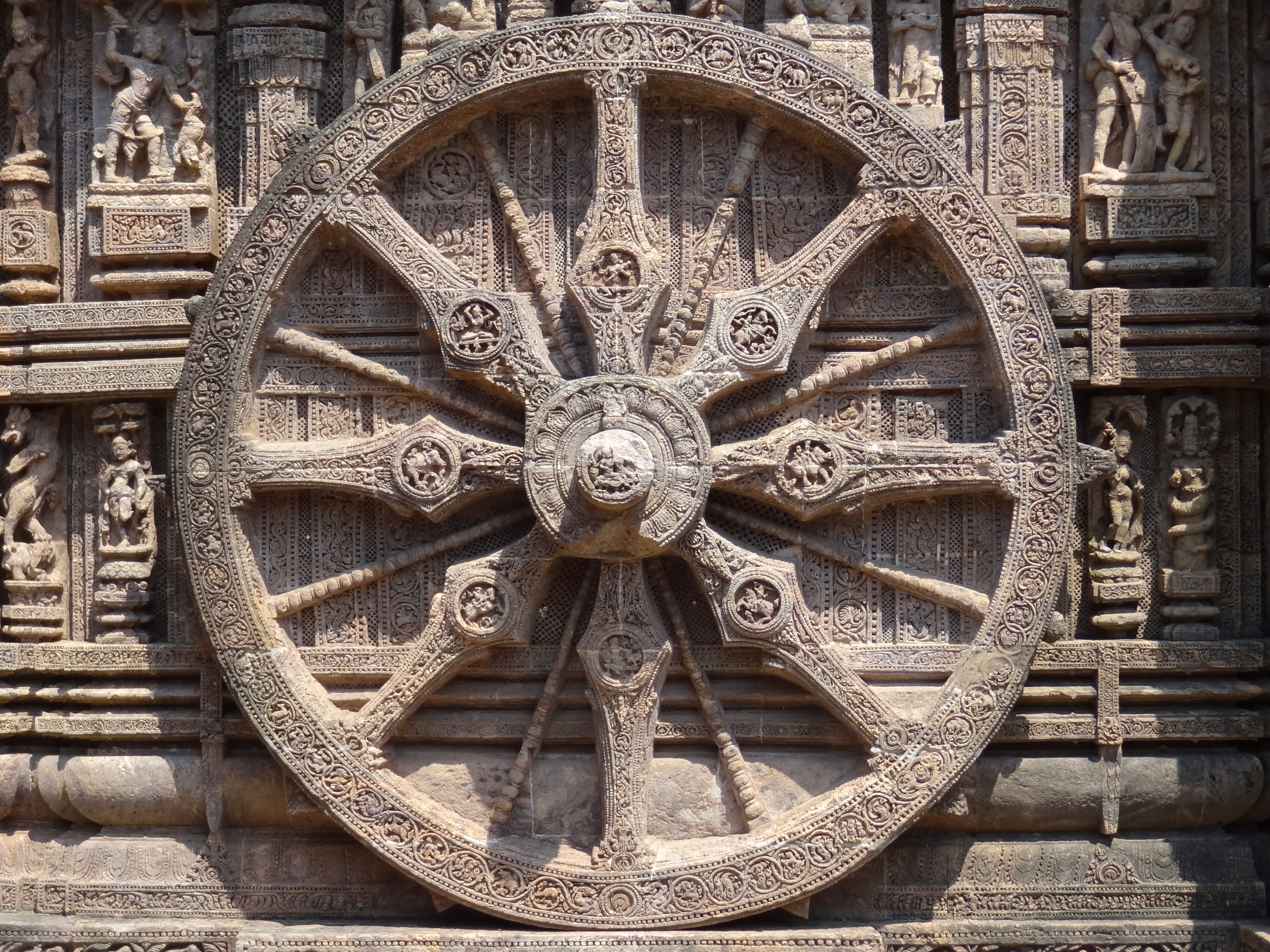
| Epithet (IAST) | Sense | Where it points |
|---|---|---|
| hiraṇya-hasta | golden-handed | the blessing, outstretched arms at dusk |
| hiraṇya-pāṇi | golden-palmed | the giving gesture |
| amati (golden) | radiant form, splendor | reserved chiefly for Savitṛ |
| prasavitṛ | impeller, instigator | the core function, sū doubled |
| sūrya-raśmi | having the sun’s rays | the one verse that ties him to Sūrya |
There is one verse, and to my knowledge only one, where the Rigveda calls Savitṛ sūrya-raśmi, “having the rays of the sun.” Read positively, it identifies him with Sūrya. Read carefully, it does the opposite: you only need to say a god “has the sun’s rays” if he is not simply the sun. You do not tell the dawn that she has dawn-light. The single equation is the exception that marks the rule.
The golden hand also carries a famous later legend, recorded in the Brāhmaṇa prose rather than the Rigveda: that Savitṛ lost a hand at a sacrifice and was given a golden replacement. The story is almost certainly a back-formation, a narrative invented to explain the fixed epithet hiraṇya-hasta once its original force (“the generous, gold-giving hand”) had faded. That direction of travel, epithet first and story second, is worth holding onto, because the entire afterlife of the Gāyatrī runs the same way: the words come first and the explanations accrete around them.
The verse itself
Here is the stanza, in the form the Rigveda preserves it, with the standard modern scholarly rendering.
tát savitúr váreṇyaṃ / bhárgo devásya dhīmahi / dhíyo yó naḥ pracodáyāt
“Might we make our own that desirable effulgence of god Savitar, who will rouse forth our insights.”
RV 3.62.10. After Jamison and Brereton (Oxford, 2014), with diacritics standardised.[10]
Three eight-syllable lines, twenty-four syllables in the ideal: that is the meter called gāyatrī, and we will come back to the fact that the verse and the meter share a name. Word for word the sense is plain. tat… vareṇyam bhargo devasya savitur: “that desirable splendor of the god Savitṛ.” dhīmahi: “may we attain,” or, with Jamison and Brereton, “might we make our own.” dhiyo yo naḥ pracodayāt: “who shall impel (pra-codayāt, from the same family of “impel” verbs) our dhiyaḥ, our insights, our visionary thoughts.”
Linger on dhī. It is not “prayers” in any pious sense, though Griffith translated it that way in 1896. Dhī is the inner faculty by which the Vedic poet sees the hymn, the flash of formulated vision that becomes verse. To ask Savitṛ to impel one’s dhiyaḥ is to ask the god whose entire nature is impulsion to start the machinery of insight itself. The verse is, in a precise sense, a poet’s prayer about the conditions of poetry: set my mind in motion so that the seeing can happen. It is reflexive, almost a hymn about how hymns get made. That reflexivity is part of why it travelled so well into later contemplative use, long after anyone cared which solar god was being addressed.
The range of published translations shows how much room those nine words leave.
| Translator | Year | Rendering of the verse |
|---|---|---|
| Monier Monier-Williams | 1882 | “Let us meditate on that excellent glory of the divine vivifying Sun; may he enlighten our understandings.” |
| Ralph T. H. Griffith | 1896 | “May we attain that excellent glory of Savitar the god: so may he stimulate our prayers.” |
| Stephanie Jamison and Joel Brereton | 2014 | “Might we make our own that desirable effulgence of god Savitar, who will rouse forth our insights.” |
The drift across the column is instructive. Monier-Williams, a Victorian, hears a hymn to a vivifying Sun and a prayer for enlightened “understanding.” Griffith keeps Savitar by name but slides dhī toward “prayers.” Jamison and Brereton, working from a century of philology, return dhī to “insights” and keep Savitṛ’s defining verb, “rouse forth,” front and center. The verse got more, not less, itself over time, once scholarship stopped trying to make it sound like church.
Aside. A small textual scandal: as the Rigveda preserves it, the first line tat savitur vareṇyaṃ has only seven syllables, not the eight the gāyatrī meter requires. The line is one short. Metrical reconstruction, set out in Barend van Nooten and Gary Holland’s 1994 Rig Veda: A Metrically Restored Text, shows that the original was almost certainly vareṇiyam, four syllables, later contracted to the three-syllable vareṇyam.[11] So the most carefully recited verse in the world is, as chanted, technically defective by one beat. Reciters cope by lengthening the final m into a hum, or simply restoring the older form.
Why this verse, and why Viśvāmitra
Tradition assigns RV 3.62.10 to Viśvāmitra, the poet-sage credited with most of the third maṇḍala, the family book of the Viśvāmitra clan. The attribution is plausible in the ordinary Rigvedic sense: Mandala 3 is the Viśvāmitra collection, and the verse sits inside it. But the placement of the verse repays a closer look, because it tells us the stanza was not, in its own time, set apart.
RV 3.62 is a composite hymn, built in tṛcas, groups of three stanzas, each group addressed to a different deity or pairing: Indra and Varuṇa, then Bṛhaspati, then Pūṣan, then Savitṛ, then Soma, and so on. The Gāyatrī is simply the first verse of the Savitṛ triplet, following directly on a triplet to Pūṣan, the pastoral guide-god. Macdonell noticed the join: in two consecutive verses, Pūṣan is asked to look kindly on us, and then Savitṛ is asked to impel our thoughts toward the splendor of the god.[12] There is no frame around the Gāyatrī announcing it as special. It is one stanza in a workmanlike litany that distributes praise across the pantheon.
graph TD
    A[Root su: impel] --> B[Savitr, the Impeller]
    B --> C[RV 3.62.10, Savitri verse]
    C --> D[gayatri meter, 3x8]
    D --> E[Name slips: verse = Gayatri]
    C --> F[Prefixed with om + vyahrtis]
    F --> G[upanayana initiation verse]
    G --> H[Daily japa at dawn and dusk]
    E --> I[Goddess Gayatri, Vedamata]
    H --> I
So the question sharpens. If the verse was not marked out in the Rigveda, what pulled it out of the crowd? Several forces, working together over centuries.
The first is the meter. The gāyatrī is the shortest and, in a sense, the most elementary of the major Vedic meters, and it carried symbolic weight of its own: in the speculative literature it came to stand for the whole class of sacred utterance. When a single verse and the meter it is composed in bear the same name, gāyatrī, the verse can quietly inherit the meter’s prestige. The slippage from “a gāyatrī” (any verse in that meter) to “the Gāyatrī” (this verse) is half the story of its rise. Readers interested in how Vedic meter became a chronological and symbolic instrument in its own right can follow the thread in our piece on the Vedic meter as a syllable-clock.
The second is the content. Of all the short verses available, this one asks for the impulsion of dhī, of mind and insight. As Vedic religion turned inward, from external sacrifice toward meditation and the knowledge-quest of the Upaniṣads, a verse that prays for the setting-in-motion of the mind was perfectly positioned to become a meditative seed. It reads as if it had been written for contemplative recitation, even though it almost certainly was not.
How the verse grew its frame
The Gāyatrī you hear today is longer than the Rigvedic stanza. It opens with oṃ, then the formula bhūr bhuvaḥ svaḥ (earth, mid-air, heaven), the so-called mahāvyāhṛti or “great utterance,” and only then the twenty-four syllables of the verse. None of that frame is in the Rigveda. The prefix is prescribed in the later ritual literature; the Taittirīya Āraṇyaka (2.11) lays out that the verse should be chanted with oṃ and the three vyāhṛtis before it.[13] The accretion is exactly the epithet-then-story pattern we saw with the golden hand, run forward: a powerful core, then layers of explanatory and amplifying material settling around it like rings.
The decisive institutional move was ritual. The verse became the sāvitrī, the verse “of Savitṛ,” imparted to a boy at his upanayana, the initiation that begins Vedic study. To receive the Gāyatrī was to be “twice-born,” and the verse was, in the strict classical rule, reserved for that initiation and for the daily sandhyā worship at the junctions of the day, dawn and dusk, the very hours that the old hymns had assigned to Savitṛ. The god’s morning-and-evening character outlived the god. Even after Savitṛ vanished as an object of cult, his verse kept being chanted at his hours.
The classical system even matched meter to social class. The sāvitrī given at initiation differed by varṇa: the gāyatrī stanza RV 3.62.10 for a Brahmin, a triṣṭubh verse for a kṣatriya, a jagatī verse for a vaiśya.[14] The principle is the same throughout: the verse is an instrument, slotted into a structure, valued for its function in a rite, much as the god it names was valued for his function in the cosmos.
| Initiate’s class | Meter of the sāvitrī | Cited verse | Syllables per line |
|---|---|---|---|
| Brahmin | gāyatrī | RV 3.62.10 | 8 |
| Kṣatriya | triṣṭubh | RV 1.35.2 | 11 |
| Vaiśya | jagatī | RV 4.40.5 | 12 |
[!NOTE] That RV 1.35, the great night-hymn of Savitṛ, supplies the kṣatriya initiation verse is a quiet confirmation that the whole sāvitrī complex really did cluster around this one god. The initiation verses are not drawn at random from the Rigveda; they are drawn from Savitṛ’s own hymns.
The verse becomes a goddess
The last transformation is the most dramatic and the least intuitive. Over time the Gāyatrī stopped being only a verse and became a she: the goddess Gāyatrī, personification of the verse and the meter, eventually titled Vedamātā, “Mother of the Vedas.” A masculine impeller-god at dawn became, by way of his verse, a goddess who is the mother of the whole revealed corpus.
The mechanism is the same slippage that has run through this entire story, now at full stretch. A meter (gāyatrī, grammatically feminine) lent its name to a verse; the verse, recited and revered, accumulated the aura of all sacred speech; and sacred speech in the Vedic imagination was already a goddess. The Rigveda’s own self-aware hymn to Vāc, divine Speech, RV 10.125, has Speech declare herself the power who carries the gods; the personification of a holy utterance as a goddess was a move the tradition already knew how to make, as we discuss in our reading of the Devī-sūkta and the goddess Vāc. The Gāyatrī simply followed the path Vāc had cleared. Dominik Haas’s 2023 monograph, with the exact title Gāyatrī: Mantra and Mother of the Vedas, traces this long career from Rigvedic stanza to deified mantra in detail, and it is the place to go for the full arc.[15]
What had happened to Savitṛ himself by then? He was gone. Macdonell and the standard reference works note flatly that Savitṛ disappears as an independent deity after the Vedic period; he survives in classical Hinduism essentially as the sāvitrī, the verse, and as the name of the goddess.[16] The god dissolved into his own verse and the verse grew a new divine body. There may be no cleaner example in the history of religion of a deity surviving entirely as a quotation of himself.
What the Buddhists thought of it
A useful outside check on the verse’s prestige comes from people who did not accept its authority. The early Buddhist canon, composed in Pāli, refers to the sāvittī (the Pāli form of sāvitrī) as a marker of Brahmanical learning, and it does so with evident familiarity. In the Majjhima Nikāya (sutta 92) and again in the Sutta Nipāta (3.4), the Buddha names the sāvittī as the foremost of meters, in the same breath as the sun is foremost of lights and the ocean foremost of rivers, and he identifies it precisely as the chant “of three lines and twenty-four syllables.”[17]
aggihuttamukhā yaññā, sāvittī chandaso mukhaṃ
“Of sacrifices, the fire-oblation is foremost; of meters, the sāvittī is foremost.”
(Sutta Nipāta 3.4, after Mills; cf. Shults 2014)
The detail to notice is the syllable count. A non-Brahmanical text, polemically engaged with Vedic religion, knows the verse so well that it can cite its meter and its exact length as a shorthand for the whole Brahmanical world. That is independent evidence, from outside the tradition that revered it, that by the time of the early suttas the Gāyatrī had already become the representative sacred verse, the one you name when you want to invoke the entire apparatus of Vedic authority in three words.
What we can and cannot conclude
Pull the threads together and a few things stand on firm ground, and a few do not.
Firmly: the verse RV 3.62.10 is a Rigvedic stanza of the Viśvāmitra book, addressed to the god Savitṛ, asking him to impel the worshippers’ insight. That much the text gives us directly. Firmly, too: the elaborate frame (oṃ, the vyāhṛtis), the initiation rite, the daily sandhyā, the goddess, and the title “Mother of the Vedas” are all later, and we can watch most of them accrete in datable layers of the ritual and speculative literature.
Less firmly: exactly why this stanza, and not one of the hundreds of other gāyatrī-meter verses in the Rigveda, became the one. The honest answer is overdetermination. The shared name with the meter, the reflexive content about impelling the mind, the connection to the dawn-and-dusk god whose hours suited daily worship, the authority of Viśvāmitra: no single factor is decisive, and the historical record does not let us rank them cleanly. We are reconstructing a thousand-year selection process from its end state.
There is also a caution worth stating plainly. It is tempting, looking back, to read profundity into the choice, to say the tradition “recognized” the verse’s spiritual depth. Maybe. But the Rigvedic evidence suggests something more mundane and more interesting: the verse was available, short, in the prestigious meter, about the mind, and attached to the right god at the right hours, and ritual systems, like rivers, take the path that is already cut. The Gāyatrī’s greatness is partly a fact about the verse and partly a fact about the channel it happened to fit.
Two observations close this out. First, the career of Savitṛ is a near-twin of a better-known case: Viṣṇu, another modest Rigvedic figure defined by a single function, the three strides, who rose to supremacy while his function stayed constant. We trace that parallel ascent in our piece on Viṣṇu’s three strides. Savitṛ shows the inverse outcome from the same starting material: a function-god who did not rise as a god at all, but whose words rose without him. Function-gods, it turns out, are unusually portable; with no fixed natural body to anchor them, they can be carried into new theologies, or distilled into a verse, far more easily than a god who simply is the fire or the dawn.
Second, the verse rewards being read as what it is, a poet’s request for the conditions of vision, before it is read as anything later wanted it to be. Open the third maṇḍala at RV 3.62, find the tenth stanza in its unremarkable place between Pūṣan and Soma, and read it once with no oṃ, no goddess, no initiation, just nine words asking a dawn-god to set a mind moving. Then read RV 2.38, Savitṛ at dusk, telling the weaver to fold her web. Between the two you have the whole god: the impulse that starts the day’s work and the hand that ends it. The Gāyatrī is only the morning half, the go-ahead, preserved because the tradition needed a verse to start things with, and chose, out of the function-god of beginnings, the verse about beginning to think.
References
Macdonell, Arthur A. Vedic Mythology. Strassburg: Karl J. Trübner, 1897. archive.org.
Keith, Arthur Berriedale. The Religion and Philosophy of the Veda and Upanishads. 2 vols. Harvard Oriental Series 31–32. Cambridge, MA: Harvard University Press, 1925. archive.org.
Monier-Williams, Monier. A Sanskrit–English Dictionary. New ed. Oxford: Clarendon Press, 1899 (entry savitṛ, p. 1190). archive.org.
Macdonell, Vedic Mythology, on the agent gods (Dhātṛ, Trātṛ, Tvaṣṭṛ, Savitṛ), 1897.
Keith, Religion and Philosophy of the Veda, vol. 1, on “functional gods,” 1925.
Yāska. The Nighaṇṭu and the Nirukta (12.12). Edited and translated by Lakshman Sarup. Lahore/Oxford, 1920–1927. archive.org.
Sāyaṇa. Commentary on the Ṛgveda (on RV 3.62.10), 14th century. Discussed in Macdonell, Vedic Mythology, 1897.
Haas, Dominik A. “A Nature Deity? The Ṛgvedic Savitṛ Revisited.” Cracow Indological Studies 22, no. 1 (2020). archive.org.
Macdonell, Vedic Mythology, on Savitṛ’s golden epithets and amati, 1897.
Jamison, Stephanie W., and Joel P. Brereton. The Rigveda: The Earliest Religious Poetry of India. 3 vols. Oxford: Oxford University Press, 2014 (RV 3.62.10, p. 554).
van Nooten, Barend A., and Gary B. Holland. Rig Veda: A Metrically Restored Text. Harvard Oriental Series 50. Cambridge, MA: Harvard University Press, 1994.
Macdonell, Vedic Mythology, on the Pūṣan–Savitṛ sequence in RV 3.62, 1897.
Carpenter, David, and Ian Whicher, eds. Yoga: The Indian Tradition. London: Routledge, 2003 (on the mahāvyāhṛti and Taittirīya Āraṇyaka 2.11), p. 31.
Gonda, Jan. “The Indian Mantra.” Oriens 16 (1963): 244–297. JSTOR.
Haas, Dominik A. Gāyatrī: Mantra and Mother of the Vedas. Vienna: Austrian Academy of Sciences Press, 2023. doi.org/10.1553/978OEAW93906.
Griffith, Ralph T. H. The Hymns of the Ṛgveda. 2 vols. Benares: E. J. Lazarus, 1896 (RV 2.38; RV 3.62.10). archive.org.
Shults, Brett. “On the Buddha’s Use of Some Brahmanical Motifs in Pali Texts.” Journal of the Oxford Centre for Buddhist Studies 6 (2014): 106–140 (on the sāvittī in Majjhima Nikāya 92 and Sutta Nipāta 3.4).
Staal, Frits. “The Sound of Religion.” Numen 33, no. 1 (1986): 33–64. JSTOR.
Haas, Dominik A. “Translating the Gāyatrī-Mantra.” Asian Literature and Translation 10, no. 1 (2023): 47–91. doi.org/10.18573/alt.57.
Bloomfield, Maurice. A Vedic Concordance. Harvard Oriental Series 10. Cambridge, MA: Harvard University Press, 1906. archive.org.
Comments (0)
No comments yet. Sign in to start the discussion.