The Boundless Mother: Aditi and the Adityas
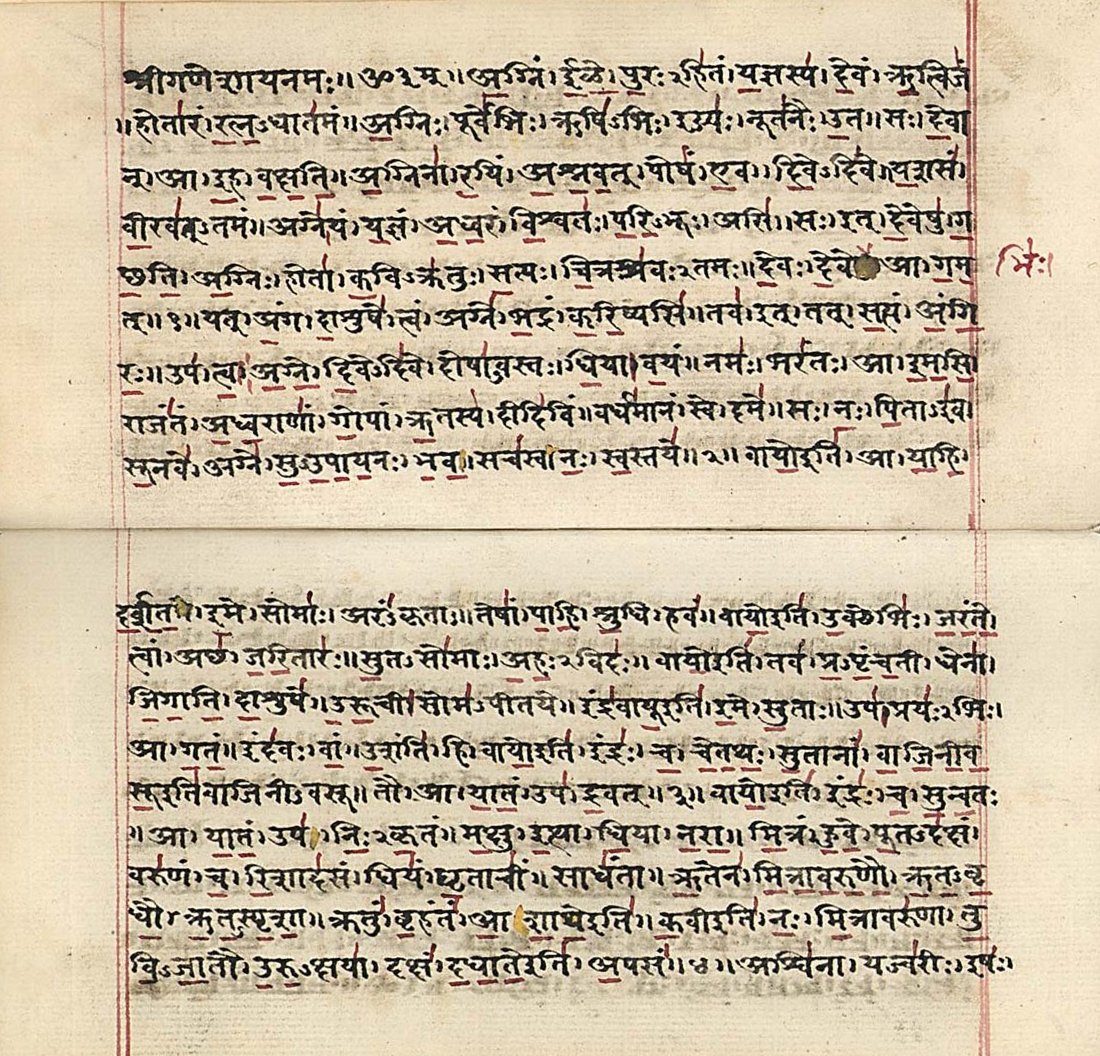
Most gods are named for something they are. Aditi is named for something she is not. Her name reads as a-diti, ‘un-bound,’ the negation of binding, limit and constraint. She is, almost literally, Boundlessness itself, made into a goddess. In a collection full of vivid, physical deities, Aditi is the Rig Veda’s great abstraction, and one of its most important mothers.
She is, above all, the mother of the Adityas, the shining sovereign gods who include Mitra and Varuna, the guardians of cosmic and moral order. To be a son of Aditi is to be a god of the high, ordered, sky-borne kind.
A goddess made of a negation
The Vedic poets liked to make the invisible visible, and Aditi is their boldest attempt. Where another culture might leave ‘the infinite’ as a concept, the Rig Veda gives it a name, a motherhood, and a role in worship. The contrast built into her name is sharpened by her counterpart Diti, a much shadowier figure whose name means the opposite, the bound or the divided. Aditi is the open; Diti is the limited.
Because her name is about freedom from constraint, Aditi is the goddess people turn to when they want to be released from something: from sin, from sickness, from debt, from the bonds that tie a person down. To be set free, in the language of the hymns, is to be restored to aditi, to boundlessness. A goddess whose essence is the absence of limits is the natural patron of every kind of liberation.
The poets ask Aditi to free them from sin and from distress, to give wide room, to loosen what binds. Her name is a prayer in itself: let there be no limit.
Mother of the sovereigns
Aditi’s importance is anchored by her children. The Adityas are the gods of light, order and rule, and the greatest of them, Varuna and Mitra, hold the cosmos and human society to their patterns. By making Aditi their mother, the Rig Veda places the principle of boundlessness at the very source of order. The limitless gives birth to the law-keepers.
| Aspect of Aditi | What it means |
|---|---|
| Name (a-diti) | Boundlessness, freedom from constraint |
| Mother of the Adityas | Source of Mitra, Varuna and the sovereigns |
| Freer from bonds | Invoked to release from sin and distress |
| Cosmic vastness | Identified with wide space, the open |
There is a famous, dizzying verse that tries to capture how total she is. Aditi is the sky; Aditi is the air; Aditi is mother, father and son; Aditi is all the gods; Aditi is what has been born and what is yet to be born. It is less a description than a refusal to draw a boundary around her, which is, of course, exactly the point of her name.
The abstraction that lasted
Aditi is sometimes treated as a faded or impersonal goddess, because she lacks the adventures of an Indra or the menace of a Rudra. That underrates her. She represents one of the Rig Veda’s most sophisticated moves: the turning of a pure abstraction, limitlessness, into an object of devotion. This is the same impulse that, in the latest and most philosophical hymns, asks what existed before existence and gives the unknowable a kind of reverence. Aditi is that impulse in maternal form.
She also persists. The Adityas remain a recognised class of gods; Aditi is remembered as the mother of the gods, set against Diti as the mother of their rivals, and the contrast of the bound and the boundless echoes through later mythology.
Why boundlessness needed a mother
The deepest thing about Aditi is what her existence implies about the Vedic mind. These poets did not only personify the things they could see, the fire, the dawn, the storm. They reached for the things they could only think, and gave those a face too. Naming the infinite ‘Aditi’ and calling her mother was a way of saying that limitlessness is not cold or empty but generative, that the open sky is also a parent, and that freedom from bonds is something you can pray to. For a tradition often caricatured as mere nature-worship, Aditi is the proof that its imagination reached all the way to the edge of thought, and then named it.
- Aditi's name reads as a-diti, 'un-bound'; she is Boundlessness personified as a goddess.
- She is the mother of the Adityas, the sovereign gods including Mitra and Varuna who uphold cosmic order.
- Because her essence is freedom from limits, she is invoked to release worshippers from sin, sickness and bonds.
- Aditi shows the Vedic gift for turning a pure abstraction into an object of devotion, set against the 'bound' goddess Diti.
References
Jamison, Stephanie W. & Brereton, Joel P. The Rigveda: The Earliest Religious Poetry of India. Oxford University Press, 2014. (On Aditi and the Adityas.) global.oup.com.
‘Aditi.’ Wikipedia. en.wikipedia.org/wiki/Aditi.
‘Adityas.’ Wikipedia. en.wikipedia.org/wiki/Adityas.
‘Aditi.’ Encyclopaedia Britannica. britannica.com/topic/Aditi.
Macdonell, Arthur A. Vedic Mythology. Strassburg: Karl J. Trübner, 1897. (Chapter on Aditi and the Adityas.) archive.org.
Griffith, Ralph T. H. (trans.). The Rig Veda. Wikisource: en.wikisource.org/wiki/The_Rig_Veda.
Comments (0)
No comments yet. Sign in to start the discussion.