The First to Die: Yama and the Vedic Afterlife (RV 10.14)
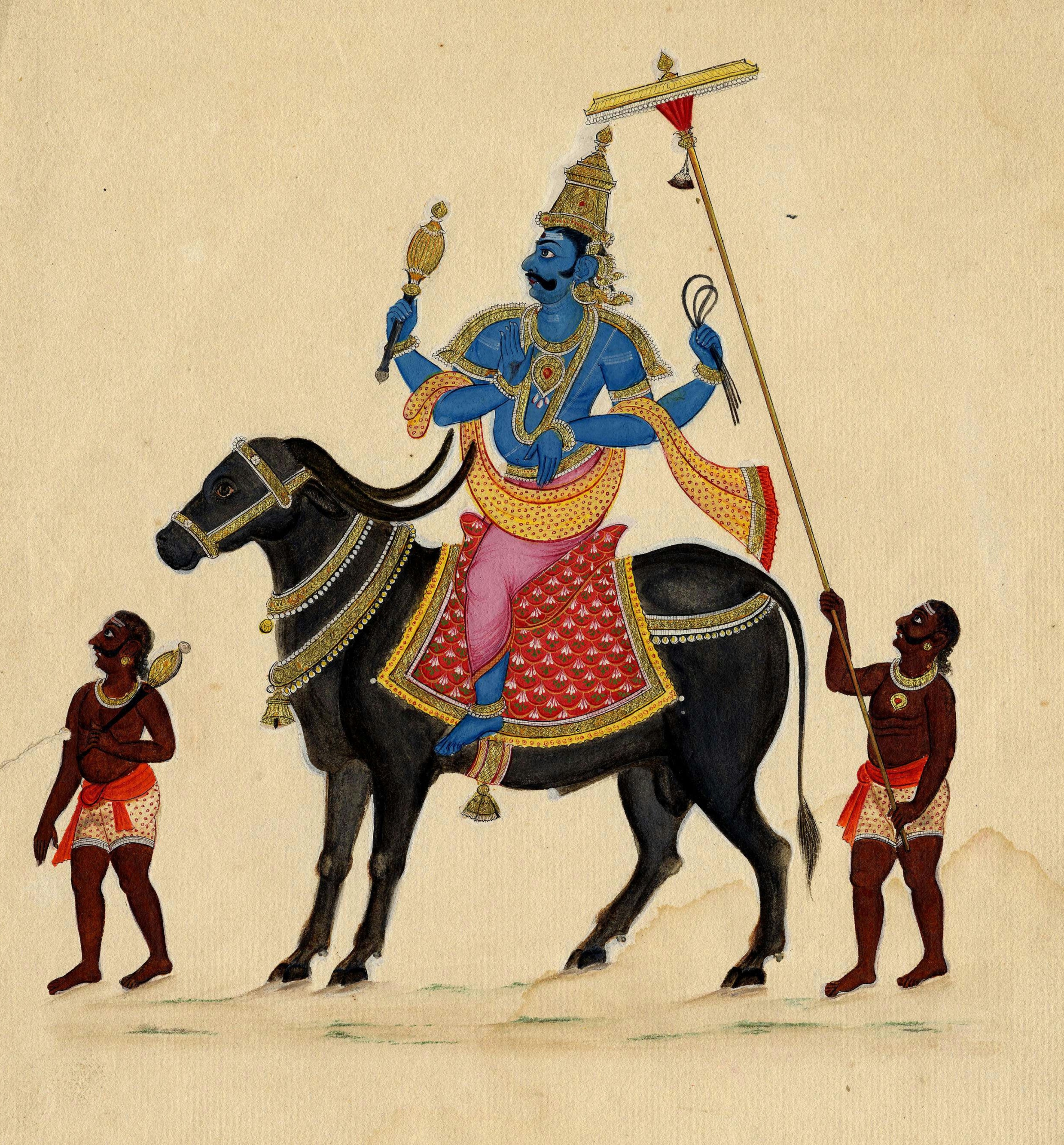
Someone had to die first. The Rig Veda gives that role a name: Yama, the first mortal to walk the road out of life, who by walking it became the one who rules its far end. He did not conquer death. He found it, and in finding it made a place for everyone who would follow. Yama, the hymn says, was the first to find us our dwelling, a place that can never be taken away.
That hymn is RV 10.14, the central Vedic poem of death, recited over the dead and addressed to Yama as the gatherer of the departed. It belongs to the tenth and latest Mandala, where the Rig Veda turns more often to the great questions of origin and end. Read it at RV 10.14.
King by precedence
Yama is the son of Vivasvant, a solar figure, and has a twin sister, Yami; the name yama itself means ‘twin.’ He is not a god of death in the later sense of a grim judge or destroyer. In the Rig Veda he is the first ancestor, a kind of pioneer, who is honoured because he went ahead. The dead do not go to a punishment. They go to join Yama and the fathers (the pitrs), the ancestors who have already made the journey.
The destination, in this early picture, is bright. Yama’s realm is set in the highest heaven, a place of light where the departed feast, meet their ancestors, and are reunited in a renewed body with the good they did in life. The later, darker idea of Yama as the dreaded lord of a hell of punishment is mostly a post-Rigvedic development. The earliest Yama presides over something closer to a homecoming.
‘Go forth, go forth along the ancient pathways by which our fathers have departed before us. There you shall see the two kings, Yama and the god Varuna, rejoicing in the sacred drink.’
The two dogs on the road
The most haunting image in RV 10.14 is the pair of dogs. The path to Yama is watched by two four-eyed, broad-nosed dogs, named Shyama (‘the dark’) and Sabala (‘the brindled’), the offspring of Sarama, the divine bitch. They are Yama’s messengers and they range among the living, watching. The hymn tells the newly dead to hurry past these guardians and to entrust themselves to them, so as to reach the fathers in safety.
Four-eyed dogs guarding the road of the dead are not only Indian. Comparative mythologists have long noted parallels across the Indo-European world, from the Greek Cerberus at the gate of Hades to dogs that appear in Iranian funerary practice. The motif of the dog as a threshold creature, standing between the living and the dead, looks very old indeed.
| Element of RV 10.14 | Meaning |
|---|---|
| Yama, first to die | The pioneer who made the path |
| The fathers (pitrs) | Ancestors the dead rejoin |
| Shyama and Sabala | Two four-eyed dogs guarding the way |
| The world of light | A bright, not grim, afterlife |
| ‘House of clay’ | The grave, in the related Varuna hymns |
The hymn the twins almost did not allow
Yama’s twin sister Yami has a hymn of her own, the dialogue RV 10.10, and it is one of the boldest poems in the Rig Veda. In it Yami urges Yama to lie with her so that the human race can begin; they are, after all, the only pair. Yama refuses. He appeals to the moral order, to the gods who watch, to the wrong of union between brother and sister. The poem stages, at the very dawn of mortality, a clash between the urge to continue life and the rule that constrains how it may be continued. It is striking that the figure who first accepted death is also the figure who first refuses a transgression, as if the two acts, accepting the limit and keeping the law, belonged together.
An inheritance older than the Rig Veda
Yama is shared property of the Indo-Iranian past. His Iranian counterpart is Yima, the primordial king of the Avesta, who in later Persian tradition becomes Jamshid. Both descend from a single Proto-Indo-Iranian figure, a first man and first ruler associated with a golden age and with mortality. That the very idea of the first to die was carried, under cognate names, by two branches of one people is a reminder of how deep the roots of the Rig Veda run.
What the Vedic poets did with that inheritance was distinctly humane. They did not make death a monster to be defeated or a void to be feared. They made it a road already travelled, with a host at the end of it, watched by two dogs, lit by the company of everyone who has gone before. Yama is the Rig Veda’s answer to the oldest human fear, and the answer is not denial. It is that you will not be the first, and you will not arrive alone.
- Yama is the first mortal to die in Vedic thought, and so becomes king of the dead and the ancestors.
- RV 10.14 is the Rig Veda's funeral hymn; the early afterlife is a bright world of light, not a hell.
- The path is guarded by two four-eyed dogs, Shyama and Sabala, offspring of Sarama, with Indo-European parallels (Cerberus).
- Yama refuses his twin Yami in the dialogue RV 10.10, and corresponds to the Iranian Yima.
References
Jamison, Stephanie W. & Brereton, Joel P. The Rigveda: The Earliest Religious Poetry of India. Oxford University Press, 2014. (Translations of RV 10.14 and 10.10.) global.oup.com.
‘Yama.’ Wikipedia. en.wikipedia.org/wiki/Yama.
‘Yama and Yami.’ Wikipedia. en.wikipedia.org/wiki/Yama_and_Yami.
‘Vedic religion.’ Encyclopaedia Britannica. britannica.com/topic/Vedic-religion.
Griffith, Ralph T. H. (trans.). The Rig Veda (RV 10.14). Wikisource: en.wikisource.org/wiki/The_Rig_Veda.
Comments (0)
No comments yet. Sign in to start the discussion.