Varuna and the Order of Things: Sin and Rita in the Rig Veda
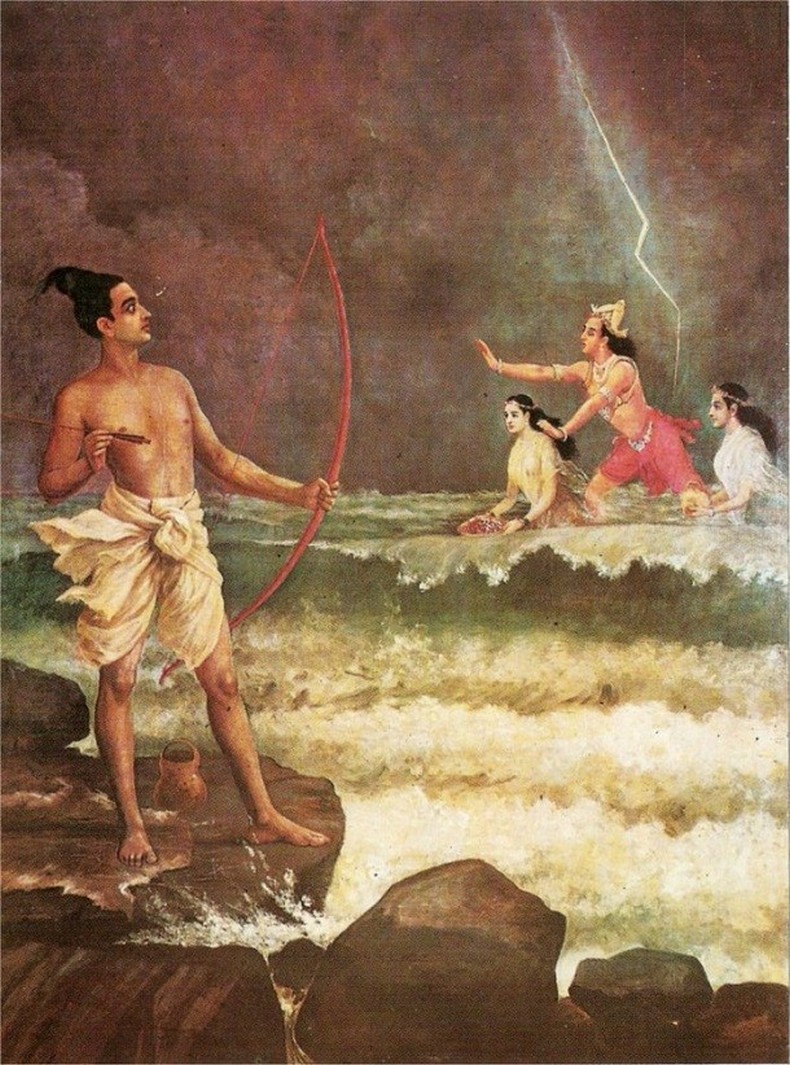
Most Rig Vedic gods are asked for things: rain, cattle, victory, long life. One god is asked, instead, for forgiveness. Varuna is the deity the worshipper approaches not as a customer but as a wrongdoer, and the hymns to him contain something close to a confession of sin. In a hymnbook built largely around the exchange of offering for benefit, that is a startling exception.
Varuna is the great guardian of rita, a word usually translated as cosmic order, truth, or the right way things are. Rita is the pattern that makes the rivers flow, the seasons turn, the sun rise on time, and human dealings hold true. Varuna keeps it. Read his penitential hymn at RV 7.86.
The god who watches
Varuna is an Aditya, a son of the goddess Aditi, and in the older layers of the text he carries the dignity of an asura, a lord, before that word soured into ‘demon’ in later Sanskrit. He is most often paired with Mitra, the god of contracts and alliance, as the dual Mitra-Varuna, the two sovereigns who together uphold the order: Mitra leaning toward friendship and agreement, Varuna toward oath, judgement and rule.
What distinguishes Varuna is his surveillance. He sees everything. The hymns say he employs spies who move through the world and report what people do; he knows the flight of birds, the path of ships, the secret thoughts of men. Nothing escapes him, not even what is done in the dark. This is not merely a powerful god; it is a god functionally defined by moral oversight.
‘If we have sinned against the man who loves us, have ever wronged a brother, friend or comrade, the neighbour ever with us, or a stranger, O Varuna, remove from us the trespass.’
Sin, the noose, and dropsy
Because Varuna guards order, breaking order is an offence against him personally. The Rig Veda has real vocabulary for this: agas and enas, words for sin or transgression, appear concentrated in the Varuna hymns in a way they do not elsewhere. The sinner who violates rita is caught in Varuna’s noose (pasha), and the punishment is imagined physically. Varuna is associated with disease, especially dropsy, the swelling with water, which fits a water-linked god: the offender’s own body fills and fails. To be released from Varuna’s noose is to be forgiven and to be healed at once.
| Concept | In the Varuna hymns |
|---|---|
| Rita | The order Varuna upholds and the sinner breaks |
| Agas / enas | Sin, guilt, transgression |
| Spies | Watchers who see every deed |
| Pasha | The noose that binds the guilty |
| Dropsy | The disease read as Varuna’s punishment |
The penitential hymns
The high point of all this is a small group of hymns in the seventh Mandala, attributed to the seer Vasishtha, that read like nothing else in the Rig Veda. In RV 7.86 the poet asks what he has done wrong and longs to be reconciled with a god he once knew as a friend. He wonders whether his sin was deliberate or an accident, whether it was even his own doing or the work of wine, anger, dice or carelessness. The tone is intimate and anxious, the voice of someone who feels he has lost a relationship and wants it back.
In RV 7.88 Vasishtha remembers being close to Varuna, the two of them once together, before something came between them. In RV 7.89 he pleads not to go yet to the ‘house of clay,’ the grave, and blames his lapse on human frailty, naming need, an intoxicant, dice and thoughtlessness rather than a settled will to do wrong. These hymns introduce into the Rig Veda a sense of personal guilt and the hope of pardon that scholars have often singled out as the tradition’s nearest approach to an ethics of conscience.
Why Varuna fades, and why he matters
Varuna’s grandeur does not last in quite this form. Across the Vedic period the warrior Indra rises to the front of the pantheon, and Varuna gradually narrows into a god of the waters and the ocean, the role he mostly keeps in later Hinduism, where he is lord of the sea. The all-seeing moral sovereign becomes, in time, a lord of rivers.
But the idea he carried did not fade. Rita, the order Varuna guarded, is one of the most consequential concepts the Rig Veda produced. It is the ancestor of dharma, the later word for law, duty and the right ordering of life, and it lies behind the long Indian conviction that the cosmos is structured by a truth that human action can either honour or violate. Varuna is the god who first made that order personal, who turned the question ‘is the world ordered?’ into the question ‘have I kept faith with it?’ In the penitential hymns the Rig Veda asks that second question out loud, and waits, a little fearfully, for an answer.
- Varuna guards rita, the cosmic and moral order, and is the Rig Veda's most ethical god.
- He watches through spies, binds sinners with his noose (pasha), and is linked to dropsy as a punishment.
- The penitential hymns RV 7.86, 7.88 and 7.89 (by Vasishtha) express personal guilt and a plea for forgiveness.
- Varuna later narrows into a water-god, but rita endures as an ancestor of the concept of dharma.
References
Jamison, Stephanie W. & Brereton, Joel P. The Rigveda: The Earliest Religious Poetry of India. Oxford University Press, 2014. (Translations of RV 7.86, 7.88, 7.89.) global.oup.com.
‘Varuna.’ Wikipedia. en.wikipedia.org/wiki/Varuna.
‘Rita.’ Encyclopaedia Britannica. britannica.com/topic/rita-Hinduism.
‘Rta.’ Wikipedia. en.wikipedia.org/wiki/%E1%B9%9Ata.
Griffith, Ralph T. H. (trans.). The Rig Veda (RV 7.86). Wikisource: en.wikisource.org/wiki/The_Rig_Veda.
Comments (0)
No comments yet. Sign in to start the discussion.