The Dog Who Talked Back: Sarama and the Panis (RV 10.108)
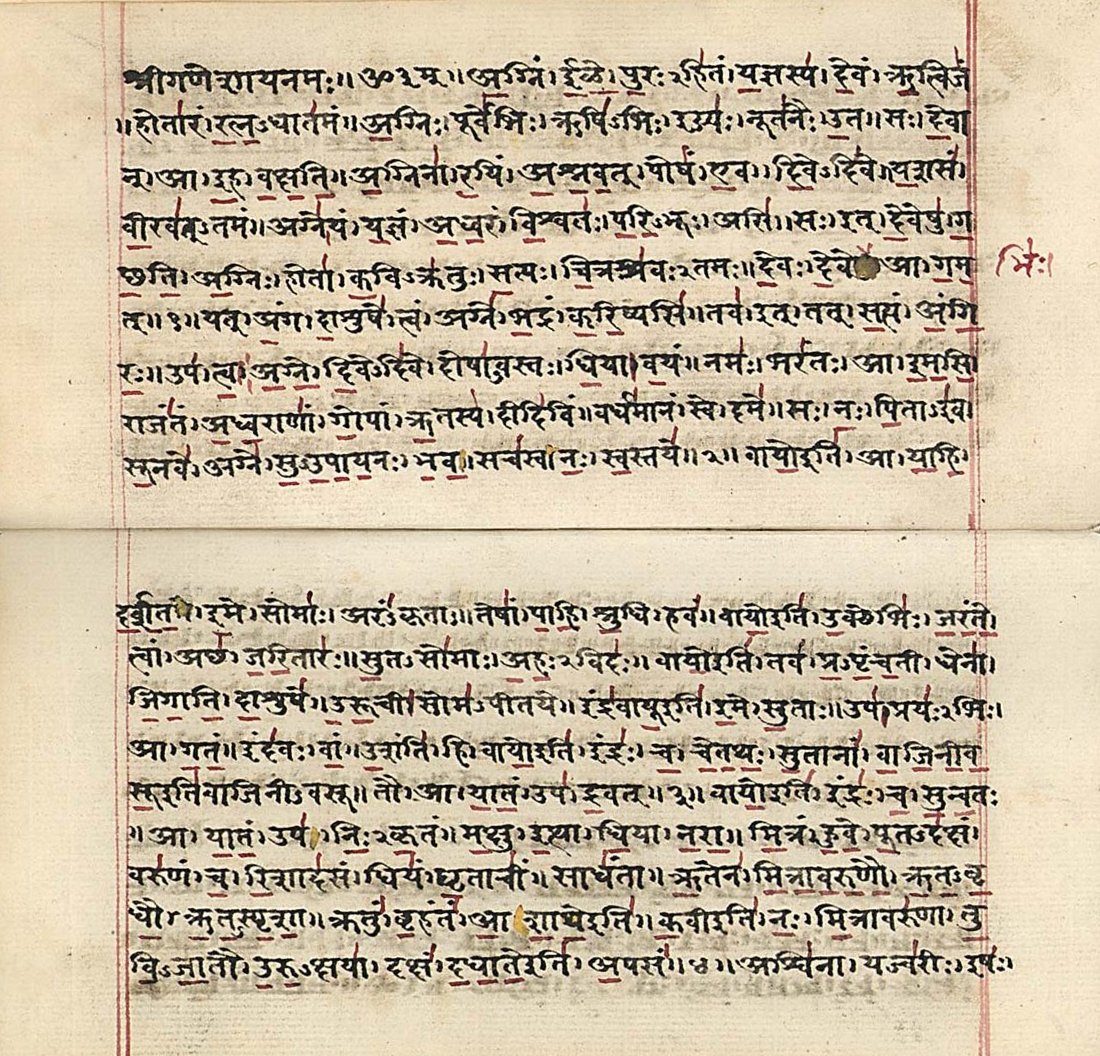
The Rig Veda’s first diplomat is not a god or a priest. It is a dog. In RV 10.108 the bitch Sarama, the deva-shuni or ‘divine dog,’ crosses a far river on Indra’s errand, finds the cattle-hoarding Panis in their rock fastness, and holds a negotiation with them in verse. The whole hymn is a dialogue, back and forth, between a messenger and the people she has come to threaten. Read it at RV 10.108.
It is one of the strangest and least-told stories in the collection. The cows that drive so much of Vedic myth have been stolen and penned in a distant cave. Indra needs to know where they are. He does not send a thunderbolt first; he sends a tracker, and the tracker can talk.
A negotiation, not a battle
The hymn opens with the Panis asking the obvious question: who are you, and how did you get here? Sarama answers that she comes as the emissary of Indra, seeking their hidden herds, and that she leapt the deep waters of the river Rasa without fear because the gods sent her. The Panis try every angle. They flatter her. They ask why she made so hard a journey. Then they make an offer: stay with us, be our sister, share the cattle, and you need never go back.
Sarama refuses. She is not for sale. She tells them plainly that Indra and the Angirases, the singing ancestors, are coming, and that the Panis had better give up the cows before the gods arrive to take them by force. The dialogue ends with the threat still hanging. In the wider myth the cave is broken open and the cows are freed, but the hymn itself stops at the standoff, a messenger and a den of thieves measuring each other.
The Panis say: ‘Be our sister, Sarama, do not go back. We will give you a share of the cattle.’ Sarama answers: ‘I know nothing of brotherhood or sisterhood. Indra and the dread Angirases know.’
What the story is really doing
Read past the charm and the hymn is doing serious work. It is, in effect, the Rig Veda’s founding envoy myth: the first time the text dramatises a formal message carried across a hostile frontier, complete with credentials, an attempted bribe, and a refusal. The structure is recognisably diplomatic. Sarama states who sent her, why she came, and what will happen if the demand is not met.
| In the dialogue | What it models |
|---|---|
| Sarama names her sender (Indra) | An envoy’s credentials |
| She crosses the river Rasa | A guarded frontier breached |
| The Panis offer a share of cattle | A bribe to turn the messenger |
| Sarama refuses and warns them | Loyalty, and an ultimatum |
The Panis themselves are a puzzle worth pausing on. They are not quite gods and not quite a known human tribe. They hoard wealth and give nothing away, the opposite of the generous patron the poets praise, and their name is linked by some scholars to words for stinginess and bargaining. They are the anti-economy of the Rig Veda: cattle that do not circulate, locked behind a rock.
Why a dog
Choosing a dog as the gods’ agent is not an accident. Dogs track, dogs guard, dogs cross ground that people will not. The same tradition that sends Sarama after the cattle also posts two dogs, later called the offspring of Sarama, on the road to the world of the dead, where they watch the path of souls. The dog sits exactly on the Vedic boundary between the known and the dangerous elsewhere, which is why it makes such a fitting messenger and guardian.
Sarama also leaves a long trail in later texts. The grammarians and the epics remember her; the term sarameya, ‘son of Sarama,’ becomes a word for a dog. A minor hymn-character grows into the ancestress of an entire mythic lineage of dogs.
The myth behind the myth
The Sarama hymn is one face of the great Vedic cattle myth, the release of the cows from the Vala cave. In that story Indra and the Angiras singers split the rock with sound and light and drive the hidden herds, often read as the dawns or the waters, back into the world. Sarama is the scout who finds them first. Her crossing of the Rasa is the moment the locked wealth is located, and everything else follows from it.
That is why this small dialogue repays attention. It hides, inside an exchange between a dog and a band of misers, two of the oldest ideas the Rig Veda has: that wealth must move or it rots, and that the first step of any rescue is someone willing to go and look. The poets gave that someone four legs, a voice, and the nerve to say no to a bribe.
- RV 10.108 is a verse dialogue between Sarama, Indra's divine dog, and the Panis, who hoard stolen cattle.
- Sarama crosses the far river Rasa as Indra's envoy, refuses a bribe of cattle, and warns of the gods' coming.
- It works as the Rig Veda's first formal messenger myth, with credentials, a bribe and an ultimatum.
- It is part of the larger Vala myth, the release of the hidden cows by Indra and the Angirases; Sarama later becomes the ancestress of dogs.
References
Jamison, Stephanie W. & Brereton, Joel P. The Rigveda: The Earliest Religious Poetry of India. Oxford University Press, 2014. (Translation of RV 10.108.) global.oup.com.
‘Sarama.’ Wikipedia. en.wikipedia.org/wiki/Sarama.
‘Panis.’ Wikipedia. en.wikipedia.org/wiki/Panis.
Macdonell, Arthur A. Vedic Mythology. Strassburg: Karl J. Trübner, 1897. (On Sarama, the Panis and the Vala myth.) archive.org.
Griffith, Ralph T. H. (trans.). The Rig Veda (RV 10.108). Wikisource: en.wikisource.org/wiki/The_Rig_Veda.
Comments (0)
No comments yet. Sign in to start the discussion.