The Archer Who Heals: Rudra in the Rig Veda
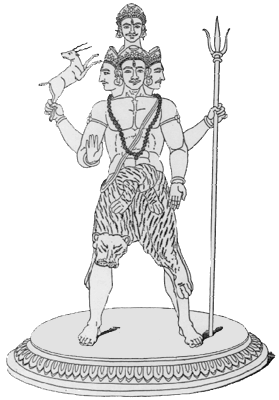
Most gods in the Rig Veda are safe to praise. Rudra is not. He is the god you address carefully, because the same power that heals you can, if it turns, strike you down. He carries a bow. The arrows are disease. And in the very hymns that beg him not to shoot, the poets also call him the greatest of healers, the keeper of remedies. Rudra is the Rig Veda’s study in ambivalence: a single god who is at once the source of the sickness and the cure.
His name is usually read as ‘the roarer,’ from a root for howling or crying out, which fits a god of the storm, the wild and the howling places beyond the settlement.
The god you ask to look away
The tone of the Rudra hymns is unlike anything addressed to the friendly gods. Where Indra is invited and Agni is welcomed, Rudra is approached with what reads almost like nervous flattery. The poets praise him, then ask him to keep his anger and his shafts away from their people, their cattle, their horses and their children. Spare the great, they say, and spare the small; do not harm us in our offspring or our cattle. The prayer is not ‘come and help’ so much as ‘please do not strike.’
‘Do not harm us in our children or our descendants, not in our lives, not in our cattle, not in our horses. Do not in your anger slay our strong men.’
Rudra is the archer. His bow and arrows are real fixtures of his myth, and what they carry is illness and sudden death, the fever that takes a child or the murrain that empties a byre. He dwells apart, in the mountains and the wilderness, the dangerous outside of the ordered village world. He is, in a phrase the hymns nearly use, the god of everything that can go wrong from a distance.
The same hand that cures
Here is the turn that makes Rudra so striking. The god who shoots disease is also the supreme physician. The hymns call him the greatest healer of healers and ask him for his jalasha, his cooling, soothing remedies, the medicines he is said to possess in abundance. To be spared by Rudra and to be healed by Rudra are the same act, because the harm and the cure flow from one source.
| Face of Rudra | In the hymns |
|---|---|
| The archer | Bow and arrows that carry disease and death |
| The wild one | Dwells in mountains and wilderness, apart |
| The roarer | Linked to storm, wind, the howling outside |
| The healer | Holds the jalasha remedies; greatest physician |
This double nature is not a contradiction the poets failed to notice. It is the point. Rudra embodies a truth the Vedic world knew well: that the powers which sustain life are the same powers that can end it, and that the wild, dangerous edge of things is also where healing comes from. You do not tame such a god. You approach him with respect and ask for the gentle face.
From Rudra to Shiva
Rudra has one of the longest afterlives of any Vedic god. His epithets soften over time; he comes to be called Shiva, ‘the auspicious,’ first as a careful, propitiating name for a fearsome power, the way one might call a dangerous thing ‘kindly’ to keep it kindly. The Shri Rudram hymn of the Yajurveda multiplies his names and salutes him in all his forms at once. By the classical period the Vedic archer-healer has grown into Shiva, one of the great gods of Hinduism, who still carries the old doubleness: destroyer and yet the most gracious, dweller in wild places and yet the supreme yogi.
The line from the Rig Vedic Rudra to the later Shiva is one of the clearest cases of a Vedic deity developing across two thousand years without losing the core of his character.
Why Rudra still unsettles
Rudra matters because he refuses the easy split between good gods and evil powers. The Rig Veda mostly asks its deities for things and praises them for giving. Rudra forces a harder posture: reverence mixed with fear, gratitude braided with dread. He is the god who reminds the worshipper that the same arrows that bring the fever also bring the medicine, and that the wild edge of the world is not only a threat but a source. Few figures in any early scripture hold those two truths together as tightly as the archer who heals.
- Rudra, 'the roarer,' is the Rig Veda's most ambivalent god: an archer whose arrows are disease and death.
- The same hymns that beg him to spare people and cattle also call him the greatest healer and ask for his jalasha remedies.
- He dwells apart in the mountains and wilderness, the dangerous outside of the settled world.
- Over time Rudra becomes Shiva, 'the auspicious,' carrying the old doubleness of destroyer and gracious lord.
References
Jamison, Stephanie W. & Brereton, Joel P. The Rigveda: The Earliest Religious Poetry of India. Oxford University Press, 2014. (Translations of the Rudra hymns.) global.oup.com.
‘Rudra.’ Wikipedia. en.wikipedia.org/wiki/Rudra.
‘Rudra.’ Encyclopaedia Britannica. britannica.com/topic/Rudra.
Macdonell, Arthur A. Vedic Mythology. Strassburg: Karl J. Trübner, 1897. (Chapter on Rudra.) archive.org.
Griffith, Ralph T. H. (trans.). The Rig Veda. Wikisource: en.wikisource.org/wiki/The_Rig_Veda.
Comments (0)
No comments yet. Sign in to start the discussion.