The Maruts: A Storm Set to Verse
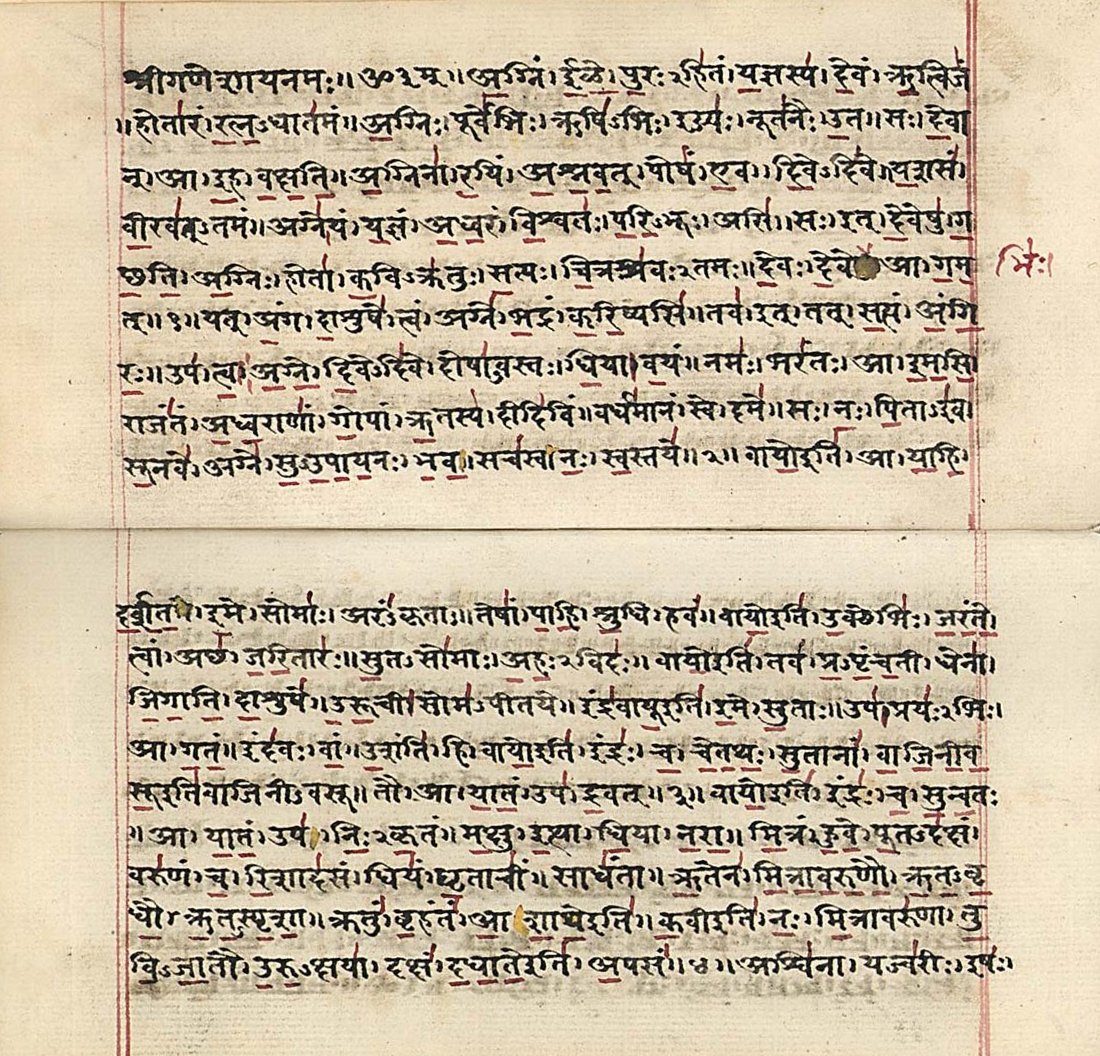
When a monsoon storm builds over the plains, it does not arrive as a single thing. It comes as a crowd: a front of wind, a scatter of lightning, a roll of thunder, all moving together. The Rig Veda’s poets caught that plural quality and made a god out of it, or rather a troop of gods. The Maruts are never one. They are a band of young storm-deities who always act together, and the hymns to them are some of the most kinetic poetry in the collection.
They are addressed in around 33 hymns, and their number is given as a round host: three times seven, or in one verse three times sixty. They are the sons of Rudra, the dangerous god of the wild, and of Prishni, the ‘dappled’ one, usually read as the speckled storm cloud. Read a Marut hymn at RV 1.85.
A troop, not a person
Most Vedic gods are characters. The Maruts are a movement. The poets describe them as a war-band of brothers, all the same age, born together, dressed alike, advancing in a line. They wear gold on their chests and helmets of gold, they carry spears that are the lightning, and they ride chariots drawn by spotted deer. When they pass, the mountains tremble, the trees bow down, and the earth shakes. The imagery is relentlessly collective: where Agni is a single flame and Indra a single champion, the Maruts are a plural force, and the grammar keeps them in the plural throughout.
| Marut feature | What it pictures |
|---|---|
| Golden spears | Flashes of lightning |
| Chariots and spotted deer | The driving storm front |
| Shaking mountains, bending trees | The wind’s visible force |
| Milk of Prishni | The rain from the dappled cloud |
| Song and roar | Thunder, and the chant that mirrors it |
The poetics of weather
What makes the Marut hymns special is how closely the form of the poetry tracks the thing it describes. The verses pile up phrases, repeat, accelerate, and crowd together, so the sound of the hymn imitates the gathering of the storm. The Maruts ‘sing’ as they come, and the poet’s own song joins their roar. This is weather rendered as performance: the chant does not merely describe the storm, it tries to move with it.
‘They make the rocks to tremble, they tear apart the kings of the forest. Go on, you Maruts, like madmen, you whole company with all your power.’
There is fear in the praise as well as wonder. The Maruts are Rudra’s sons, and Rudra is the god you beg not to harm you. The storm gives the rain that the herds and the barley need, but it also flattens, drowns and kills. The hymns hold both: the Maruts are gentle and kind in one verse and terrifying in the next, exactly as a monsoon is both the year’s salvation and its danger.
The quarrel with Indra
The Maruts are Indra’s companions. They march with him against Vritra, the serpent who pens the waters, and their massed force is part of how the great deed gets done; Indra even carries the title Marutvant, ‘accompanied by the Maruts.’ But the Rig Veda also preserves a remarkable hymn, RV 1.165, in which Indra and the Maruts argue over the credit. Indra insists he killed Vritra by his own strength; the Maruts press their share. It is a rare glimpse of tension among the gods, and it has a social edge: the lone champion against the loyal war-band, the king against his retainers. The hymn resolves in mutual recognition, but it leaves the question hanging, who really wins the battle, the hero or the host?
Rain, herds and the chant
Behind the spectacle lies a practical prayer. The people who sang to the Maruts depended on the rains for their cattle and their crops, and a storm that came at the right time was the difference between plenty and famine. The Maruts are asked for the milk of Prishni, the rain that the dappled cloud lets down, and for the safety of the herds beneath it. The most cosmic-sounding of the storm poetry sits on a very concrete need.
That doubleness is the heart of the Maruts. They are at once a literal description of the monsoon, a war-band of glittering young gods, and a test case for how Vedic poetry works, by making its own movement imitate the world it sings. Read enough Marut hymns in a row and the technique becomes unmistakable. The poets did not just write about the storm. They tried to make the hymn behave like one.
- The Maruts are the Rig Veda's storm-troop, addressed in around 33 hymns and always invoked as a plural host.
- They are sons of Rudra and the dappled cloud Prishni, armed with golden spears (lightning) and riding the storm front.
- Their hymns enact the weather: piled-up, accelerating verse that moves like a gathering storm.
- They march with Indra against Vritra but quarrel with him over the credit in RV 1.165.
References
Jamison, Stephanie W. & Brereton, Joel P. The Rigveda: The Earliest Religious Poetry of India. Oxford University Press, 2014. (Translations of the Marut hymns, RV 1.85 and 1.165.) global.oup.com.
‘Maruts.’ Wikipedia. en.wikipedia.org/wiki/Maruts.
‘Rudra.’ Wikipedia. en.wikipedia.org/wiki/Rudra.
Macdonell, Arthur A. Vedic Mythology. Strassburg: Karl J. Trübner, 1897. (Chapter on the Maruts and Rudra.) archive.org.
Griffith, Ralph T. H. (trans.). The Rig Veda (RV 1.85). Wikisource: en.wikisource.org/wiki/The_Rig_Veda.
Comments (0)
No comments yet. Sign in to start the discussion.