A World Without Blue: Colour Words in the Rig Veda
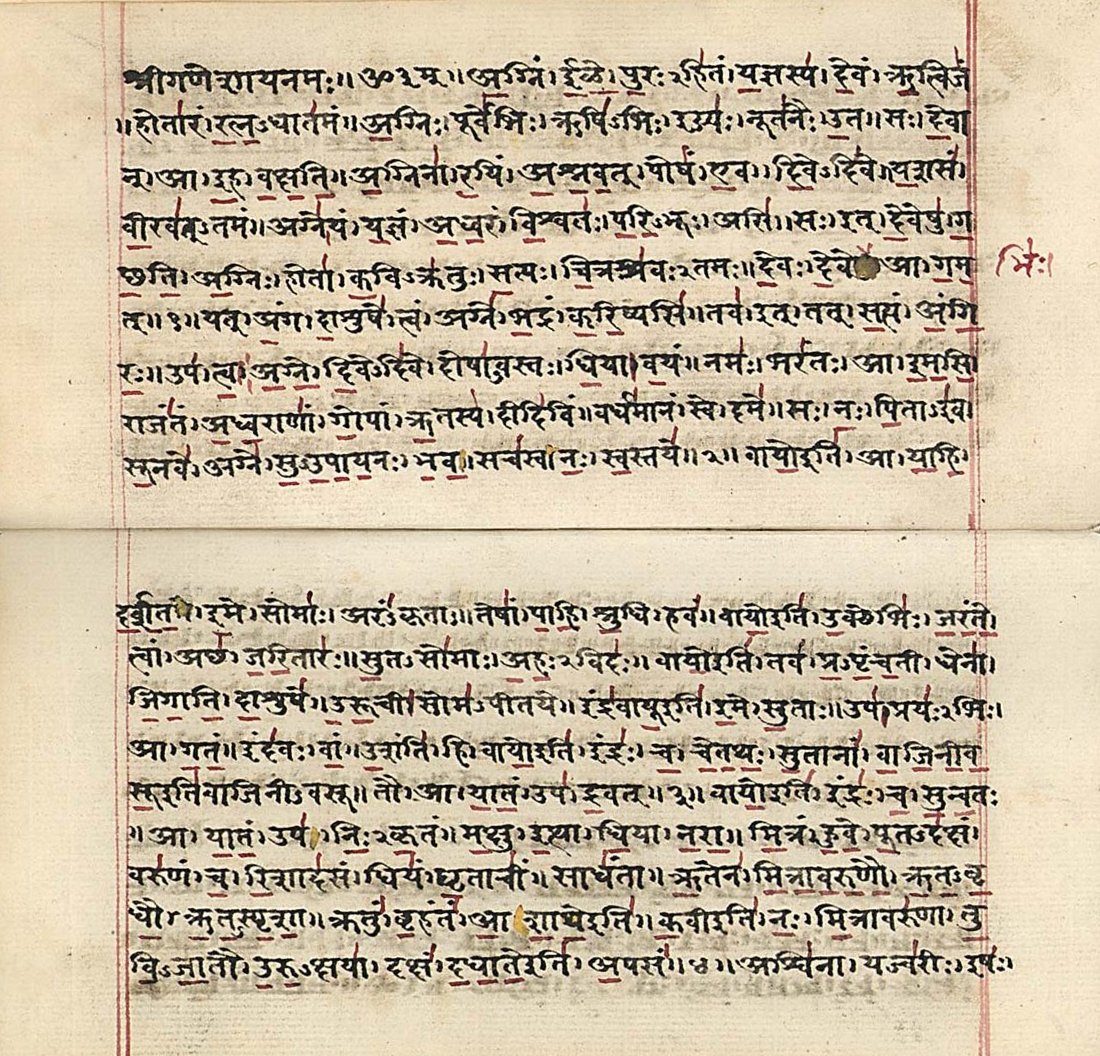
Read enough of the Rig Veda and you start to notice something missing. The hymns are drenched in colour: dawn is ruddy, fire is bright, the gods are golden, the horses gleam. But there is no steady, ordinary word for one colour we treat as basic. The Rig Veda has, in effect, no settled word for ‘blue.’
This is not because the people who made it could not see blue. The sky was over them every day. It is because of how colour words enter a language at all, and what the Vedic poets were actually interested in when they looked at the world.
What the Rig Veda is rich in
Vedic colour language clusters around brightness and warmth, not the cool end of the spectrum. The words that recur describe things that shine, redden or glow. Shukra and shveta cover the bright and the white. Aruna and rohita carry the reddish, ruddy, dawn-coloured range. Hari and harit slide across yellow, gold and tawny, the colour of Soma, of horses, of the sun. Krishna is the dark, the black, often less a hue than an absence of light.
| Vedic term | Rough range |
|---|---|
| shukra, shveta | bright, white, shining |
| aruna, rohita | ruddy, red, dawn-coloured |
| hari, harit | yellow, gold, tawny, greenish |
| krishna, shyama | dark, black, dusky |
| (no fixed term) | blue |
Notice the shape of that list. The poets had fine distinctions for the warm and the bright and the dark, the very things a fire cult and a dawn-watching people would care about. The cool blues and greens are thin. The word hari itself wanders between yellow and green in a way that frustrates anyone hunting for a clean modern colour.
Why blue comes late
The Rig Veda is not unusual here. Across many languages, basic colour terms enter in a fairly regular order, and blue tends to arrive late. The classic study is Brent Berlin and Paul Kay’s 1969 work on basic colour terms, which argued that languages acquire colour words in stages: first the contrast of dark and light, then red, then green and yellow, and only later blue. Their specific claims have been debated and refined ever since, but the broad pattern, that red is named early and blue late, has held up well enough to be a standard reference point.
On that map the Rig Veda sits exactly where an early Indo-European text should. It has a strong dark and light contrast, a rich red and a rich gold, and only weak coverage of blue. The absence of a blue word is not a defect; it is a snapshot of a language at a particular stage.
The Rig Veda had no trouble seeing the sky. It simply had no single, ordinary word that meant ‘the colour of the sky,’ because no one had needed to coin one yet.
A famous trap
This is where readers, and some popular writers, go wrong. It is tempting to leap from ‘no word for blue’ to ‘they could not see blue’ or ‘the sky looked different to them.’ That leap is not supported. The eye that watched a thousand dawns saw the same spectrum we do. What changes between languages is not the retina but the vocabulary: which slices of a continuous spectrum get their own everyday names. The Vedic poets carved the spectrum differently from us, with much more attention to glow and ruddiness and dark, and far less to the cool middle.
The debate over how much language shapes perception, the question behind linguistic relativity, is real and unsettled. But the honest reading of the Rig Veda is the modest one: the text shows us a colour vocabulary, not a colour blindness.
What the poets were really watching
The deeper point is about attention. A colour vocabulary is a map of what a culture finds worth distinguishing. The Rig Veda is the scripture of a fire ritual sung at the edge of night, watching for the first ruddy line of Ushas, the dawn, and feeding the bright tongues of Agni, the fire. Of course its colour words crowd around light and red and gold. Those were the colours that carried meaning, the colours the gods arrived in.
So the missing word for blue is not a gap to apologise for. It is a clue. It tells us that this was a young colour vocabulary, following the same path many languages follow, and that its speakers had trained their naming on the parts of the sky that mattered to them most: the parts that burned.
- The Rig Veda has rich words for bright, white, ruddy and golden, but no settled basic word for 'blue.'
- This fits the Berlin and Kay observation that colour terms enter languages in stages, with blue arriving late.
- It does not mean the Vedic people could not see blue; the difference is in vocabulary, not in the eye.
- Vedic colour language clusters around light, fire and dawn, the things a fire-and-dawn cult cared about most.
References
Berlin, Brent & Kay, Paul. Basic Color Terms: Their Universality and Evolution. University of California Press, 1969. en.wikipedia.org/wiki/Basic_Color_Terms.
‘Color term.’ Wikipedia. en.wikipedia.org/wiki/Color_term.
‘Linguistic relativity and the color naming debate.’ Wikipedia. en.wikipedia.org/wiki/Linguistic_relativity_and_the_color_naming_debate.
‘Blue and green distinction in language.’ Wikipedia. en.wikipedia.org/wiki/Blue-green_distinction_in_language.
Macdonell, Arthur A. Vedic Mythology. Strassburg: Karl J. Trübner, 1897. archive.org.
Griffith, Ralph T. H. (trans.). The Rig Veda. Wikisource: en.wikisource.org/wiki/The_Rig_Veda.
Comments (0)
No comments yet. Sign in to start the discussion.